
You give kids a prepared environment where low shelves, child‑sized tools and self‑correcting materials let them explore without constant adult direction, so their absorbent minds turn everyday tasks into purposeful discovery. Freedom within clear limits lets them test boundaries while feeling safe, sparking intrinsic motivation. Repeating real‑life practical activities builds confidence and self‑efficacy, and respectful communication reinforces emotional safety. Long, uninterrupted work periods sharpen executive function, while peer modeling and empathy drills nurture autonomy. Keep going and you’ll see how to apply these ideas at home.
How the Absorbent Mind Fuels Natural Curiosity
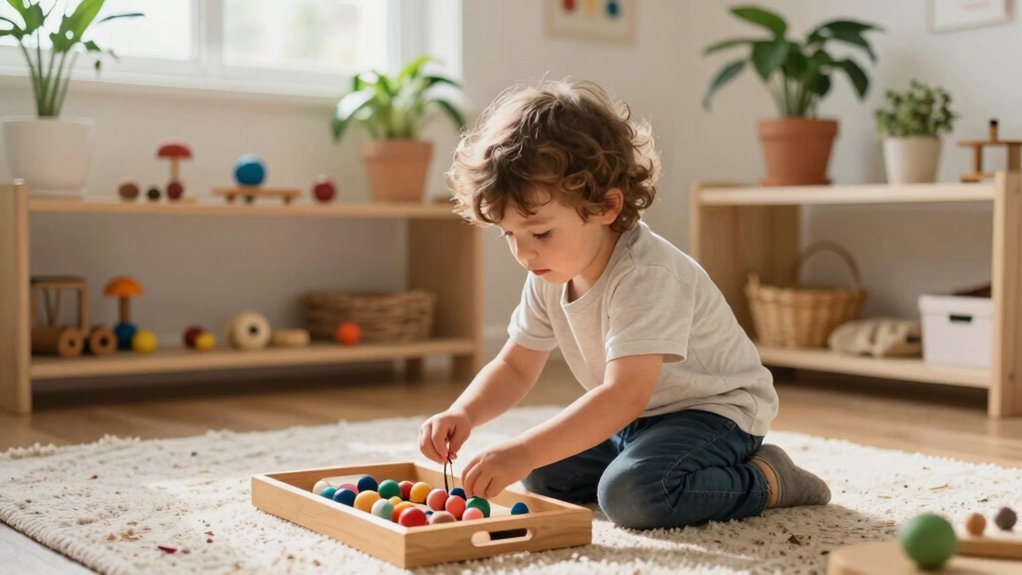
Ever wondered why children seem to soak up the world around them? You’ll see the Absorbent Mind at work when a toddler explores a low‑shelf tray of textured beads. The prepared environment offers real‑life engagement, letting autonomy guide purposeful repetition of sensorial work. As they manipulate objects, intrinsic motivation spikes, and internal curiosity deepens. Providing children with low bookcases that are designed for accessibility further supports their drive for independent exploration and learning.
How Freedom Within Limits Ignites Intrinsic Motivation
When the Absorbent Mind gives way to conscious reasoning, children begin to test the boundaries of their choices. You notice that Freedom within limits grants them a sense of control, turning simple decisions into a powerful source of intrinsic motivation. In a child-sized environment, you set clear expectations while allowing autonomy, so they can pick purposeful activity that matches their interests and pace. This structure nurtures self‑regulation; calm, consistent guidance helps them internalize rules without external rewards. As they manipulate self‑correcting materials, they experience immediate feedback, reinforcing their internal drive. The resulting self‑correction builds competence, confidence, and a lasting desire to master challenges, keeping learning lively and self‑directed. Incorporating age-appropriate safety features allows children to engage independently with practical activities, further fostering their motivation and confidence.
How Montessori Practical Life Activities Build Confidence

You’ll notice how letting kids choose and repeat real tasks gives them a sense of self‑directed mastery.
When the materials correct their own mistakes, they learn to trust their abilities instead of relying on adult prompts.
This combo of autonomous practice and built‑in error correction fuels lasting confidence.
Montessori tools like the binomial cube especially promote fine motor skills and spatial reasoning through hands-on manipulation.
Self‑Directed Mastery
Practical‑life activities give kids age‑appropriate challenges that they can tackle on their own, turning each successful attempt into a confidence boost.
When you let children choose a task, you spark intrinsic motivation and autonomy, letting them own the process.
The repetitive, deliberate practice of pouring, buttoning, or sweeping builds muscle memory and self‑directed mastery.
Uninterrupted work periods of two to three hours let them slip into flow, deepening concentration and persistence.
Self‑correcting materials provide instant feedback, so they notice mistakes and fix them without adult intervention.
This ownership of error and success reinforces belief in their abilities, turning each practical life activity into a stepping stone toward lifelong confidence and self‑direction.
Montessori materials, such as the built-in autonomous error correction system in geometry puzzles, uniquely support children’s ability to self-monitor and learn independently.
Error‑Correction Confidence
Curious how a simple spill can become a confidence booster? When you hand your child a tray of water‑splatter cups, the self‑correcting materials instantly reveal the mistake, letting them fix it without adult interruption. This error‑correction confidence fuels deep concentration, because the task stays within a prolonged work period that respects their focus. You give them meaningful choices—whether to mop, wipe, or reorganize—so internal motivation drives the effort. As they repeat dressing, tidying, and snack preparation, self‑efficacy rises; each successful correction proves they can master real‑life challenges. Your non‑punitive guidance models calm expectations, turning errors into growth opportunities and reinforcing a resilient, self‑directed mindset. These principles align with Montessori tools like shatterproof acrylic mirrors, which safely support independent exploration and confidence building in infants.
How to Create Choice‑Based Routines at Home
When you set up a home environment where low shelves, child‑sized furniture, and reachable materials are the norm, children can pick activities that genuinely interest them, turning everyday routines into opportunities for autonomous decision‑making.
In a Montessori environment, arrange daily routines around choice‑based routines: place art supplies, books, and practical life tools on low shelves so child autonomy thrives.
Let them decide when to dress, clean, or snack, but keep clear limits for safety.
Offer meaningful activities that align with their interests, encouraging self‑directed learning and internal motivation.
Use self‑correcting materials for immediate feedback, reinforcing competence.
Keep the schedule predictable yet flexible, so they own the process, develop discipline, and stay engaged without external rewards.
Incorporating child-sized tools such as a step stool with safety railings can further foster independence by allowing safe access to higher surfaces.
How Respectful Communication Boosts Intrinsic Drive

Choosing a low‑shelf activity is only half the story; the other half lies in how you talk about it. When you use respectful communication, you create emotional safety that lets children name feelings and practice self‑regulation. Your calm, courteous tone models listening empathy, showing that their ideas matter. By involving them in age‑appropriate decisions, you nurture autonomy, which fuels intrinsic motivation and inner motivation. Avoiding bribes or threats reduces fear‑based behavior, so kids pursue challenges for personal satisfaction rather than external rewards. Pairing respectful dialogue with tasks that match their interests strengthens intrinsic drive, building persistence and a lasting love of learning. This approach turns everyday interactions into powerful catalysts for self‑directed growth. Additionally, using versatile, colorful cushions like classroom reading corner cushions can foster inviting, organized spaces that support a child’s engagement and self-driven learning.
How Self‑Correcting Materials Teach Without Praise
Because self‑correcting materials give instant feedback, children spot and fix mistakes on their own, so they don’t need external praise to stay motivated. You watch them engage, notice how each error becomes a clue, and feel their intrinsic motivation rise as they chase mastery instead of applause. The process builds autonomy, concentration, and self‑direction, turning every activity into a problem‑solving adventure that fuels their internal drive.
- Immediate cues let kids correct errors, reinforcing mastery.
- Uninterrupted work periods deepen concentration and self‑direction.
- Mastery‑focused feedback cultivates intrinsic motivation and lasting drive.
How Montessori Multi‑Age Classrooms Inspire Peer Exploration
You’ll see older kids modeling skills, which instantly sharpens your child’s mastery while younger peers look up and copy.
The mixed‑age setting pushes you to explain ideas and help others, building leadership and empathy.
Those everyday interactions turn the classroom into a natural community where responsibility and independence grow together.
Peer Learning Amplifies Mastery
Ever wondered how a classroom can become a living laboratory for mastery? In a mixed‑age Montessori setting, you’ll see peer learning spark intrinsic motivation. Older children model techniques while younger ones teach back, cementing mastery for both. The fluid environment nurtures collaborative problem‑solving, leadership, and social skills, all woven into Montessori methods.
- Model‑and‑Teach Loop – Older peers demonstrate a skill, younger peers rehearse it, reinforcing both understanding.
- Shared Material Focus – Real‑time observation of concentration deepens each child’s engagement and mastery.
- Leadership Rotation – Regular role swaps cultivate confidence, empathy, and a drive to help others learn.
These dynamics turn everyday interaction into a powerful engine for lasting competence.
Age‑Diverse Role Modeling
How does watching an older child effortlessly focus on a self‑correcting puzzle shape a younger one’s own work habits? In a multi‑age classroom, you see peer learning in action: the older student models concentration, independence, and leadership, while the younger imitates those habits. This role modeling sparks intrinsic motivation, because you recognize that effort leads to visible progress.
As you collaborate on shared materials, you negotiate roles, practice empathy, and strengthen executive function. The environment lets you choose tasks, fostering autonomy while still feeling supported.
Over time, you internalize a drive to explore, solve problems, and help others, turning peer interaction into a powerful engine for personal growth and lasting self‑direction.
How Movement‑Integrated Learning Links Body and Brain
When children manipulate Montessori materials, their bodies become the conduit for learning, and the physical actions they take forge stronger neural pathways that link movement to cognition. You’ll notice how sensorimotor play ignites brain development, turning each reach, pinch, or slide into a lesson in concentration and embodiment. The self‑correcting nature of Montessori materials invites self‑directed learning, letting you explore concepts through purposeful movement.
- Hands‑on tasks – turning screws or threading beads builds fine‑motor control and spatial reasoning.
- Active transitions – moving between workstations reinforces memory of the previous activity.
- Embodied problem‑solving – arranging blocks to match a pattern translates tactile feedback into abstract thought.
These patterns show that movement isn’t extra; it’s the engine driving deeper learning and lasting neural growth.
How Long, Uninterrupted Work Periods Build Executive‑Function Skills
When you give a child a 2‑3‑hour block of uninterrupted work, they slip into deep focus sessions that train their brain to stay on task.
Those long stretches let them practice planning, problem‑solving, and shifting strategies, which sharpens cognitive flexibility.
The result is a stronger internal drive and better executive‑function skills.
Deep Focus Sessions
Because Montessori classrooms give children the freedom to choose a task and then protect them from interruptions, they can settle into deep focus sessions that often last two to three hours. You’ll notice that this uninterrupted window lets concentration deepen, turning simple work into a flow state. Self‑correcting materials let them spot and fix errors alone, reinforcing self‑directed learning and intrinsic motivation. Freedom within limits means they pick meaningful activities, so attention stays steady without external rewards. The result is stronger executive function skills that transfer to other challenges.
- Choose a purpose‑driven activity.
- Engage for 2‑3 uninterrupted hours.
- Reflect on the outcome, noting self‑correction.
Enhanced Cognitive Flexibility
Extended, uninterrupted work periods of two to three hours act like a mental gym, strengthening the brain’s executive‑function muscles. In a Montessori setting you choose a task, dive deep, and stay focused, which fuels intrinsic motivation and builds an internal drive for learning. Self‑directed activity lets you receive immediate feedback from self‑correcting materials, so you recognize errors and adjust strategies on the spot. This constant tweaking sharpens cognitive flexibility, turning each problem‑solving episode into a rehearsal for adaptability. Moving while manipulating objects links physical motion to mental processing, reinforcing neural pathways that support flexible thinking. Multi‑age classrooms add social nuance, requiring you to negotiate different perspectives and further cement independence and resilience.
How Montessori Empathy Training Supports Autonomous Growth
If you watch a Montessori classroom, you’ll see how multi‑age interaction and grace‑and‑courtesy lessons turn empathy into a habit rather than a lesson. You notice children modeling respectful behavior, which builds inner motivation and fuels autonomous growth. The daily reflective pause lets them process feelings before responding, fostering mindful responses that guide self‑regulated learning.
- Empathy training in multi‑age classrooms creates a social mirror, so kids internalize consideration without external rewards.
- Grace‑and‑courtesy drills turn kindness into a default action, aligning personal goals with group well‑being.
- Reflective pause practice reduces impulsivity, empowering children to initiate projects and pursue independent learning confidently.
These elements intertwine, making empathy a catalyst for autonomous growth and sustained inner motivation.
How to Measure Long‑Term Motivation Impact
What tells you whether a child’s intrinsic drive will endure? You gauge internal motivation by watching long‑term motivation trends, not just one‑off successes. Track how often your child chooses self‑directed learning over passive entertainment, noting increased curiosity and willingness to tackle new challenges. Observe language growth, emotional regulation, and the frequency of independent problem‑solving. Consistent use of self‑correcting materials signals that autonomy and mastery are taking root. Record how meaningful routines reinforce purpose and how the child persists after setbacks. Over months, a pattern of sustained engagement, deeper mastery, and authentic joy in learning confirms that intrinsic motivation has become a lasting, self‑sustaining force.
How to Translate Montessori Principles Into Everyday Home Practices
A Montessori‑inspired home starts with a thoughtfully arranged environment that invites choice, so you can place child‑sized shelves, low tables, and clearly labeled bins within easy reach. You then embed Montessori principles into daily home practice: let your child pick purposeful activities, provide autonomy, and act as guidance as facilitator. The setup creates intrinsic motivation and fuels self‑directed learning.
- Create self‑correcting stations – use puzzles or bead frames that show errors instantly, so mastery builds without adult praise.
- Design routine corners – a low table for pouring, a shelf for dress‑up, encouraging independent skill use.
- Rotate materials weekly – fresh challenges keep curiosity alive while reinforcing competence and purposeful engagement.
Frequently Asked Questions
What Is the 7 7 7 Rule for Parents?
You follow the 7‑7‑7 rule by giving your child seven‑minute focused activities, checking progress weekly for seven days, and setting seven‑week milestones, keeping effort consistent, motivating, and manageable.
What Is the Biggest Criticism of Montessori?
The biggest criticism is that Montessori can under‑emphasize traditional academics, delaying formal literacy and numeracy benchmarks, especially when teacher training, curriculum alignment, and home‑school support are inconsistent.
Did Mark Zuckerberg Attend Montessori?
You can’t confirm he attended Montessori; no reliable source shows Mark Zuckerberg was a Montessori student, so you should treat that claim as unverified rather than factual.
What Is the Montessori Parenting Style?
You practice Montessori parenting by acting as a respectful guide, offering help only when kids ask, setting up child‑sized, orderly environments, and praising effort over outcomes so they develop self‑directed motivation and independence.