
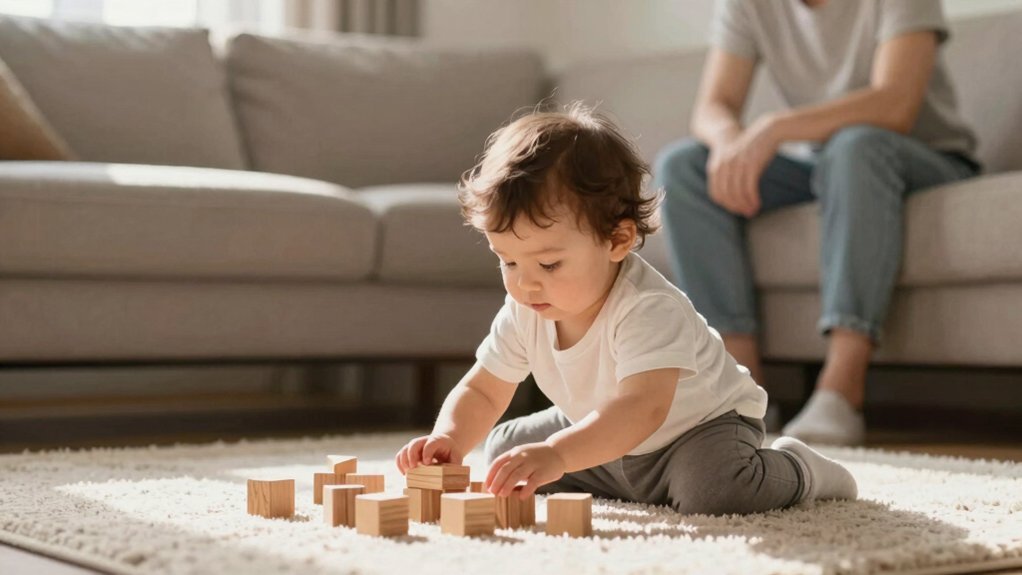
Create a quiet, distraction‑free corner with soft light and a clear view of the play area, then sit nearby with a notebook and pen within arm’s reach. Turn off the TV, silence your phone, and ask others for space so you don’t interrupt. Observe the toddler’s sensory focus—what they see, hear, touch, smell, and taste—using brief, objective notes without interpreting. Record raw behaviors, facial cues, and micro‑expressions, then end with a concise summary. Keep these habits and you’ll discover deeper insights.
Set Up a Quiet Observation Space

Where can you find a spot that feels both calm and unobtrusive? You choose a corner where the light is soft, the floor is clear, and the door stays shut.
A soft‑lit corner, clear floor, closed door—quiet, unobtrusive space for calm observation.
Set aside five to ten minutes of time, settle in, and take a few deep breaths before you start. Bring a notebook, a pen, maybe a voice recorder, and place them within arm’s reach.
Eliminate distractions: turn off the TV, silence your phone, and ask anyone else in the house to give you space.
Sit where you can see the child’s play area without blocking their view. This quiet observation space lets you watch, listen, and feel the moment without interrupting the natural flow of their activity.
Using age-appropriate and safe Montessori materials, such as wooden play food sets, can enhance your understanding of your toddler’s natural curiosity during observation.
Five‑Minute Sensory Notebook for Toddler Observation
You’ll start by picking a sensory focus—what you see, hear, smell, taste, or touch—using a simple prompt template to keep your notes concrete. Then you’ll jot down quick observations in a five‑minute notebook, noting each sense in turn without interpreting. Finally, a brief reflection tip reminds you to end with an objective summary of the toddler’s engagement. Incorporating observations from sensory play mats can enhance understanding of a toddler’s tactile and motor skill development during these sessions.
Sensory Focus Areas
What you’ll notice first is the visual landscape: note the brightness, colors, shapes, and any movement, then move methodically through sounds, tastes, textures, and smells, recording each sensation without interpretation. Stick to the five-sense framework, keeping your notes objective and free of judgment. Use a quick, five‑minute window, stay quiet, and resist the urge to interact; this preserves natural behavior. After you’ve captured the sensory data, you can later link it to a specific activity, describing muscles, problem‑solving steps, and emotions with the same neutrality.
- Sight – light, hue, form, motion
- Sound – pitch, source, volume
- Touch – pressure, temperature, surface texture
In environments designed for toddler independence, such as those with Montessori-friendly step stools, children can safely explore and develop sensory awareness.
Observation Prompt Templates
Typically, you’ll start the five‑minute sensory notebook by calming the environment and gathering your note‑taking tools, then move straight into recording raw, non‑interpretive data for each sense. Use observation prompts to guide you: first, write sight notes—colors, shapes, movements, spatial relations—without judgment. Next, capture hearing details, noting volume, rhythm, source. Then record touching sensations, describing textures and temperature. Follow with smelling cues, naming aromas and intensity. Finally, log any tastes if your child samples food or a drink. After the sensory sweep, apply a prompt for behavior: describe the puzzle activity, noting muscle use, problem‑solving steps, facial expressions, and interaction patterns. Keep each entry factual, brief, and free of interpretation. For safety during cooking activities, consider using a child-friendly cooking thermometer to monitor food temperatures accurately.
Quick Reflection Tips
Where does your attention go first when you settle into a quiet corner with your notebook? You take a breath, open your page, and let the room’s sights fill the line. Begin with what you see—color of blocks, the toddler’s posture—without labeling. Then move through hearing, tasting, touching, and smelling, noting each sensation in the order you experience it. After the five‑sense sweep, focus on a single activity like a puzzle, describing muscle use, problem‑solving steps, facial expressions, and any peer interaction. Keep your tone neutral; the notebook is a tool for observation, not interpretation.
- Capture visual details first.
- Follow the other four senses systematically.
- Record objective activity notes, avoiding conclusions.
Recognize Natural Play Rhythms Before Intervening
When you pause and watch your toddler’s movements, you’ll notice a subtle rhythm that reflects their growing independence and curiosity.
Their steps, giggles, and sudden pauses form a pattern that signals when they’re ready to explore or need a brief break.
Pay close attention to the tempo of their play: a fast‑paced chase may indicate high energy, while a slower, repetitive stacking suggests concentration.
By observing these cues, you can let the child lead, stepping in only when safety is at risk or when a natural transition presents itself.
Offer gentle prompts that validate their choices instead of directing the activity, and create space for them to initiate and delay adult‑driven tasks, preserving the authentic flow of their play.
Montessori-inspired musical instruments encourage development of fine motor skills and rhythm recognition through self-directed sound exploration.
Use “What‑If” Questions to Keep Observation Focused

You can steer your watch by asking “What‑if” scenarios that let the toddler explore options without you taking over. Pose open‑ended prompts like “What if you try the train this way?” and pair them with a nod or eye contact to signal you’re observing, not directing. These low‑stakes questions reveal problem‑solving and preferences while keeping your role non‑intrusive. Using age-appropriate design elements that match a child’s developmental stage can also support their confidence and interest during exploration.
IfWhatIfenarios
How could a simple “What if…” question shift your attention from directing play to simply watching? You’ll notice that a well‑timed What‑If prompt lets the toddler choose, while you stay a quiet observer. It frames actions as possibilities, not tasks, and gives you a pause to record genuine intent. By consistently noting responses, patterns emerge without adult pressure.
- Pose a scenario, then step back to watch the child’s spontaneous move.
- Use neutral language (“What if you try…?”) to keep the interaction non‑directive.
- Log the outcome immediately, linking it to earlier choices for later analysis.
Questions‑If” Insight
Curious about turning a playful moment into a data‑rich observation? You can keep your focus sharp by asking What‑if questions that stay inside the scene. What‑if the toddler picks the train track over the car—what would that look like in their plan? That prompt nudges you to note timing, sequence, and problem‑solving steps instead of labeling intent. What‑if they pause to adjust grip—what does that reveal about fine‑motor development? Shift the lens to sight, touch, or movement: What‑if they stare at a bright block before reaching? Each query anchors you to concrete behavior, letting you capture agency without directing play. By rotating What‑if scenarios, you build a holistic, data‑driven picture of the child’s moment‑to‑moment choices.
How to Keep Your Toddler Safe While You Observe
Ever wondered how to keep your toddler safe while you step back and watch? You can create a secure play zone without hovering constantly. First, gate stairways and lock doors, but leave a clear path to safe exploration areas. Second, clear the floor of hazardous items, pad sharp corners, and keep medicines, batteries, and loose furniture out of reach. Third, stay vigilant, offering gentle guidance only when needed, and model safe habits like looking before crossing. By balancing active supervision with thoughtful environment tweaks, you let your child discover confidently while you observe comfortably.
- Secure entry points and create safe zones
- Remove hazards and pad sharp edges
- Provide gentle guidance and model safe behavior
Capture Body Language and Facial Expressions Without Labeling
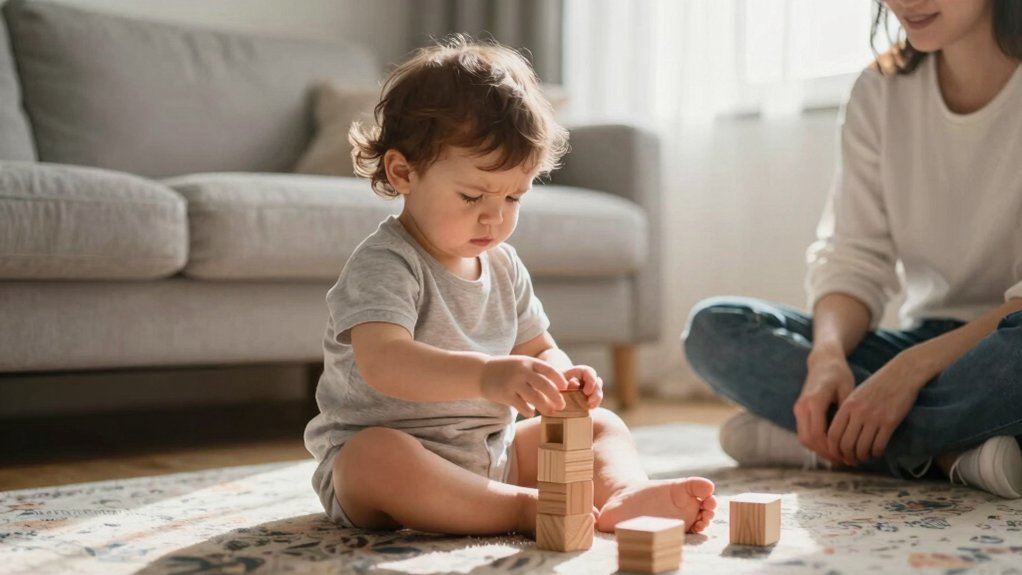
You’ll start by watching the tiny gestures that flicker in a second, like a quick eyebrow raise or a brief head turn. Notice the micro‑expressions that flash across the face—clenched jaw, widened eyes—without labeling them as happy or angry. By logging these objective details, you gather useful data while keeping your interpretation out of the moment.
Observe Subtle Gestures
How can you notice the tiny, unspoken signals that reveal a toddler’s inner world? You watch the child’s fleeting gestures, letting neutral attention guide you. When a little brow lifts or a mouth corner twitches, you note the motion, not the meaning. A forward lean on tiptoes, a shoulder tension, or a quick head tilt tells you the child is ready to act. A soft sigh, a brief grunt, or a focused pursed‑lip expression signals frustration or concentration. By recording these cues without labeling, you capture the authentic rhythm of the child’s experience.
- Spot micro‑expressions like eyebrow raises or subtle smiles.
- Observe posture shifts—leaning, tensing, toe‑balancing.
- Listen for brief vocal hints such as sighs or grunts.
Using tools made with sustainable bamboo can also encourage mindful observation by promoting a calm and eco-conscious environment.
Notice Micro‑Expressions Directly
At the moment a toddler’s face flickers, you can capture the micro‑expression before it fades. You watch the fleeting furrow, a quick jaw clench, or a flash of widened eyes, then note the accompanying shift in posture or hand placement. Keep your observations short and distraction‑free, recording only what you see—no labels, just raw signals. Over time, this practice sharpens your ability to read genuine emotions before the child consciously masks them.
| Cue | Typical Context |
|---|---|
| Brow furrow | Possible frustration |
| Lip press | Emerging disappointment |
| Eye dart | Sudden curiosity |
Document Problem‑Solving Steps in Real‑Time Play
When you watch a toddler tackle a puzzle, note each observable step: the moment they recognize the goal, the options they try, the trial they test, and any adjustments they make. Record the exact actions—how they grasp a block, rotate it, stack it, or discard it. Capture pauses, repeated attempts, and any shift in posture or focus. Keep the log strictly factual: “Child placed red block on blue platform, paused 2 seconds, then re‑gripped with opposite hand.” This creates a clear map of their problem‑solving process without interpreting motives.
- Identify goal and initial strategy
- List generated options and trial attempts
- Document adjustments, pauses, and outcome
Use a “Pause‑and‑Reflect” Cue for Non‑Intrusive Presence
Ever wonder how a simple “Pause‑and‑Reflect” cue can keep you present without taking over the play? You can say, “I’m going to observe for a moment while you play,” and then step back for a fixed 60‑second window. This Pause-and-Reflect signal sets a clear boundary, letting your toddler know you’re attentive yet not intrusive.
During the silent interval, you watch body language, problem‑solving attempts, and emotional cues, preserving the child’s autonomy. When the timer ends, you can re‑engage with a brief comment or question, reinforcing that the child led the activity.
Turn Observation Notes Into Parenting Insights
If you list what your toddler actually did before you interpret it, you’ll turn raw observations into clear parenting insights. Start with objective observation notes: note the exact action, the context, and any repeat patterns. Then match each behavior to a developmental domain—language, motor, problem‑solving—and ask what need it might signal, such as autonomy, novelty, or certainty. Finally, translate those insights into tiny, respectful steps that support the child’s agency while keeping safety in mind.
- Concrete behavior → possible need – e.g., stacking blocks → desire for mastery.
- Pattern identification – track recurring actions across days to spot trends.
- Actionable support – offer open‑ended choices or adjust materials to nurture the identified need.
Share Your Observations With Caregivers or Professionals
What’s the most effective way to share what you’ve seen with other caregivers or professionals? Use objective, non‑judgmental language that pins down the toddler’s actions, timing, and setting. Write concise notes in a standard format—date, time, activity, observed behavior, intensity—so everyone reads the same picture. Include measurable details: approximate start time, duration, triggers, location, and sequence of events. Offer video or photo clips when they add clarity, and invite questions to keep the dialogue collaborative.
| Date | Time | Observation |
|---|---|---|
| 04/12 | 09:15 | Toddler built a tower, fell, repeated 3× |
| 04/12 | 14:30 | Toddler refused snack after loud TV, 2‑minute pause |
| 04/13 | 10:00 | Toddler shared toy with sibling, smile noted |
| 04/13 | 16:45 | Toddler clutched blanket, walked to doorway, 5 min |
These observations help caregivers spot patterns, discuss strategies, and align support without guessing motives.
Create a Daily Routine for Consistent Toddler Observation
After logging observations in a clear, shared format, the next step is to embed short, focused observation windows into your everyday schedule. Set two 5‑10‑minute slots—one in the morning, one in the afternoon—when you can sit quietly, breathe, and have your notebook ready. Use a fixed structure: first note the environment and the toddler’s actions, then capture sensory details, muscle engagement, problem‑solving steps, emotions, and interactions. By aligning these windows with routine moments like mealtimes or nap transitions, you keep the flow of caregiving smooth and preserve the toddler’s attention for natural play.
Set two daily 5‑10‑minute observation slots, using a fixed template to capture environment, actions, sensations, and emotions.
- Choose consistent times each day.
- Prepare a quiet spot and tools before starting.
- Follow the structured note‑taking template.
Turn Observation Into Insightful Parenting Reflections
Ever wondered how a few minutes of mindful noting can become a roadmap for better parenting? You start by logging raw sensory input—what you see, hear, feel—then narrow your attention to concrete behaviors. After the session, turn those notes into reflections that link observed patterns to actionable steps. Ask yourself: “What does my toddler’s persistence tell me about their need for autonomy?” or “How does their problem‑solving reveal where scaffolding would help?” By consistently converting observation into insight, you build a feedback loop that sharpens your parenting intuition.
| Observation | Reflection |
|---|---|
| Child stacks blocks, steadies hand | Notice growing fine‑motor control; offer varied shapes to stretch skill |
| Toddler hums while drawing | Recognize self‑regulation; provide quiet time for creative flow |
| Child hesitates at a new toy | Identify need for gentle encouragement; model exploration |
| Toddler shares a toy with sibling | Observe emerging empathy; reinforce cooperative play |
Frequently Asked Questions
What Is the 3 3 3 Rule for Toddlers?
You’ll find the 3‑3‑3 rule means by age three, toddlers should walk steadily; by three‑and‑a‑quarter, speak short sentences; and by three‑and‑a‑half to four, dress with minimal help.
What Is the 777 Rule for Toddlers?
You follow the 777 rule by watching your toddler for seven minutes, then taking seven deep breaths, and finally pausing seven seconds before deciding whether to intervene or let them solve it themselves.
What Is the 10 10 10 Rule for Toddlers?
You follow the 10/10/10 rule by waiting ten minutes before reacting, checking back after ten hours, and reassessing the situation again ten days later to see if the behavior persists.
How to Teach a Child to Be More Observant?
You’ll spark curiosity by pausing, asking open‑ended questions, and letting them explore freely; model attentive listening, note their sensory details, then review together, reinforcing their own observations.




Leave a Reply