

You honor your toddler’s natural pace by offering a safe, multisensory environment that lets them explore and learn at their own speed. Focus on rich, varied play—textures, sounds, movement—that strengthens neural pathways rather than ticking off rigid milestone boxes. Provide choices, gentle prompts, and immediate, context‑specific consequences to guide behavior without pressure. Keep routines predictable, give brief warnings before transitions, and celebrate small victories. Continue and and you’ll discover practical tools and deeper insights.
What Developmental Milestones Really Mean for Your Toddler?

What do developmental milestones actually tell you about your toddler? They’re broad guidelines, not strict deadlines, showing typical ranges for skills like walking (9‑16 months) or first words (12‑18 months).
You’ll notice that development isn’t linear; children excel in motor, language, social, or cognitive domains at different times. That variability reflects an individualized pace, driven by neuroplasticity and multisensory experiences.
Instead of comparing your child to a chart, focus on creating a safe, stimulating, and responsive environment that nurtures early childhood growth.
When you celebrate each new ability, you reinforce confidence and curiosity, allowing the brain to adapt naturally.
Using child-size tools like whisks and utensils designed for small hands can support skill-building and independence in toddlers.
Why Each Toddler’s Developmental Path Is Unique
Why does each toddler’s developmental path feel so distinct? You’ll notice that milestones are guidelines, not strict timelines; some kids walk at nine months, others at sixteen, yet both are within the normal range. Their developmental pace reflects individual differences in language, motor, and social skills, especially during the rapid 18‑24‑month surge in vocabulary and two‑word phrases. Neuroplasticity fuels early childhood growth, letting the brain reorganize from multisensory experiences and social interaction. When you provide a secure, responsive environment that respects each child’s unique timing, you nurture confidence and resilience without pressure to “keep up.” This personalized support acknowledges that there’s no single required order of development, allowing every toddler to thrive on their own schedule. Using tools like Montessori-friendly step stools can support a toddler’s growing independence and motor skills as part of this individualized development.
How Your Toddler’s Brain Adapts While Learning
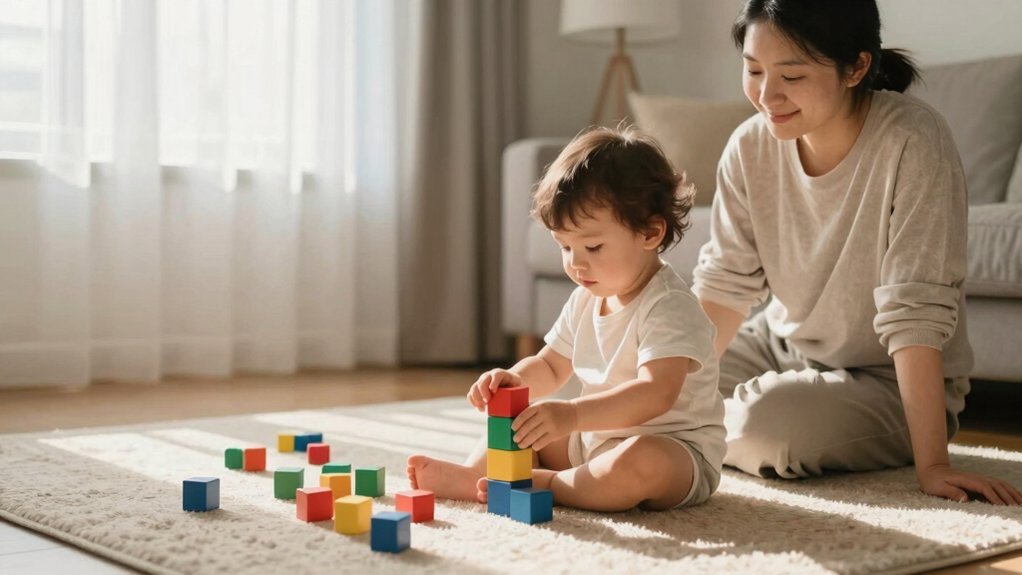
You’ll notice your toddler’s brain rewiring itself as you give them rich, multisensory play—touch, sight, sound, and movement all spark new connections.
Because of neuroplasticity, the areas you stimulate most often grow faster, while less‑engaged regions lag behind.
Using visual learning support systems can further enhance this developmental process by reinforcing communication and independence.
Plasticity and Connections
Do you notice how quickly your toddler picks up new sounds, shapes, or movements? That speed stems from neuroplasticity, the brain’s ability to rewire itself with each experience. When you offer multisensory engagement—touching a textured block while naming its color and moving it around—you’re forging stronger synaptic pathways than with a single sense alone.
Environmental enrichment, like varied toys, music, and social interaction, amplifies this process, turning fleeting moments into lasting neural architecture.
Consistency matters: regular, responsive play reinforces connections, while overstimulation or neglect can erode them. By pacing activities to your child’s rhythm and providing balanced, rich inputs, you nurture a resilient, adaptable brain that builds language, cognition, and motor skills at its own natural speed. Selecting toys that support fine motor control development and spatial reasoning can further enhance these neural connections.
Multisensory Learning Boost
When you layer touch, sight, sound, and movement together, your toddler’s brain weaves richer neural tapestries than any single‑sense activity can achieve. Multisensory learning taps early childhood plasticity, prompting rapid neural development as each sense reinforces the others. A simple activity—like a song paired with a textured book and a clapping rhythm—creates coordinated pathways that solidify memory and skill.
Repeating such varied, safe experiences lets your child explore at their own pace, avoiding pressure while still challenging the brain. Over time, these integrated moments boost language, cognition, and executive function, because the brain learns best when it can synthesize multiple inputs simultaneously. Keep the play dynamic, repeatable, and enjoyable to maximize growth.
Choosing tools that support growth alignment, such as those designed for an age range 18 months to 6 years, can further enhance this developmental process.
Experience‑Driven Neural Rewiring
Why does your toddler’s brain reshape itself with each new experience? Because neural rewiring thrives on multisensory stimulation that floods touch, sight, sound, and movement into a single learning moment. When you read aloud while pointing to pictures, you’re weaving language, vision, and motor pathways together, strengthening synapses that match your child’s development pace. Rich social interaction adds emotional context, making those connections more durable.
Conversely, a quiet, under‑stimulating environment lets emerging pathways weaken. By offering varied, purposeful activities—singing, building blocks, exploring nature—you keep the brain’s plasticity active, encouraging continuous, context‑dependent rewiring. This dynamic process respects each region’s unique timeline, ensuring growth feels natural and supportive. Introducing Montessori Blue Triangles provides structured, hands-on experiences that promote spatial reasoning and independent problem-solving in early childhood development.
How Multisensory Play Supports Developmental Milestones
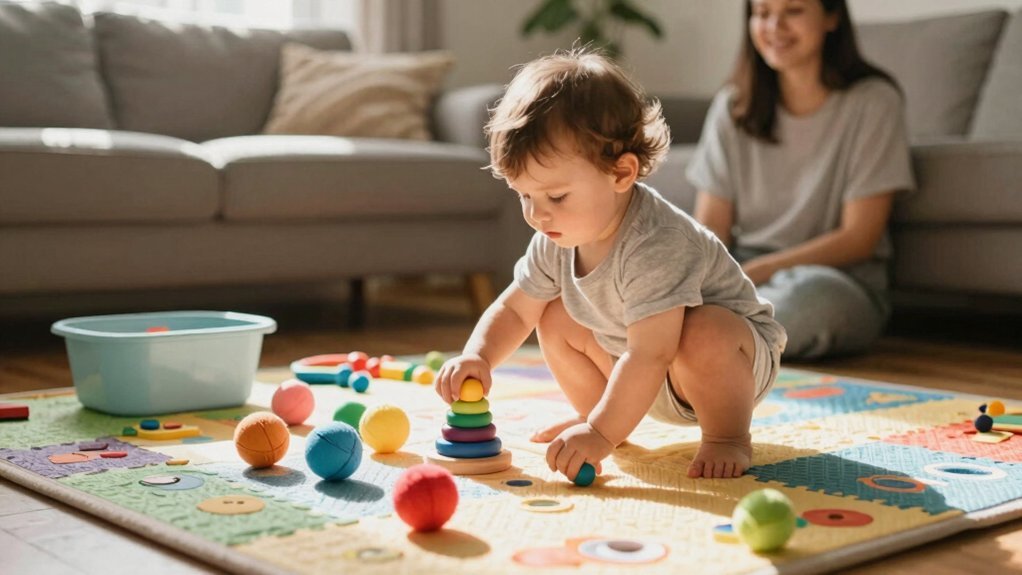
When you give your toddler a chance to explore textures, sounds, and colors together, you’re wiring sensory integration that fuels learning. Those rich experiences link movement with words, so reaching for a block while naming its color builds motor‑language coordination.
The more varied the play, the faster the milestones click into place. Integrating a safe and supportive environment like a Montessori floor bed can further enhance your toddler’s independent exploration and sensory development.
Sensory Integration
How does multisensory play boost your toddler’s development? By weaving touch, sight, sound, and movement together, you spark sensory integration that honors each child’s natural development pace. When you hand textured blocks, name colors, and play a soft tune, you reinforce neural pathways that support attention, memory, and early language. Enriched settings—music, books, hands‑on exploration—stimulate cross‑modal processing, fostering motor, cognitive, and social‑emotional growth. Social interaction during these activities builds joint attention and imitation, laying groundwork for later communication and problem‑solving. Sensorimotor experiences give varied input, letting milestones unfold organically without rigid timelines.
- Texture‑rich toys paired with descriptive language
- Simple instruments that invite rhythmic movement
- Color‑sorting games with background music
- Storytime with tactile props and sound effects
- Collaborative building projects that require turn‑taking
Motor‑Language Coordination
Because toddlers learn best when movement and words intertwine, multisensory play that blends touch, sight, sound, and motion creates strong links between motor and language regions in the brain. You can boost motor development and language coordination by offering activities like stacking blocks while naming colors, tracing shapes and repeating the shape’s name, or playing chase‑the‑ball with directional cues. These actions pair fine or gross motor control with new vocabulary, strengthening neural pathways that support both skills. Repeating varied, play‑based experiences lets your child generalize abilities across contexts, so progress shows up as coordinated bursts rather than rigid milestones. Observe the interaction, not the clock, and adjust support as language and movement grow together.
Designing Play Spaces That Encourage Exploration, Not Milestone Racing
What if the space itself invited curiosity instead of ticking boxes? You’ll notice your toddler’s facial expressions soften as they wander, drawn to textures, colors, and gentle sounds. An environment rich in enrichment lets them choose books, instruments, or dress‑up pieces without a checklist looming overhead. Open‑ended toys invite exploration, while low‑friction zones make transitions seamless, encouraging problem‑solving and social play at their own pace. Your responsive engagement reinforces learning, turning each moment into a natural discovery rather than a race.
- Soft rugs and tactile mats for sensory play
- Low shelves with varied, open‑ended materials
- Clear pathways and safe transition zones
- Adjustable lighting and soothing soundscapes
- Caregiver prompts that echo child‑initiated actions
Guiding Gross‑Motor Skills at a Child‑Led Pace
Ever wondered why some toddlers sprint across the living room while others linger on the rug? You can nurture gross-motor growth by letting your child set the tempo. Offer safe, varied spaces—cushioned obstacles for crawling, low sofas for cruising, open floor for walking—so they explore at a child-led development pace. Each tumble and step fires neuroplasticity, reshaping motor circuits when play feels fun and consistent.
Keep a simple log of milestones, celebrate tiny victories, and avoid pressuring a timeline. By providing stimulating, low‑risk environments and positive feedback, you reinforce balance, coordination, and confidence, letting the brain’s natural adaptability guide the next leap forward.
Simple Talk‑Back Techniques to Boost Early Speech
A simple talk‑back routine can turn everyday moments into powerful speech‑building sessions. When your toddler names a “dog,” repeat it and add a detail: “Yes, the dog is barking.” Speak slowly, use short phrases, and pause so they can process. Pair words with gestures or objects, and narrate daily actions to enrich language development. Invite turn‑taking by waiting after a sound, encouraging back‑and‑forth communication that fuels early speech.
- Repeat and expand each utterance
- Use slow, clear speech with one‑idea focus
- Pause for turn‑taking and wait for a response
- Narrate routines and describe objects vividly
- Pair words with gestures, facial expressions, or toys
Fostering Social‑Emotional Security for Confident Exploration
How can you turn everyday moments into a secure base for your toddler’s curiosity? By pairing emotional security with caregiver responsiveness, you give your child a reliable anchor for social‑emotional development. Keep routines simple and predictable, and label feelings as they arise—“You’re feeling frustrated”—so your toddler learns to recognize and regulate emotions. Offer warm, validating reactions when they stumble, and they’ll bounce back quickly, ready to explore new peers and settings.
Arrange low‑pressure playdates or group circles where you can guide interactions without demanding milestones. Consistently meeting their needs builds trust, reinforces autonomy, and encourages confident, curious exploration of the world around them.
Choice‑Based Activities That Promote Autonomy
You can give your toddler real choices—like picking a snack or deciding which game to start—to nurture autonomy and keep power struggles low.
Phrase the options as simple questions, such as “coat on in the bedroom or the kitchen?” so they can make decisions without feeling coerced.
Offer‑Choice Options
Ever wondered how a simple “this or that” can turn a toddler’s day into a confidence‑building adventure? When you give a clear *choice*—like which shirt to wear—you nurture autonomy and spark development. Phrase the option as a question, and the child decides without feeling pressured. Pair these moments with straightforward statements for non‑choices, such as “Time to put away toys now,” to keep routines firm. Mix indoor and outdoor activities so your little one can practice selection in varied settings. Balance free choice with guided participation, ensuring safety while boosting confidence.
- Choose between two outfits before heading out
- Pick a snack from two healthy options
- Select a play station: blocks or puzzles
- Decide whether to draw indoors or paint outdoors
- Opt for a storybook or a song before bedtime
Simple Decision Prompts
Offer simple, choice‑based prompts throughout the day to nurture your toddler’s sense of autonomy. When you ask, “Would you like the apple or the banana?” you turn snack time into a low‑stakes decision‑making moment. Phrase options as questions, and keep the choices limited to two to avoid overwhelm. Use routine points—breakfast, dressing, bedtime—to let toddlers influence small outcomes, then give a brief transition before moving on. Balance freedom with clear boundaries by stating non‑choices when needed, such as “We’re washing hands now; you can pick the soap scent afterwards.” This structure supports autonomy, respects each child’s pace, and builds confidence in everyday decision‑making.
Empowering Outcome Choices
How can a simple choice turn everyday tasks into confidence‑building moments? When you let your toddler pick a snack or a shirt, you give them autonomy and practice decision‑making within familiar routines. Phrase the options as a question, then link the outcome to the choice—“If you pick the plate, we’ll sit here to eat.” Predictable transitions let them see the cause‑and‑effect of their selections, while gentle guidance prevents frustration.
- Offer two real options for a task (e.g., red or blue shirt).
- Phrase each option as a clear question.
- State the next step that follows each choice.
- Embed the choice in a daily routine (dressing, snack time).
- Provide brief, supportive help if they stall.
Immediate, Context‑Specific Consequences for Managing Toddler Behaviors
Why wait for a lesson to sink in when you can tie the consequence directly to the behavior you just saw? You give immediate consequences that are context‑specific, so the toddler behavior sees the link between action and outcome. If a child throws a toy, calmly say, “We’re putting the toy away because it can hurt someone,” and remove it briefly. The brief removal halts the escalation and resets attention, while a short explanation reinforces the connection. Consistency matters—use the same related consequence each time the same toddler behavior recurs, so the child feels secure and learns predictably. Offer concrete alternatives on the spot, like a soft ball for throwing, to guide the next action without vague admonitions.
Anticipating Frustration Triggers to Prevent Tantrums
Ever notice how a sudden change in routine can send your toddler into a spiral? When you spot clenched fists, narrowed eyes, or repetitive requests, you know a transition is brewing. Anticipation is your secret weapon—give a heads‑up about what’s next and let them pick between two simple options. Those brief, calm redirections keep frustration from exploding into a tantrum. Consistent, predictable routines and a quiet‑down corner teach self‑regulation, turning potential meltdowns into smooth shifts.
- Offer a 30‑second warning before any change.
- Provide two clear, acceptable choices for the next activity.
- Use a calm voice and brief redirection when tension rises.
- Incorporate a sensory calm‑down spot with breathing prompts.
- Keep transition times a bit longer than you think they need.
Imaginative Play Ideas That Strengthen Cognitive Links
When you move from preventing tantrums to sparking imagination, you can turn a calm moment into a learning adventure. Offer a tray of sand, water, and play dough and invite your toddler to build a “beach” where shells become treasure maps; narrate the scene together, prompting them to label textures and actions, which boosts language processing.
Use open‑ended blocks that can become towers, cars, or houses, and ask, “What happens if we add a bridge?” This encourages flexible thinking and strengthens cognitive development.
Encourage role‑play with simple costumes, letting them act out a shop or a rescue mission while you label emotions and dialogue. These imaginative play moments weave perspective‑taking, executive function, and fine‑motor skills into a cohesive learning tapestry.
How to Observe and Record Your Toddler’s Growth Respectfully?
How can you capture your toddler’s growth without turning it into a comparison contest? You can honor their unique development pace by keeping individualized records that focus on language, motor, and social‑emotional milestones as they naturally unfold. Use neutral observation language, noting behaviors without judgment, and always add context—new settings, routines, or caregiver interactions—to interpret changes. Review the notes regularly, spot patterns, and celebrate small gains, keeping the emphasis on learning and engagement rather than fixed timelines.
Honor your toddler’s unique pace by documenting neutral, contextual observations across language, motor, and social‑emotional milestones.
- Write brief entries after each day’s key moments.
- Phrase observations with neutral, non‑judgmental words.
- Include the environment or routine that preceded the behavior.
- Track progress across multiple domains, not just one.
- Review monthly to identify trends and acknowledge incremental growth.
Frequently Asked Questions
What Is the 3 3 3 Rule for Toddlers?
You follow the 3‑3‑3 rule by checking that by three months you show early social smiles, by three years you walk and speak several words, and by three years you combine words into short phrases, remembering each child’s timing varies.
What Is the 7 7 7 Rule in Parenting?
You give your child seven minutes of eye contact, seven minutes of talking or singing, and seven minutes of shared activity each day, adjusting the timing to fit their individual rhythm and needs.
Which Sibling Is Usually the Favorite?
You won’t find a universal favorite; it shifts with each family’s dynamics, moods, and needs. Sometimes the youngest gets more hands‑on care, sometimes the oldest receives structured guidance, and often it’s situational.
What Is the 10 10 10 Rule for Toddlers?
You give your toddler a 10‑minute warning, then a 10‑minute heads‑up, and finally a 10‑minute preparation before any transition, helping them anticipate and adjust to the upcoming change.




Leave a Reply