
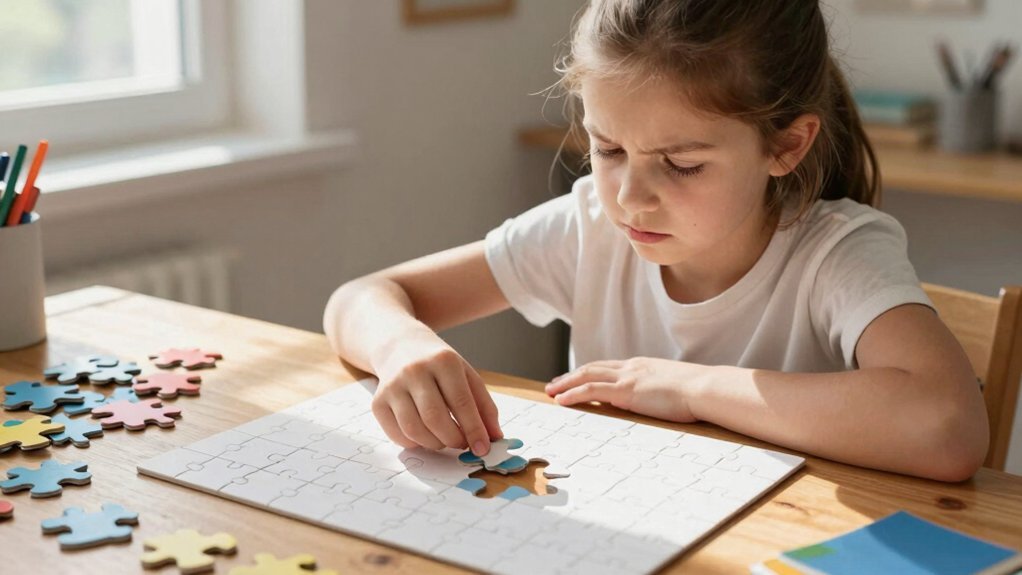
In a Montessori setting you spot a click, a wobble, or a gap, and you instantly know something’s off, so you adjust the piece without waiting for help. Those tactile and visual cues turn each mistake into a mini‑problem you solve on the spot, sharpening your concentration and confidence. The repeated trial‑and‑error loop builds a habit of independent reasoning that transfers to math, language, and real‑world tasks. Keep going and you’ll discover how to nurture these habits at home.
What Self‑Correction Looks Like in a Montessori Classroom
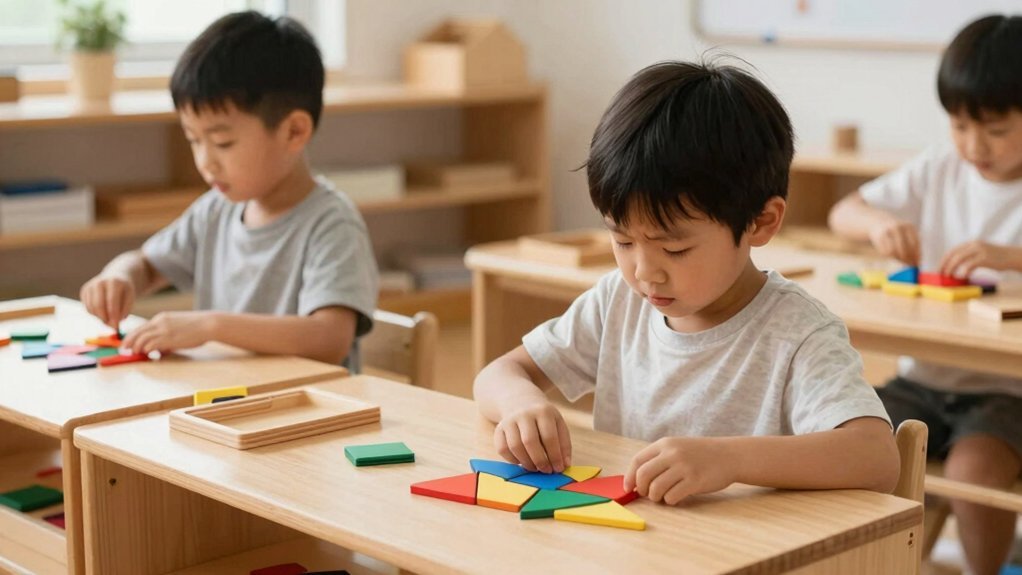
Ever wondered how a Montessori classroom turns mistakes into learning moments? You’ll see self-correction in action when a child picks up a cylinder block and feels the notch misalign. The material itself signals the error—its shape won’t fit, the tower wobbles, the spindle box refuses to close. You watch as the child pauses, re‑examines the piece, and adjusts their grip without adult prompting. The design forces a trial‑and‑error loop: only a correct placement lets the activity proceed, so concentration deepens and inner motivation rises. As you observe, you notice the child refining strategies, noticing patterns, and building problem‑solving skills—all through the built‑in cues that make mistakes visible and fixable. In Montessori settings, tools like the Comfy Cubs Kids Step Stool Montessori Tower aid independence and allow children to engage confidently in learning activities, enhancing self-correction opportunities.
Why Self‑Correction Boosts Confidence & Reduces Shame
When a child discovers that a mis‑aligned cylinder won’t fit, the material itself nudges them to try again, turning the slip into a clear cue for adjustment. You’ll notice how each misstep becomes a signal, not a verdict, and that signal fuels confidence. By letting mistakes guide the next attempt, you create a safe space where you can persist without fearing judgment. The feedback loop reinforces intrinsic motivation, so you stay engaged and resilient. Over time you internalize progress, and the shame that once shadowed errors fades away, replaced by a steady belief in your ability to self‑correct and grow. Many educational tools, such as color-coded rods, provide immediate visual feedback that enhances this self-correction process.
| Aspect | Effect |
|---|---|
| Mistakes as cues | Builds confidence |
| Immediate material feedback | Reduces shame |
| Self‑directed adjustment | Increases resilience |
| Visible progress | Boosts intrinsic motivation |
How Mistakes Turn Into Self‑Correction Problem‑Solving Opportunities

Because a mistake instantly highlights a mismatch between expectation and reality, it becomes a natural cue for self‑correction. You notice the error, pause, and ask what went wrong. The material you’re using gives immediate tactile feedback; the observation of the result provides visual cues. Those signals turn the slip into a data point, prompting you to adjust grip, angle, or sequence. As you experiment, you develop resilience and a habit of testing alternatives rather than fearing failure.
Low‑stakes challenges let you repeat the task, each iteration sharpening critical thinking. Over time, you internalize a problem‑solving mindset that treats every mistake as a stepping stone toward mastery. Selecting tools with ergonomic handles and appropriate sizes can enhance this learning process by making physical interaction more comfortable and intuitive.
How Adult Observation Supports Self‑Correction
You’ll notice that when you model positive behaviors, children pick up the mindset they need to self‑correct. By stepping back and encouraging independent exploration, you let them spot mistakes and try new approaches on their own. This supportive observation creates a safe space where they can experiment, reflect, and deepen their problem‑solving skills. Incorporating tools designed with safety features and design helps children practice these skills confidently in a real kitchen environment.
Model Modeling Positive Behaviors
How does an adult’s calm, attentive presence teach you to self‑correct? You watch them monitor a task without intervening, and their quiet focus signals the mindset you need for self-correction. When they later re‑present the problem or tweak the prompt instead of giving the answer, you learn to anticipate mistakes and adjust on your own. Their reflective pauses—brief stops to assess progress—show you how to slow down and think deliberately. Positive, non‑judgmental cues keep you persistent and concentrated, reinforcing the habit of checking outcomes before moving on. By modeling these behaviors, adults help you internalize error‑control strategies, building confidence that you can verify results independently and apply self-correction to future challenges. Using tools like color-coded designs encourages immediate feedback loops that support this reflective process.
Encouraging Independent Exploration
What happens when an adult steps back and simply watches you work? You feel the space to try, fail, and adjust without immediate judgment. The room stays organized, so you can spot mismatched pieces or odd outcomes and pause to reflect. When the adult re‑presents the task later, they offer a calm, non‑judgmental glance that signals a new chance to experiment. Mechanical cues—like a wobbling tower—or social cues—like a puzzled expression—guide your self‑correction. You learn to trust your own observations, deepening concentration and intrinsic motivation. Mistakes become data points, not defeats, and you develop a mindset that every error is a stepping stone toward smarter problem solving. This process mirrors how infants develop fine motor skills and sensory exploration when engaging with Montessori-inspired wooden rattles.
How Mechanical Control of Error Guides Independent Thinking
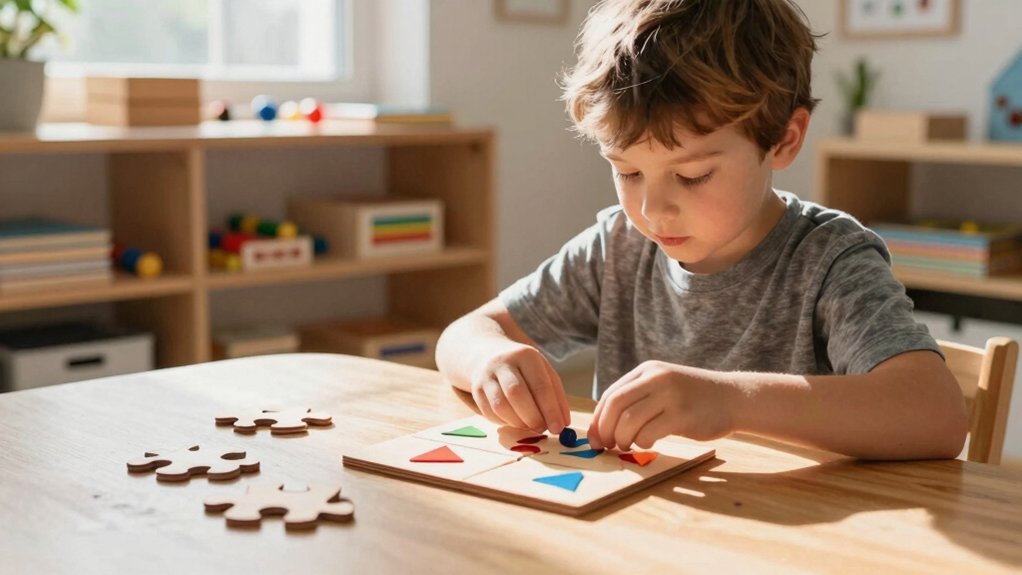
You’ll notice that when a piece clicks into place, the physical alignment instantly confirms you’re on the right track. That tactile feedback lets you spot mismatches yourself, so you can correct errors without anyone’s help. Over time, this hands‑on detection sharpens your pattern recognition and procedural reasoning. This process is foundational in developing fine motor skills and hand-eye coordination through engaging activities like hammering pegs.
Physical Alignment Reinforces Understanding
Ever notice how a puzzle piece only fits when it’s aligned correctly, instantly signaling a mistake? That moment is the core of physical alignment reinforcing understanding. When you manipulate Montessori blocks, the shape and fit give immediate tactile feedback. If a piece refuses to settle, you recognize the error without a teacher’s cue. This self‑correction loop forces you to slow down, test placements, and refine your strategy until the material functions as intended. The tangible resistance sharpens sequencing, logical reasoning, and concentration. By trusting your own discrimination, you develop internal motivation to solve problems, relying on the mechanical control of error rather than external validation. This hands‑on experience builds lasting problem‑solving confidence.
Immediate Sensory Confirmation
When a puzzle piece refuses to snap into place, the resistance itself tells you something’s wrong, and that immediate sensory cue pushes you to rethink the fit before any adult steps in. You feel the mis‑alignment, notice the mechanical control of error, and instantly know the piece belongs elsewhere. This tactile feedback acts as a checkpoint, letting you correct the mistake without prompting. You watch the component, adjust your grip, and try again, building concentration as you chase the satisfying click.
Because the error signal is built into the material, you practice trial‑and‑error, develop persistence, and gain self‑reliance. Each successful snap reinforces the correct procedure, paving the way for more complex tasks.
Independent Error Detection
How does a simple click or a stubborn resistance tell you that something’s off? You hear the click, feel the jam, and instantly know a piece is misplaced—no adult needed. Mechanical control of error forces you to notice mismatches, prompting you to adjust before you move on. This tactile feedback turns trial and error into a disciplined routine, sharpening your independent thinking and self-correction skills.
- A smooth click signals a perfect fit, reinforcing confidence.
- A stubborn resistance signals a mismatch, urging you to re‑examine orientation.
- A silent gap signals a missing component, compelling you to search for the right piece.
How Perceptual Error Cues Teach Kids to Spot Mistakes
Because perceptual cues—like a mismatched shape that won’t fit or a surface that feels uneven—immediately signal a mistake, children learn to notice errors on their own. You’ll see them pause, compare the odd piece to the pattern, and adjust without adult prompting. This perception‑based feedback creates a rapid loop: the cue tells you something’s wrong, you try a new move, and the cue either disappears or persists. Over time, you trust your senses, stay focused, and develop intrinsic motivation to solve problems independently.
| Cue Type | Sensory Modality | Typical Response |
|---|---|---|
| Mismatched shape | Visual | Re‑orient piece |
| Uneven surface | Tactile | Apply pressure evenly |
| Color clash | Visual | Swap color |
| Loose joint | Tactile | Tighten connection |
| Missing piece | Visual | Search for piece |
How Sensorial Materials Enable Self‑Correction
What makes Montessori sensorial materials so powerful for self‑correction is their built‑in feedback: each piece only works when it’s placed correctly, so the moment you try a wrong fit you feel or see an immediate mismatch. You learn to notice the tactile “click,” the visual gap, or the kinesthetic wobble, and you adjust instantly without adult prompting. This hands‑on loop builds concentration and intrinsic motivation, turning errors into clues.
- Cylinder blocks that slip out of the wrong hole, urging you to realign.
- Pink Tower rings that wobble when stacked out of order, signaling a sequencing error.
- Spindle boxes that feel off‑balance unless the correct count is placed, prompting you to recount.
These cues nurture self‑correction, fostering problem‑solving skills that transfer to any domain.
How Math Tools Support Self‑Correction
The tactile feedback that makes cylinder blocks and Pink Tower rings self‑correcting also appears in Montessori math tools, where each piece only fits when the calculation is right.
You’ll notice that the golden beads, number rods, and fraction circles all enforce mechanical control of error: a bead snaps into place only if the sum matches the target, and a rod slides into the correct slot when the value aligns.
Those tactile cues trigger perceptual control of error, so you spot a mismatch instantly and adjust without adult prompts.
Materials don’t lecture; they simply work when used properly, prompting you to reflect, correct, and repeat.
This self‑correction loop deepens concentration, builds inner motivation, and nurtures autonomous problem‑solving.
How Language Activities Foster Self‑Correction
Language activities let you spot mistakes instantly because the materials—like the movable alphabet and three‑part cards—only fit together when the phonetic sounds or images match the labels. You pull a letter, hear its sound, and see the picture; if the pieces don’t click, you know something’s off. This tactile feedback triggers self‑correction without a teacher’s prompt, sharpening your internal monitor and keeping you engaged.
Tactile tools let learners instantly spot and self‑correct mistakes, sharpening phonetic awareness and engagement.
- Movable alphabet – you arrange letters, hear the word, and notice mismatches.
- Three‑part cards – you match image, word, and phonetic symbol; a wrong combo forces a retry.
- Spelling puzzles – you build words, see the result, and immediately correct errors.
These tools build phonetic awareness, boost word‑building strategies, and nurture independence in identifying and fixing language mistakes.
How Practical Life Tasks Promote Self‑Correction
Ever notice how pouring a glass of water or buttoning a frame instantly tells you if you’ve done it right? Those tiny moments give you immediate, tangible feedback that triggers self‑correction. You see the spill or the misaligned button, pause, and adjust your grip or alignment. Repeating the task without adult prompts lets you reflect, notice the error, and try again, building concentration and resilience. The real‑world outcome—dry floor or a neatly fastened frame—reinforces the link between effort and accurate results, fostering intrinsic motivation to tackle bigger challenges.
| Task | What you learn |
|---|---|
| Pouring water | Detecting overflow, adjusting flow |
| Buttoning a frame | Aligning holes, correcting mis‑placement |
| Folding cloth | Spotting uneven edges, refining technique |
Adult Strategies to Support Self‑Correction in the Classroom
You can turn a classroom into a self‑correction hub simply by shaping the space and your role. First, clear the clutter and scale materials so each child can see where they went wrong without distraction. Next, step back while they work, offering only gentle prompts that invite reflection rather than direct fixes. Finally, model a growth mindset by treating every mistake as a clue to mastery, and use observation notes that focus on strategies, not just outcomes.
- Arrange tables and tools for easy access and error visibility.
- Use a “pause‑and‑think” cue when a student hesitates, letting them assess their own process.
- Celebrate self‑correction moments with brief, specific feedback that reinforces independence.
Bringing Montessori Self‑Correction Home
You’ll notice that well‑designed materials give clear error signals, so kids can spot mistakes without your prompting.
By setting up a low‑clutter, scaled space, you let them explore independently and correct themselves.
This home environment nurtures concentration, reflection, and intrinsic motivation just like the classroom.
Materials Error Signals
How do Montessori materials turn mistakes into instant feedback? You see a block that won’t slide, a puzzle piece that refuses to fit, or a bead that feels wrong in your hand. Those error signals spark self‑correction without a teacher’s “no.” The design forces you to notice, reflect, and try again, building problem‑solving stamina.
- Mechanical fit – a cylinder only clicks into its matching slot, so you feel the mismatch instantly.
- Perceptual cue – color patterns misalign, prompting you to compare the intended design with what you’ve built.
- Social cue – an adult watches, then re‑presents the task later, letting you discover the error on your own.
These signals keep you engaged, turning each slip into a learning moment.
Independent Exploration
Ever wonder how a child can turn a simple tabletop activity into a mini‑lab of discovery? You set out a few Montessori‑style tools that give immediate, tactile feedback—like a puzzle that clicks when pieces align or a bead frame that slides smoothly only when the pattern matches. The child tries, notices a mismatch, and adjusts without you stepping in. Keep the space tidy and choose tasks sized for their hands; the clear error signals let them self‑correct naturally. You watch from a distance, offering a nod or a gentle prompt only when they’re truly stuck.
Over weeks, this independent exploration builds self‑trust, fuels intrinsic motivation, and sharpens problem‑solving persistence that spills over into school work and everyday challenges.
Home Environment Design
What if your living room became a quiet workshop where mistakes turn into lessons? You can shape a low‑pressure home that nurtures self‑correction by clearing clutter, arranging shelves at child height, and using Montessori‑inspired tools that give instant feedback. Step back while they work, observe without judgment, and let trial‑and‑error unfold naturally. Offer time for exploration, avoid rushing, and sprinkle encouragement only when needed. Celebrate each independent solution to cement a growth mindset.
- Clear zones – define a tidy reading nook, a hands‑on math table, and a creative art corner.
- Feedback‑rich materials – choose puzzles, bead frames, and sorting trays that show right or wrong instantly.
- Quiet observation – position yourself nearby but invisible, allowing the child to adjust without adult interference.
Long‑Term Benefits: Confidence, Critical Thinking, and Lifelong Learning
Why does confidence matter when you tackle problems on your own? Because self‑correction turns each slip into proof that you can recover, so you approach new challenges without hesitation. You start seeing mistakes as stepping stones, which builds resilience and sharpens critical thinking. Regularly confronting low‑stakes errors forces deeper concentration, and your brain learns to monitor itself, persisting through difficulty. Over time, those habits spill over into every domain, making lifelong learning feel natural rather than forced. You’ll notice you can transfer strategies to unfamiliar contexts, because you’ve practiced adjusting on the fly. Ultimately, the confidence you gain fuels a growth mindset, keeps you curious, and ensures you keep solving problems long after formal instruction ends.
Frequently Asked Questions
What Is the 70 30 Rule in Teaching?
You follow the 70/30 rule by spending roughly seventy percent of class time on guided practice, hands‑on activities, and peer collaboration, and thirty percent on direct instruction, modeling, and targeted explanations.
Why Is Self-Correction an Important Skill for Readers to Develop?
You need self‑correction because it forces you to spot gaps, test alternatives, and refine meaning, building confidence, independence, and sharper problem‑solving instincts that transfer to any reading challenge.
How Do People Develop Problem-Solving Skills?
You develop problem‑solving skills by confronting challenges, analyzing errors, testing alternatives, and reflecting on outcomes; this active, iterative practice builds resilience, critical thinking, and the confidence to tackle new problems.
What Does Self-Correction Help With?
You’ll improve focus, resilience, and critical thinking; you’ll learn to spot errors, adjust strategies, and persist through challenges, turning mistakes into stepping stones for smarter, independent problem‑solving.