Turn everyday meals into multisensory lessons by letting kids help cook, read recipes, and measure ingredients, which builds language, math, and executive skills. Set up sensory bins with rice, pasta, or nature finds and ask them to name colors, shapes, or count items while you explore together. Use music, rhythm, and storytelling in daily routines—sing chants while sorting letters and clap beats for spelling. Create movement‑based games like number‑line hopscotch or air‑letter tracing to engage kinesthetic learners. Build a low‑cost home classroom with tactile zones, visual charts, and auditory read‑alouds, and you’ll discover even more ideas ahead.
Turn Everyday Meals Into Multisensory Learning

Ever wondered how a simple dinner can become a hands‑on classroom? You can turn everyday meals into multisensory learning by inviting kids to help with cooking. When you read recipes together, you boost language development and teach sequencing. Measuring flour, scooping sugar, and timing the bake turn kitchen chores into math in cooking, sharpening executive function as children compare quantities and adjust portions. Sensory exploration happens as they feel dough, smell spices, and taste a pinch of salt, linking words to flavors and textures. Experiential learning shines when they stir, pour, and watch batter rise—each step is a mini‑science experiment. These hands‑on activities make kitchen science vivid, turning ordinary prep into a dynamic, educational adventure. Integrating Montessori play kitchens into this process can further enhance cognitive and motor skill development through interactive, realistic features.
Create Fun Sensory Bins and Go on Nature Walks
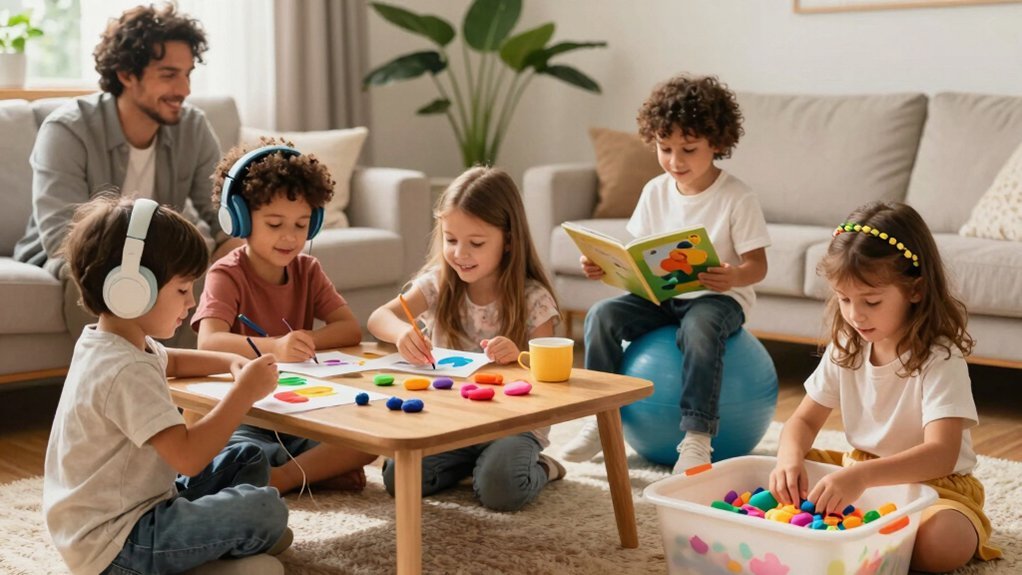
When you gather a bin of rice, pasta, or beans and sprinkle in seasonal treasures like pinecones or shells, you instantly create a tactile playground that sharpens fine‑motor skills and invites kids to explore textures, count, and trace letters—all while you guide their curiosity with simple prompts and supervision. This multisensory setup fuels tactile learning and early literacy, letting children feel grainy rice, smooth shells, and rough bark while you ask them to name colors or shapes. Pair the bin with a short nature walk, collecting leaves, acorns, or feathers to extend cross‑curricular play. Rotate items weekly to keep engagement high, and weave math or phonics into the hands‑on experience. These activities respect diverse learning styles, boost fine motor skills, and turn everyday moments into rich, exploratory learning. Incorporating wooden memory games into sensory play can further enhance memory and concentration skills through engaging tactile experiences.
Use Music, Rhythm, and Storytelling for Multisensory Auditory Learning

How can a simple song or a lively story turn everyday learning into a memorable auditory adventure? You can boost multisensory, auditory learning by weaving music, rhythm, and storytelling into daily routines. Sing a chant while sorting letters; the rhythm reinforces phonemic awareness and strengthens memory. Use expressive prosody in storytelling, varying pitch and pacing to highlight key concepts. Alternate vocal dynamics during read‑alouds to keep engagement high and support listening comprehension. Pair math facts with a catchy melody, so melody cues recall. Integrate clapping or tapping beats while reciting spelling lists, turning abstract symbols into tangible sounds. These strategies create vivid auditory cues, deepen phonemic awareness, and make learning feel like a fun, immersive experience. Incorporating physical elements like stable Montessori step stools can further enhance engagement by promoting independence and hands-on interaction during learning activities.
Design Movement‑Based Math and Reading Games for Kinesthetic Learners
By turning math and reading into kinetic play, you give kinesthetic learners the chance to feel concepts as they happen. Use multisensory learning by creating movement‑based games that link math concepts to body actions—think base‑ten block toss, number‑line hopscotch, or jumping to count multiples.
For reading skills, have kids form letters in the air, trace textured shapes while reciting phonemes, or clap rhythmically to syllable patterns. Design instruction that emphasizes proprioception and tactile activities, offering clear rules and immediate physical feedback.
Keep active engagement high by scaling difficulty, alternating fast‑paced rounds with brief, quieter reading tasks, and ensuring each activity aligns with the child’s learning style. This approach turns abstract ideas into concrete, memorable experiences.
Set Up a Low‑Cost Multisensory Home Classroom

Ever wondered how you can transform everyday household items into a vibrant, multisensory classroom without breaking the bank? Start by turning rice‑filled bins, beans, pasta, or sand into tactile learning zones where kids shape letters and numbers.
Set up learning stations that cover visual‑auditory‑kinesthetic modes: flashcards and color‑coded charts for visual, read‑alouds and rhymes for auditory, and textured letters or chalk trays for tactile.
Use everyday materials like paper towel tubes for counting and cardboard cutouts for shapes, creating DIY learning tools that enable cross‑modal activities.
Integrate kitchen/math integration—measure ingredients, follow spoken recipes—to anchor concepts in real life.
Label each area, add rotation cues, and keep the layout simple so the low‑cost home classroom stays organized, engaging, and truly multisensory.
Including child-safe tools such as silicone-coated whisks can further enhance hands-on learning while ensuring safety during kitchen activities.
Frequently Asked Questions
What Are Multisensory Learning Strategies?
You use visual, auditory, tactile, and kinesthetic activities together—like reading aloud while tracing letters, moving objects while counting, or singing directions while drawing—to reinforce concepts and boost memory.
What Are the 7 Types of Learning Styles?
You’ve got seven styles: visual, auditory, kinesthetic, read/write, interpersonal, intrapersonal, and logical. Each shapes how you absorb, process, and recall information, guiding your learning preferences.
How Is Orton Gillingham Multisensory?
You engage visual, auditory, and tactile senses simultaneously—tracing letters, saying sounds, feeling movements—so you encode phonics through sight, sound, and touch, reinforcing decoding and spelling instantly.
What Are the Sensory Learning Styles?
You recognize visual, auditory, tactile, and kinesthetic learning styles; each emphasizes seeing, hearing, touching, or moving. You also can tap submodal senses—like proprioception or equilibrioception—to deepen engagement.