

You guide Montessori children to walk the line because it sharpens their concentration, balance, and self‑control while teaching them graceful, courteous movement. The elliptical path forces heel‑to‑toe steps, which improves gait and spatial awareness. Walking together synchronizes pace, fostering social harmony and respect for peers. This purposeful activity also builds fine‑motor skills that lay a foundation for later STEM learning. Keep exploring to discover how each element supports their overall development.
What Is Montessori Line Walking?
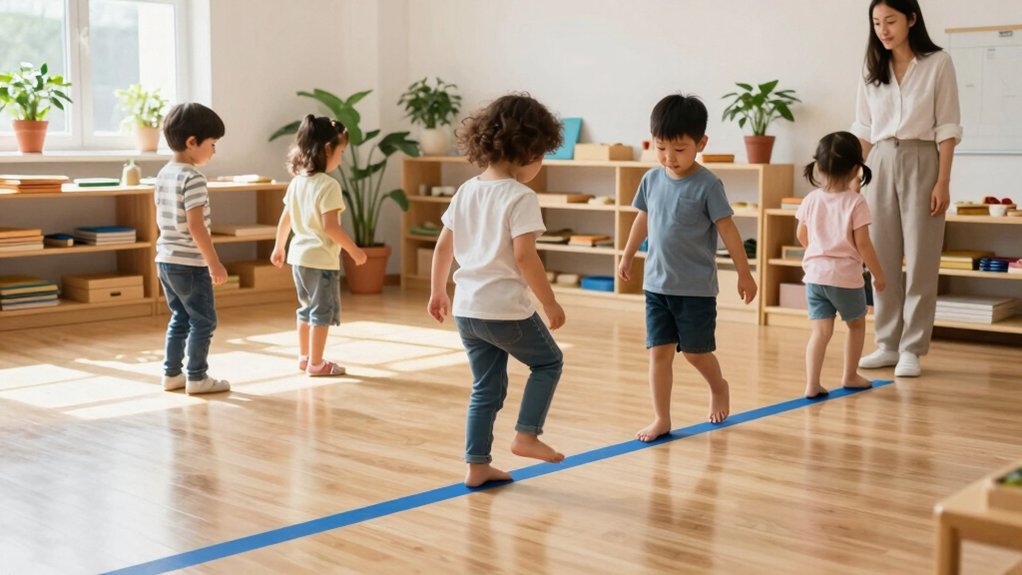
What’s Montessori line walking? You step onto an ellipse line taped on the floor and move deliberately within that narrow path. The activity, created by Maria Montessori, trains your balance and concentration as you shift from a normal gait to heel‑to‑toe steps, tackling balance challenges as you improve. You walk in a group, matching pace with peers, maintaining quiet awareness, and displaying grace and courtesy. This coordinated movement links physical control to cognitive and emotional growth, fostering inner discipline and classroom readiness. Each stride reinforces mind‑body coordination, helping you stay focused, calm, and respectful while navigating the line. The practice builds a solid foundation for self‑regulation and social harmony. Incorporating supportive tools like the Kitchen Step Stool for Kids with Safety Rail can further enhance balance and confidence during early learning activities.
Historical Roots of Montessori Line Walking
Why did Montessori turn to an elliptical line on the floor? You’ll find that Maria Montessori observed calm, well‑ordered environments produced refined, purposeful movement. She introduced the Montessori line as a dedicated space where children could practice balance, rhythm, and intentional motion.
Early in her work, she linked this simple walking exercise to concentration and self‑control, arguing that bodily control mirrors the will. The elliptical shape gave each child a clear path to follow, reinforcing inner order through repeated, mindful steps.
Over time, the activity evolved from basic balance tasks into a structured practice that nurtured mindfulness, social harmony, and disciplined, purposeful action within everyday classroom life. This approach aligns with the broader Montessori focus on motor skills development through hands-on materials that support visual discrimination and coordination.
How Montessori Line Walking Builds Concentration, Balance & Self‑Control?

The elliptical line that Montessori created isn’t just a decorative floor marking; it’s a focused movement exercise that trains the mind and body together. When you step onto the line, you must keep your heel‑to‑toe placement precise, watching each foot land quietly. That demand sharpens concentration, because any wobble or distraction pulls you off the path. The same practice stretches your balance, as you shift weight smoothly while resisting the urge to sway toward a neighbor.
Meanwhile, self‑control blooms when you wait for cues, pause at rhythm changes, and adjust your pace without breaking the shared flow. In a Montessori environment, this simple activity weaves body awareness, cognitive planning, and emotional regulation into everyday learning.
- Heightened concentration through focused foot placement
- Improved balance by managing weight shifts and gait changes
- Strengthened self‑control via cue‑following and rhythm adjustments
- Social harmony cultivated through synchronized line walking in the classroom
This activity also supports cognitive, language, and motor skills development in young children, aligning with Montessori principles.
Setup & Practical Tips for Classroom Implementation
When you set up a Montessori line‑walking area, start by marking an elliptical path on the floor with tape, chalk, or paint, then clear a surrounding space so each child can move without bumping a neighbor.
Choose a quiet corner, lay down a soft rug if the floor is hard, and keep the line visible from all angles.
Begin each classroom activity with natural gait walking along the line to establish balance.
Introduce a single drumbeat cue, asking children to place toes on the line and face the center.
Add a second beat for spacing, then a turn cue to align direction.
Gradually shift to walking in time with the rhythm, stopping when the beat ends.
Vary tempo—speed up, slow down, return to natural rhythm—to keep focus sharp and reinforce whole‑body control.
Including fine motor development activities alongside walking exercises can further enhance children’s coordination and concentration.
Grace, Courtesy & Social Harmony in Montessori Line Walking
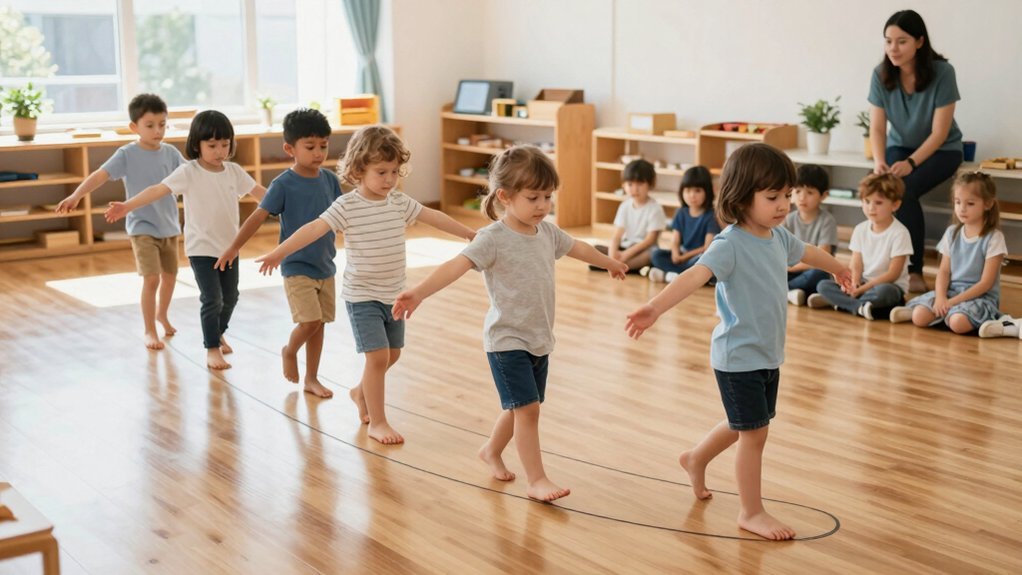
When you step onto the line, you instantly become part of a graceful shared movement that synchronizes each child’s rhythm. You learn to sense the space around you, adjusting your pace so you never crowd or lag behind.
This subtle awareness builds respect and keeps the whole group flowing in harmonious unity. Much like the precision required in a slow-squeeze cold press juicer for optimal harmony and efficiency, Montessori line walking nurtures a careful balance of individual attention and group coordination.
Graceful Shared Movement
Ever wondered how a simple line can teach grace, courtesy, and social harmony? You’ll find that walking the line becomes a living lesson in coordinated movement and self‑control. Each step mirrors the next, reinforcing classroom etiquette while nurturing social harmony. You learn to pause, match pace, and adjust gait, turning a routine into graceful shared movement.
- You match your stride to peers, creating a fluid, coordinated rhythm.
- You pause briefly when someone slows, showing courtesy and self‑control.
- You maintain quiet awareness, reinforcing classroom etiquette and social harmony.
- You experience calm, purposeful motion that reflects inner order and grace.
Respectful Spatial Awareness
Walking the line isn’t just about matching steps; it teaches you to occupy space with respect, grace, and courtesy. In line walking you become aware of the ellipse around you, noticing how each footfall fits within a shared corridor. Your spatial awareness sharpens as you pause, yield, and adjust your pace, embodying grace and courtesy while peers move beside you. This coordinated rhythm builds social harmony, because you learn to respect classmates’ personal zones and wait patiently for turns. Montessori education frames these moments as practice for self‑discipline, turning simple movement into a collaborative dance. By moving deliberately, you reinforce a quiet, collective order that supports a calm, respectful classroom community. This mindful engagement also parallels how Montessori materials support progressive sensory learning, fostering attention and respect for nuanced experiences.
Parent FAQs About Montessori Line Walking
Curious how line walking fits into your child’s daily routine? You’ll find that Montessori line walking isn’t a chore; it’s a simple, daily ritual that nurtures mind–body coordination, concentration, emotional regulation, and self‑discipline. When your child steps onto the ellipse, they practice quiet presence and purposeful movement, laying groundwork for later skills like handwriting and focused learning. The activity also builds social harmony, as each child mirrors the pace and calm of peers, turning a solitary exercise into a communal practice.
Montessori line walking nurtures coordination, concentration, emotional regulation, and self‑discipline through purposeful, communal movement.
- How often should we practice?
- What age is it appropriate?
- How do we handle frustration?
- What signs show progress?
This kind of purposeful movement supports fine motor skills development foundational to STEM learning and scientific thinking.
Frequently Asked Questions
What Is the Purpose of Walking on the Line Montessori?
You walk the line to sharpen coordination, balance, and focus; it trains deliberate, rhythmic movement, builds spatial awareness, and cultivates self‑discipline while fostering quiet, cooperative group behavior.
What Is the Biggest Criticism of Montessori?
You’ll find the biggest criticism is that Montessori lacks solid empirical evidence for many practices, especially line walking, and that it may underemphasize standardized assessment, making outcomes harder to measure.
What Is the Golden Rule of Montessori?
You follow Montessori’s Golden Rule: treat everyone with respect, courtesy, and consideration, moving quietly, matching peers’ pace, and yielding gently, fostering harmony, self‑control, and mindful cooperation in every activity.
How Do You Control the Error of Walking on the Line in Montessori?
You control the error by starting with a natural gait, then adding heel‑to‑toe steps, rhythmic cues, and balancing objects; teachers give immediate feedback through beats and visual boundaries, prompting self‑correction.