

You let the child pick the activity, materials, and direction while you provide a safe, spacious environment that encourages curiosity. Their autonomy fuels planning, focus, impulse control, and flexible thinking, especially when you supply open‑ended supplies and loose parts. You step back unless safety demands intervention, offering subtle scaffolding that strengthens executive function and language. By honoring each spark of interest, you nurture intrinsic motivation and deeper engagement, and the next sections reveal how to build this practice at home.
What Is Curiosity‑Driven Child‑Led Play?
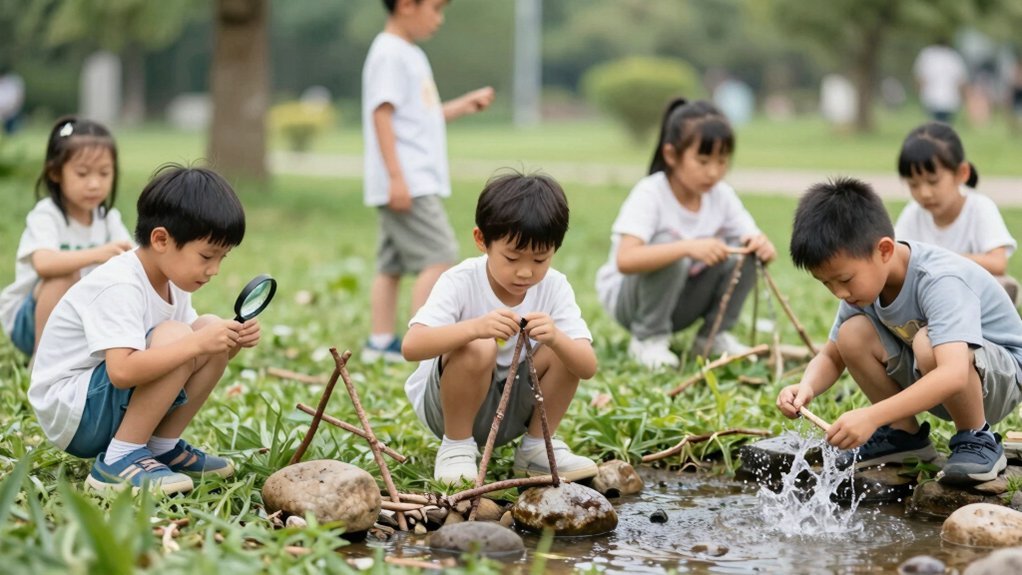
What exactly is curiosity‑driven child‑led play? You let the child pick activities, materials, and direction while you provide time, space, and a supportive environment. The child‑led approach gives them control, and the curiosity‑driven focus fuels planning, focus, impulse control, and flexible thinking. You offer open‑ended supplies and loose parts, inviting divergent thinking and deeper engagement that match their interests. By observing and giving responsive guidance, you tailor the learning space to each child’s curiosities, boosting language skills and social‑emotional growth.
Practical steps include scheduling “special time,” stepping back unless safety or limits demand intervention, and honoring the child’s requests. This balance of autonomy and subtle adult scaffolding strengthens executive function and nurtures self‑regulation. Incorporating natural wooden stacking stones into play can enhance fine motor skills, spatial reasoning, and problem-solving abilities in a hands-on, engaging way.
Why Children’s Natural Interests Fuel Child‑Led Play Learning
When you notice a child’s spark of curiosity, you’re tapping into their intrinsic motivation, which propels them to explore without prompting. That natural interest creates a personal learning pathway, letting them experiment, test ideas, and build knowledge at their own pace. Incorporating Montessori-inspired features in play environments further supports this exploration by encouraging independence and real-world imitation.
Intrinsic Motivation Fuels Exploration
Why does a child’s own curiosity spark deeper learning? You’ll notice that intrinsic motivation fuels every turn of Play. When a child chooses a block, a story, or a sound, they’re not just passing time—they’re building executive function, planning, focus, and impulse control. Open‑ended materials and a flexible space let them ask questions, test ideas, and follow personal interests without adult interruption. This self‑directed momentum sparks creativity, language growth, and social‑emotional health, laying a foundation for lifelong engagement.
- Provide varied, open‑ended resources
- Observe interests to guide subtle prompts
- Encourage planning and reflection during play
- Allow freedom to shift focus as curiosity evolves
- Celebrate effort, not just outcomes
Using 100% New Zealand wool felt materials in open-ended resources can enhance sensory experiences and support eco-friendly play.
Interest‑Driven Learning Pathways
A child’s natural curiosity fuels a learning pathway that feels effortless because the child is the one choosing the direction. When you watch a child dive into a pile of blocks, notice how the open‑ended materials sit at eye level, inviting them to experiment, stack, and narrate stories. Your role shifts to observing and offering just‑in‑time prompts that stretch their current fascination into new concepts—like counting, cause‑and‑effect, or emotional labeling.
This child‑led, curiosity‑driven play turns a simple interest into a cascade of learning, strengthening communication, critical thinking, and social confidence. By honoring the child’s intrinsic motivations, you create a seamless bridge from playful exploration to deeper cognitive, language, and socio‑emotional growth. Incorporating interactive play features such as magic bottles and feeding kits can enhance imaginative engagement and fine motor development during play.
Montessori‑Friendly Elements for Child‑Led Play
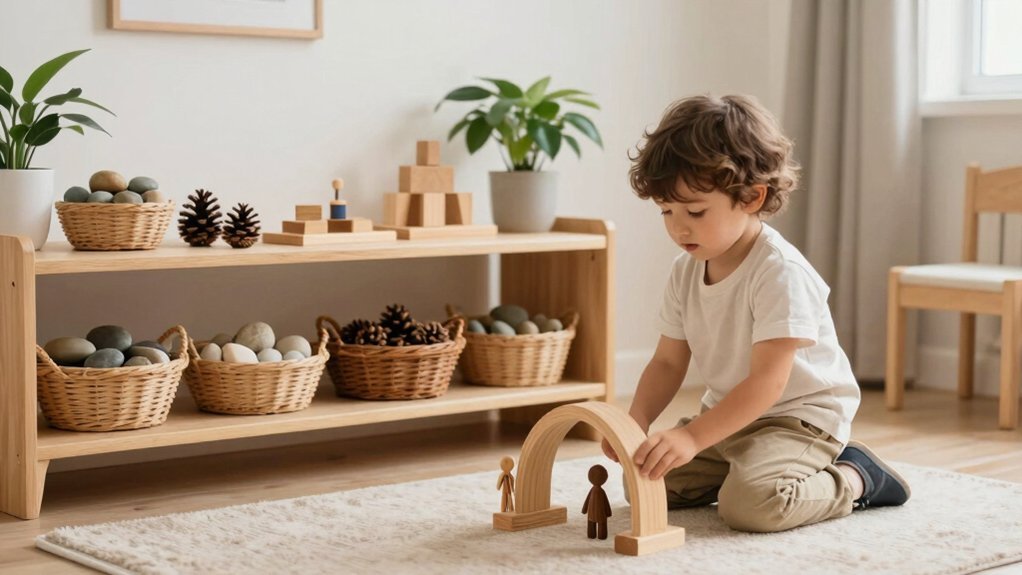
If you set up a prepared environment where materials sit at eye level and follow clear, consistent routines, you’ll instantly support a child’s autonomy and concentration. In a child‑led, curiosity‑driven play setting, the space itself becomes a silent teacher. You’ll notice the child gravitating toward natural objects—stones, shells, wooden blocks—and simple tools that invite multiple uses. You step back, observe, and only intervene when the child asks for help, keeping the flow intact. Structured “work” zones blend seamlessly with free‑play areas, allowing repeated engagement that deepens mastery. Your language cues—naming, describing, reflecting—reinforce learning without breaking the moment. Incorporating low step-in toy storage at child height can further encourage independent cleanup and accessibility.
- Low‑down, open‑ended materials at eye level
- Clear daily routines that signal safety and predictability
- Minimal adult direction; watch and respond only when invited
- Integrated work and play zones for fluid transitions
- Thoughtful language that labels actions and objects respectfully
How to Lay Out Open‑Ended Materials That Kids Want to Explore
When the room’s eye‑level shelves and low tables are stocked with open‑ended items—twigs, pinecones, corks, mason‑jar rings—you invite kids to pick, test, and combine them on their own.
To keep the set‑up attractive, group items by texture, size, or color, but leave space between clusters so children can pull pieces apart and re‑arrange them freely.
Group items by texture, size, or color, leaving space between clusters for free rearrangement.
Rotate the selection weekly, swapping in fresh natural or recycled objects to spark new ideas while preserving familiar favorites that support ongoing play themes.
Keep containers clear and accessible; a simple basket or tray lets kids dump out materials and see everything at a glance.
Follow Your Child’s Lead: A Step‑by‑Step Guide
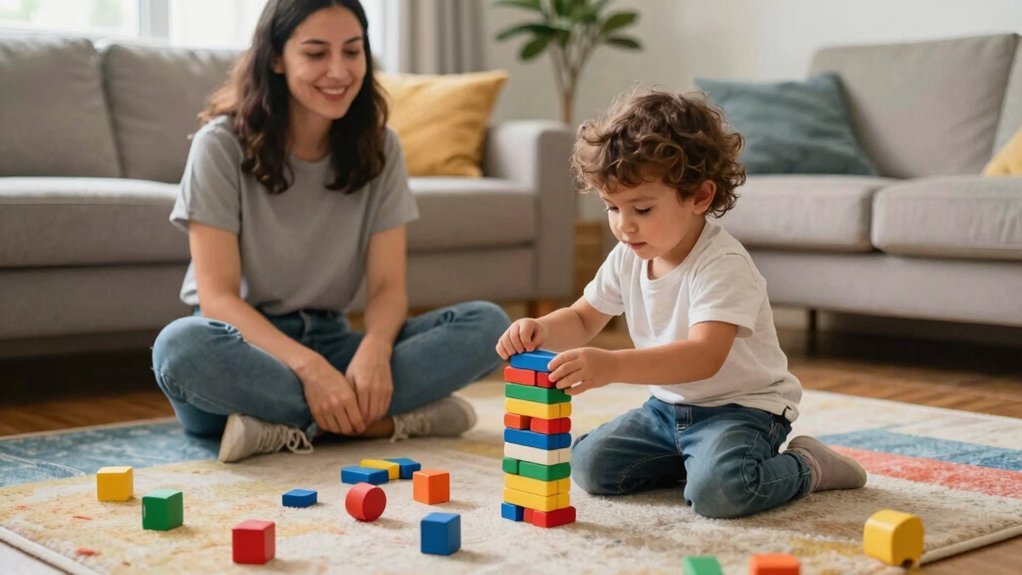
You’ll first set up an observation space where the child can freely choose materials and you simply watch. When they pick something, you can offer a gentle prompt that nudges them toward deeper exploration without taking over. This back‑and‑forth keeps the play child‑led while guiding them toward new ideas. Using Montessori-friendly tools like a step stool helper can further support independence and safe exploration during play.
Observation Space
Ever wondered how a simple, designated area can turn everyday play into a powerful learning lab? In an Observation space you set a safe corner, keep yourself nearby, and let Child‑Led Play unfold without directing it. First, watch what catches your child’s eye, then bring matching toys or supplies. Use a timer for a “special time” and give a gentle warning before it ends, helping them shift smoothly. Offer at least two sincere compliments every five minutes to reinforce social attempts. If frustration spikes, acknowledge the feeling, meet the need if you can, and tweak the environment to calm them.
- Define a clear, clutter‑free zone.
- Observe interests before adding materials.
- Use a timer with early alerts.
- Deliver two compliments per five‑minute stretch.
- Respond empathetically and adjust surroundings.
Creating a comfortable spot with features like padded benches with storage can enhance the engagement in your child’s play environment.
Prompted Exploration
How can you turn a child’s fleeting curiosity into a focused adventure without taking over the play? Start by noticing a spark—a question, a gesture, a material the child picks up. Then, gently prompt the exploration with an open‑ended question or a suggestion that expands the scene, like “What could happen if we add a leaf to that tower?” Keep the prompt brief, let the child decide the next step, and resist the urge to steer the outcome. Use the same language you’d employ in child‑led, curiosity‑driven play: supportive, curious, and non‑directive. When the child accepts, join in, mirror their language, and add another element only if invited. This way you nurture deeper focus while preserving the child’s agency.
Typical Child‑Led Play Disruptions and Gentle Fixes
Why do disruptions happen so often during child‑led play? You’re often juggling competing interests, noisy environments, or adult impulses to steer the activity. When a child’s focus is broken, the learning momentum stalls. Recognizing the pattern lets you intervene gently, preserving the child‑led spirit while smoothing the flow.
- Offer a calm, low‑stimulus space when distractions surge.
- Provide a clear, open‑ended material hub so the child can re‑engage independently.
- Model quiet curiosity by pausing your own commentary and listening.
- Set simple, consistent boundaries for noise or movement.
- Celebrate small successes to reinforce self‑regulation and confidence.
These fixes keep the play rhythm intact, nurture executive function, and let the child’s natural problem‑solving thrive.
Simple Observation Tools to Capture Learning in Play
When disruptions settle, the next step is to notice what the child actually learns during those play moments. You can use simple observation tools to capture evidence of cognitive, language, social, and emotional growth in child-led play. A checklist lets you tick when the child initiates ideas, asks questions, or problem‑solves. Anecdotal notes record new vocabulary, role‑taking, and material choices. Time‑sampling captures duration and sustained attention, while a brief rubric maps behaviors to milestones like executive function and self‑regulation. By documenting context—materials, play bout length, and interaction patterns—you build a clear picture of learning. Systematic observations then inform reflective planning, helping you adjust environments, prompts, and resources to deepen the child’s curiosity‑driven exploration.
Extending Child‑Led Play Into Everyday Life and Community Spaces
Ever wonder how a child’s spontaneous curiosity can spill beyond the classroom into the neighborhood and home? You can turn sidewalks, parks, and kitchen counters into extensions of Playful Learning by simply offering Open-ended Materials that invite tinkering, sorting, and storytelling. When you notice a budding interest—like collecting leaves or stacking crates—you respond with “yes,” add a related tool, and let the child steer the next step. This approach nurtures executive function, vocabulary, and empathy while keeping the environment responsive and low‑pressure.
- Place a basket of natural objects at eye level during a walk.
- Offer recycled boxes and fabric scraps for improvised structures.
- Invite peers to co‑create a “sound garden” with found objects.
- Turn a grocery aisle into a measurement adventure using loose items.
- Use chalk and rocks to map imagined journeys on sidewalks.
Frequently Asked Questions
What Is the Meaning of Child-Led Play?
You see child‑led play as the child choosing activities, materials, and rules, while you provide space and support, letting their curiosity drive learning, creativity, and confidence.
Why Is Montessori Against Pretend Play?
You think Montessori resists pretend play because it fears children will replace purposeful, concrete tasks with fantasy, weakening concentration, practical skills, and the hands‑on, sensory experiences Montessori prioritizes.
What Is an Example of a Child Led Activity?
You set up a cardboard box, give kids scarves, and let them decide to build a fort, a spaceship, or a secret hideout, guiding their own rules and storytelling as they explore.
What Is the Child Led Theory?
You’ll find the child‑led theory states that children drive their own learning through curiosity, choosing activities, materials, and goals, while adults simply set up supportive environments and respond without directing play.