When you set up predictable routines, visual schedules, and clearly labeled containers, you give learners a stable backdrop that cuts anxiety and lets them focus on mastering skills. Consistent expectations and visual cues turn abstract rules into concrete steps, while modeling, role‑play, and specific praise make social norms tangible. Peer modeling and ongoing coaching reinforce these habits, promoting independence and generalization. Keep exploring, and you’ll discover deeper strategies to boost growth.
Why Predictability Reduces Anxiety in Structured Learning Environments
How does predictability calm the mind? You notice that predictable routines give you a stable backdrop, so anxiety fades as you know what comes next. When each activity follows a set pattern, you can anticipate transitions instead of scrambling, which reduces confusion and the stress that fuels anxious thoughts. This calmness lets you focus on learning rather than on what might go wrong. Consistency builds a sense of security, allowing you to explore tasks with confidence. You also find that clear expectations—like labeled containers or picture cues—support your independence, reinforcing the feeling that you’re in control. In short, predictability and routines create a safe environment where anxiety drops and engagement rises. Incorporating elements with developmental coverage tailored to individual growth stages can further enhance this sense of security.
How Visual Schedules Set Clear Expectations in Structured Learning Environments
Predictability already eases anxiety, and visual schedules turn that calm into concrete expectations. You’ll notice that visual schedules map out each activity, so your learners know exactly what comes next. In structured environments, those pictures become a shared language, turning abstract rules into visible steps. When you embed them into daily routines, transitions sharpen, and kids can self‑regulate without constant prompts. The consistency builds confidence, letting children anticipate tasks and follow the sequence independently. You’ll also see fewer disruptions because the expectations are explicit, not inferred. Over time, the habit of checking the schedule transfers to other settings, reinforcing the same orderly patterns and supporting smoother, more engaged learning. Incorporating items like adjustable child-size aprons in activities helps maintain safety and comfort while promoting independence and responsibility during hands-on tasks.
Using Labeled Containers to Teach Independence in Structured Learning Environments
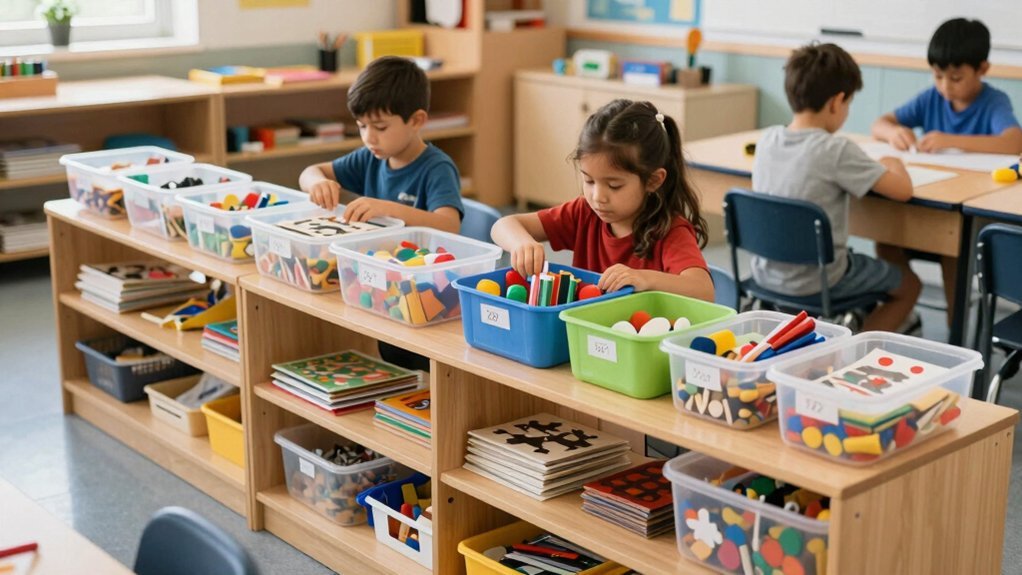
You’ll notice how visual cues on labeled containers let you quickly spot where anything belongs, so you can grab what you need without hesitation. When you check the labels yourself, you’re practicing self‑check organization and building confidence in managing your space. Over time, these habits transfer to other settings, giving you lasting independence skills. Montessori-inspired play kitchens often include built-in shelves and compartments, enhancing organizational skills through hands-on learning.
Visual Cues
Why do visual cues matter? In a structured environment they cut search time, guide you to the right container, and spark independence. Labeled bins paired with picture cues let nonreaders locate items instantly, while consistent labeling across shelves builds predictable routines that smooth transitions.
| Benefit | Example |
|---|---|
| Faster retrieval | Clear, durable labels differentiate similar supplies |
| Self‑regulation | Picture cues signal the correct bin for each task |
| Reduced errors | Demonstrations and guided practice reinforce proper use |
You’ll notice students grabbing the right tool without prompting, completing activities with confidence. By embedding visual cues into daily practice, you reinforce independence and keep the classroom orderly. Using labeled containers also supports organizing sensory materials for fine motor refinement effectively.
Self‑Check Organization
Visual cues set the stage; the next step is letting children verify their own work. You introduce labeled containers, then guide kids through a simple routine: locate the right bin, use the material, return it, and check the label before moving on. This self‑check loop builds independence because they see exactly where everything belongs and can confirm they’ve completed each step without adult prompts.
Consistent routines across classrooms and home settings reduce transitions and keep disruptions low. As you track which labels are most accessed, you gather data that shows progress and highlights where extra support is needed.
Over time, the clear visual system and repeated self‑monitoring turn routine actions into autonomous habits. Using color-coded sets for organization can enhance children’s engagement and ease of identifying materials.
Transferable Independence Skills
Ever wonder how a simple label can turn a chaotic classroom into a launchpad for lifelong independence? In structured environments you place labeled containers at each child’s reach, so they can locate crayons, books, or supplies without asking. The clear tags reinforce routines: when the morning circle ends, you signal “grab your math kit” and the child pulls the right bin, initiating the task autonomously. Visual cues paired with explicit instruction reduce transition time, letting the child move smoothly from one activity to the next. Independent access builds responsibility and cuts disruptions, while positive reinforcement speeds the transfer of independence skills to home. By embedding these containers into daily routines, you create a repeatable system that nurtures self‑help abilities across settings. Incorporating open-access shelves in these environments further supports children’s autonomy by allowing them to easily identify and select materials on their own.
Modeling and Role‑Play to Instill Social Norms in Structured Learning Environments
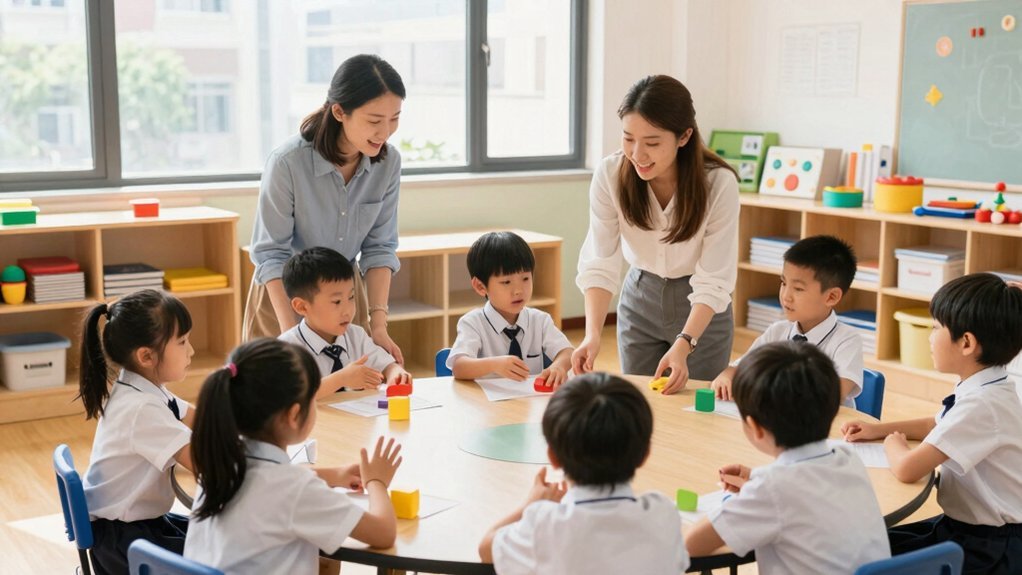
How can you help kids internalize classroom norms without endless lectures? In structured learning environments you can use modeling and role‑play to make social norms tangible. First, demonstrate the desired behavior yourself, then invite students to rehearse it in a low‑stakes scenario. The practice builds confidence, reduces anxiety, and creates a mental script they retrieve when real interactions arise. Track progress with brief notes, adjust the script as needed, and embed these drills into daily routines so the skill transfers across settings.
- Demonstrate a specific norm, then pause for student imitation.
- Guide a short role‑play, offering immediate, targeted feedback.
- Record observations, refine the model, and repeat regularly.
Using step stools with safety features in classroom setups can further support independent practice by providing safe physical access during role-play activities.
Specific Praise: Positive Reinforcement That Shapes Desired Behaviors
After students have practiced norms through modeling and role‑play, the next step is to reinforce those behaviors with specific praise. In structured environments you’ll see that positive reinforcement works best when you name the exact action—“I love how you waited your turn and shared the markers.” This concrete feedback creates a clear link between the behavior and a rewarding outcome, boosting motivation and engagement. Pair your specific praise with visible supports like a progress chart or a visual cue; the child can see growth and will likely repeat the prosocial conduct. Consistently applying this approach during routines reduces anxiety, clarifies expectations, and cultivates a classroom culture where desired behaviors flourish.
Consistent Routines: Making Transitions Smooth in Structured Learning Environments
When you establish consistent routines, you give children a predictable framework that eases anxiety and smooths every transition. Structured routines let them know what comes next, so they can shift focus without panic. You’ll notice fewer tantrums and more steady engagement when you pair visual supports—like picture schedules or labeled containers—with clear expectations. Modeling the steps and practicing them together builds self‑regulation, turning each transition into a smooth, almost automatic move.
- Use timers and visual cues to signal upcoming changes.
- Teach behavioral expectations through guided practice.
- Provide labeled containers and picture schedules for predictability.
Designing Sensory‑Friendly Zones for Neurodiverse Learners
You’ll notice that calming lighting and muted colors instantly lower excitement levels, while adjustable seating and varied textures let you choose comfort on the fly.
Quiet corners equipped with noise‑canceling headphones and sensory tools give you a safe retreat when overload spikes.
Calming Lighting And Colors
Ever wondered how a room’s lighting and hue can calm a neurodiverse learner’s nervous system? You’ll see that calming lighting and muted color palettes lower visual arousal, making transitions smoother and work periods less stressful. When you choose soft blues, gentle greens, or earth tones, you create a sensory‑friendly backdrop that supports regulation and focus. Consistent placement of fixtures and predictable light levels reinforce predictability, helping students feel secure and independent.
- Soft, diffused lighting eliminates glare and reduces overstimulation.
- Muted blues, greens, and earth tones calm the nervous system and lower anxiety.
- Adjustable dimmers let you fine‑tune illumination for individual attention needs.
Adjustable Seating And Textures
Soft, diffused lighting already eases visual strain; now consider how the seat you choose can further calm the nervous system. In structured environments you can match adjustable seating to each learner’s posture, reducing sensory overload and sharpening focus. Textured surfaces—fabric, mesh, foam—offer tactile feedback that supports self‑regulation. By labeling and placing these options consistently, you give neurodiverse students a predictable routine for choosing a spot that meets their sensory needs.
| Seating Type | Primary Sensory Benefit |
|---|---|
| Height‑adjustable chair | Posture support |
| Beanbag or scoop seat | Low‑arousal comfort |
| Cushioned stool | Tactile input |
| Mesh chair | Breathable texture |
| Foam pillow | Soft pressure |
Quickly reconfiguring these pieces creates calm zones without disrupting the classroom flow.
Quiet Corners And Sensory Tools
How can a quiet corner become a sanctuary for a neurodiverse learner? You’ll notice soft lighting, dimmable lamps, and calming décor that lower sensory overload.
By placing weighted blankets, noise‑canceling headphones, and tactile toys nearby, you give students the sensory tools they need for self‑regulation.
Color‑coded signs and visual cues tell them when the space is available and what behavior is expected, while sound‑absorbing panels and minimal décor keep distractions at bay.
Pair the corner with explicit routines so they know how to transition in and out.
- Soft lighting and dimmable lamps
- Weighted blankets, headphones, fidget toys
- Color‑coded labels and visual supports
Physical Layout Tips for Safe, Easy Movement and Focus
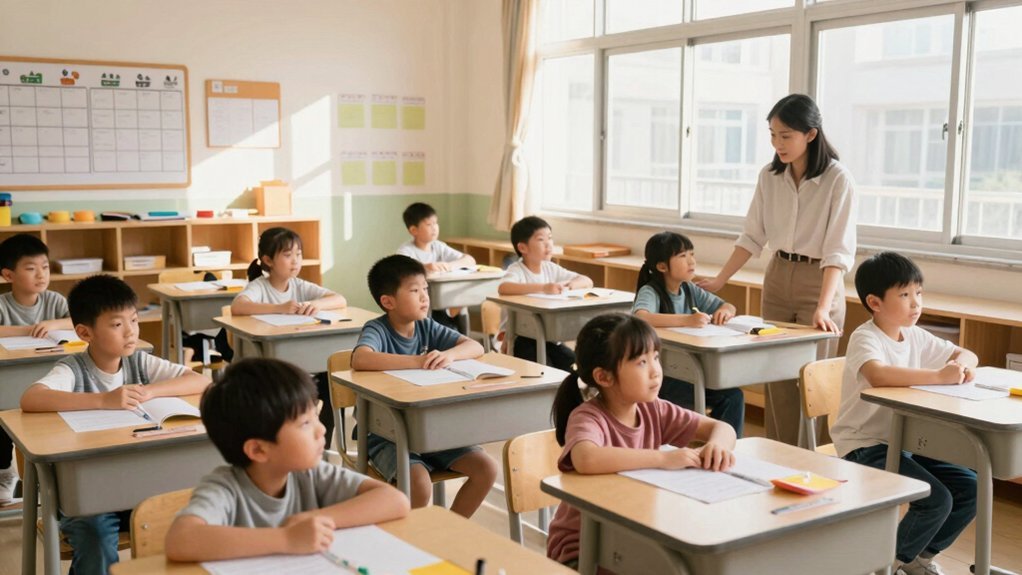
What if you could arrange your classroom so every student sees the teacher clearly and reaches needed supplies without wandering? In structured environments, a thoughtful physical layout supports daily routines and reduces chaos. Place desks in rows or clusters that keep sightlines open, and keep high‑use resources—pencils, erasers, paper—within arm’s reach. Label bins and use color‑coded containers so students locate items instantly, reinforcing routine. Designate clear pathways for movement, avoiding furniture that blocks essential routes and minimizing congestion. Set up distinct activity zones: a work area, a calm sensory corner, and a collaborative space, each with visual cues. This layout lets you transition smoothly, keeps students safe, and maximizes focus on learning.
Data‑Driven Monitoring to Guide Targeted Interventions in Structured Learning Environments
You’ll see how real‑time progress tracking lets you spot patterns instantly, so you can tweak interventions before they stall.
By using those data points, you make targeted adjustments that address each learner’s needs.
This keeps the environment responsive and guarantees every strategy is backed by evidence.
Real‑Time Progress Tracking
Ever wondered why real‑time progress tracking feels like a game‑changer in structured learning environments? You see instant feedback, you adjust on the fly, and you keep kids moving toward goals without delay. By embedding progress monitoring into daily routines, you turn raw observations into actionable data, and you practice data‑driven decisions that align school and home.
- Tally sheets and checklists capture behavioral and academic milestones instantly.
- Dashboards highlight trends, so you spot when a child needs reinforcement or a curriculum tweak.
- Immediate alerts keep teachers, therapists, and families accountable, preserving fidelity of implementation.
When you treat each data point as a cue for action, you create a dynamic loop that fuels growth, sustains motivation, and ensures every intervention is precisely timed.
Targeted Data‑Driven Adjustments
How can you turn the flood of daily observations into precise, actionable tweaks that keep every child on track? You collect tally sheets, checklists, and behavior logs every day, then feed that data into a simple progress monitoring system. When the numbers show a dip in engagement or a skill isn’t transferring, you pinpoint the exact routine or visual cue that needs reinforcement. Those data‑driven insights let you adjust curricula, modify prompts, or add a scaffold in real time, keeping interventions aligned with each child’s goals.
Integrated streams from classroom, home, and community settings reveal patterns, so you can fine‑tune support before setbacks become entrenched. The result is a responsive, evidence‑based environment where every tweak moves learning forward.
Collaborative Planning: Aligning Home and School Strategies for Structured Learning Environments
- Co‑create daily schedules that mirror classroom blocks, using the same icons and language at home.
- Share progress data weekly, adjusting interventions together to keep supports aligned.
- Establish joint training sessions so every adult models the same behavior strategies and reinforcement cues.
These steps weave a seamless support network, turning every environment into a structured learning hub.
Task Analysis: Breaking Complex Skills Into Manageable Steps
Why break a skill into tiny, doable pieces? You use task analysis to split a complex activity into clear, sequential actions. Each step becomes a checkpoint in a structured routine, letting you focus on one component before moving on. By listing discrete actions, you reduce cognitive load and make expectations explicit, so you know exactly what to do next. Guided practice then targets each step, letting you master it before combining the whole task. This approach builds independence: you follow simple cues and checklists, track progress, and adjust instruction based on data. Over time, you’ll complete the full skill confidently, having internalized each manageable piece.
Peer Modeling to Boost Social Skill Generalization
Task analysis gives you a clear sequence of steps; the next step is to let children see those steps in action. Peer modeling lets them watch classmates request help politely, share materials, and solve problems together, turning abstract social skills into concrete examples. When you embed these moments in routine activities, children notice the behavior, imitate it, and start using it across settings, boosting generalization. Consistent peer interactions, reinforced by explicit instruction and positive reinforcement, reduce anxiety and increase engagement, making prosocial habits stick.
- Choose diverse peer models who demonstrate courteous communication.
- Pair learners during structured tasks that require collaboration.
- Provide immediate, specific praise when the observed behavior is replicated.
These practices embed peer modeling, social skills, and generalization into everyday classroom life.
Ongoing Coaching: Sustaining Skill Retention Over Time
Through ongoing coaching, you keep the skills children learned in structured environments fresh and transferable.
In structured learning environments, you collect tallies, checklists, and progress notes, using that data to spot gaps and tweak interventions before they become entrenched.
Ongoing coaching ensures you model explicit instruction, guide practice, and reinforce behavioral norms, so children internalize techniques rather than just mimic them.
Ongoing coaching models explicit instruction, guides practice, and reinforces norms, ensuring children truly internalize techniques.
When you review data regularly, you tailor support to each child’s evolving needs, preserving skill retention across home, school, and community settings.
This continuous professional support lets you adjust strategies quickly, maintaining evidence‑based fidelity and preventing decay.
As a result, the skills stay robust, generalizable, and ready for new challenges.
Frequently Asked Questions
What Are Structured Environments?
You’re in a structured environment when routines, visual cues, and clear expectations are organized consistently, giving you predictable support that eases transitionS, promotes independence, and lets you focus on learning and growth.
What Are the 4 Environmental Factors That Influence Development?
You’re influenced by four environmental factors: physical space, sensory conditions, social interactions, and instructional structure. Each shapes your learning, behavior, and emotional regulation, guiding how you develop skills and confidence.
Why Is a Structured Learning Environment Important?
You thrive in a structured learning environment because it cuts anxiety, clarifies expectations, boosts independence, and lets you focus on mastering skills instead of guessing what comes next.
What Are the 5 Components of Structured Teaching?
You’ll find five components: visual schedules, clear work areas, individualized task lists, consistent routines, and frequent data monitoring to adjust instruction and support each learner’s progress.