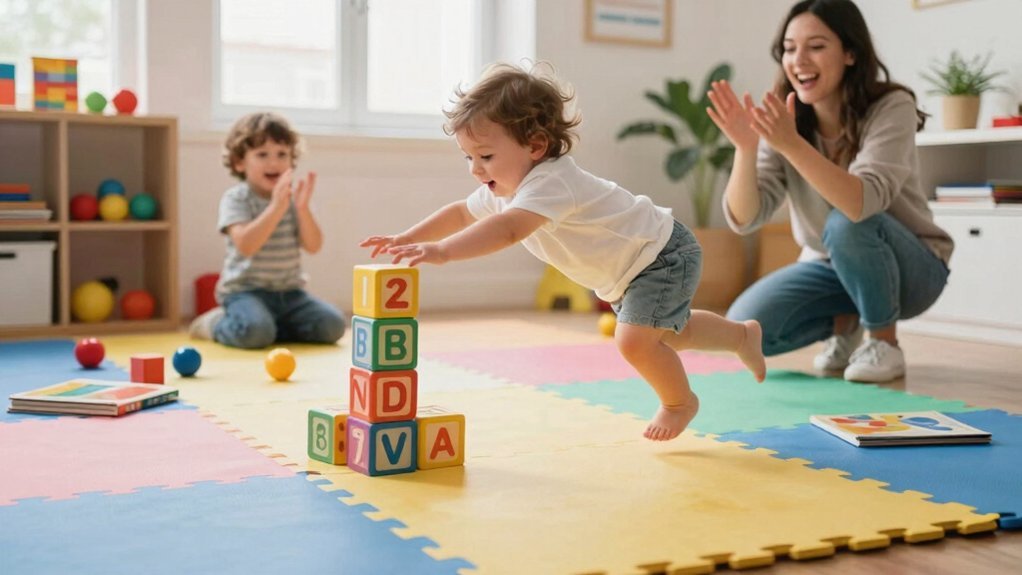
When you get your toddler moving—crawling, walking, dancing—they’re wiring the brain regions that control speech. Each new posture sends bursts of sensory feedback, sharpening attention and turn‑taking. Caregivers label the objects and actions, turning movement into social naming cues that reinforce vocabulary. Physical activity also strengthens jaw muscles for clearer articulation and boosts arousal, so more verbal exchanges happen. Keep an eye on milestones, and you’ll discover even more ways to turn play into language growth.
How Movement Sparks Early Speech Development

When babies start to roll, crawl, and eventually stand, their babbling syncs with those new motor milestones, showing that movement primes the brain for speech. You notice that each new posture triggers a burst of vowel sounds, because the shifting balance stimulates vestibular processing and heightens body awareness. Those sensations sharpen attention and make it easier to take turns in vocal play. As you explore, you engage jaw, mouth, and core muscles, gaining breath control that translates into clearer syllables. Caregivers label the objects you reach for, turning movement into a social cue for naming. The result is a tighter feedback loop: movement fuels muscle coordination, neural focus, and linguistic interaction, accelerating early speech development. Using learning tools like a wooden abacus with tactile beads can further support fine motor skills alongside language acquisition.
How Crawling and Walking Expand Toddler Vocabulary
As babies master crawling and then walking, the world opens up and every step brings new objects, sounds, and people to name. You’ll notice that each forward thrust creates fresh labeling chances; a toy on the floor becomes “ball,” a hallway becomes “corridor,” and a caregiver’s smile turns into “happy.” Gestures you make while cruising act as early words, prompting adults to echo and expand your utterances, which fuels language development. Moving also strengthens the jaw and mouth muscles, so you can articulate newer sounds more clearly. When you explore, adults naturally narrate actions—“You’re crawling to the couch,” “You’re stepping over the rug”—embedding vocabulary in context. Those back‑and‑forth exchanges turn every wobble into a learning moment, rapidly expanding your toddler vocabulary.
How Physical Activity Boosts Toddler Language Areas

Why does a simple game of tag make your toddler’s words sharper? When you encourage movement, you’re firing brain regions that handle speech and language. Physical activity boosts neural activity in those areas, sharpening vocabulary and sentence formation. As your child crawls, walks, or runs, jaw and mouth muscles strengthen, giving better breath control for clearer speech. Movement also spikes attention and arousal, creating more moments for verbal interaction during play. Vestibular and auditory input from active tasks improve sound localization, helping your toddler understand and produce language. Adding rhythmic movement while you talk reinforces impulse control and builds stronger communication pathways. So, a quick sprint or a playful chase isn’t just fun—it’s a powerful language‑building workout. Incorporating Montessori-inspired features in play environments further supports cognitive and language development by encouraging real-world imitation and independent exploration.
Fun Everyday Play Ideas That Turn Movement Into Language
A quick game of tag or a simple song can become a language‑building workshop when you weave words into movement. You can turn tummy time into a labeling session: “reach for the red ball,” you narrate, strengthening muscles and Language. Play peek‑a‑boo, hide‑and‑seek, or follow‑the‑leader, each cue paired with a verb—jump, clap, spin—so the child repeats the word while moving. Keep narration steady, describing what you see and feel in real time, turning everyday actions into a rich Language experience. Incorporating sensory texture matching activities further enriches tactile learning alongside language development.
| Activity | Language Focus |
|---|---|
| Tummy‑time reach | Object names & action verbs |
| Peek‑a‑boo / hide‑and‑seek | Spatial concepts & emotions |
| Follow‑the‑leader | Imperatives & body‑part vocabulary |
How Action Songs and Rhythmic Play Enhance Word Learning

You’ll notice that the rhythmic repetition in action songs makes new words stick, while the accompanying gestures give you a concrete cue for each meaning.
When you sing “Head, Shoulders, Knees, and Toes,” the beat helps you anticipate the next label, and the matching movement reinforces its definition.
This combo of rhythm and motion boosts attention and memory, turning simple vocabulary into an active experience.
Incorporating elements like mirror reflection can further support developmental milestones by enhancing self-recognition alongside language skills.
Rhythmic Repetition Reinforces Vocabulary
Ever notice how a catchy action song makes new words stick? When you sing a tune with a steady beat, the rhythm becomes a scaffold that your toddler can latch onto. Each repetition lets the brain lock in syllable patterns, while the accompanying Movement keeps attention high and the body engaged. The result is a stronger, faster vocabulary boost.
- A clap‑along chorus that repeats “jump, jump, jump” while you actually jump.
- A stomping beat that says “big, big, big” as you stomp, making size concepts concrete.
- A finger‑pointing verse that chants “red, red, red” while you point to a red ball.
- A swaying melody that repeats “soft, soft, soft” as you gently sway, embedding texture words.
Incorporating hands-on activities with Montessori Blue Triangles can further enhance language development by connecting movement with spatial and vocabulary skills.
Gestural Cues Support Word Meaning
Why do gestures make new words click for toddlers? When you pair an action song with a simple motion—like clapping for “clap” or pointing to a nose for “nose”—gestural cues give children a visible referent they can imitate. This multisensory link ties the auditory label to a motor plan, easing cognitive load and sharpening word retrieval.
As toddlers repeat the movement while singing, they reinforce the verb or noun in memory, making it stick longer. The rhythmic beat keeps their attention, while the coordinated motion supplies a concrete example that bridges sound and meaning. Over time, repeated gestures in song contexts boost durable vocabulary, turning new words into everyday talk. Using engaging tools like the Comfy Cubs Kids Step Stool Montessori Tower can encourage toddlers to physically explore their environment, further linking movement with language learning.
Why Vestibular Development Matters for Toddler Speech
How does the vestibular system shape a toddler’s speech? It cues balance, head position, and spatial orientation, giving your child a stable body map that translates into clearer articulation. When the vestibular system matures, arousal and focus sharpen, letting them hear sounds more accurately and follow directions with ease. Strong vestibular‑auditory links boost sound localization, so they can differentiate words and recognize speech patterns faster. Balance‑challenging play—like standing on one leg or climbing—simultaneously hones attention and receptive language, laying a neural foundation for expressive growth.
Vestibular development steadies the body, sharpens focus, and boosts sound localization for clearer, faster toddler speech.
- A toddler wobbling on a low beam, eyes fixed on a toy.
- A child spinning slowly, then pausing to repeat a new word.
- A youngster balancing on one foot while pointing to a picture.
- A little one climbing stairs, then naming each step aloud.
Providing toddler-friendly environments with low step-in toy storage helps encourage safe climbing and balanced play.
Simple Narration During Play Strengthens Listening & Speaking
What happens when you narrate a child’s play in real time? You weave words into the movement, so the toddler hears “you’re stacking blocks” while his hands lift each piece. That live commentary links language to action, strengthening listening comprehension and expressive speech. When you say “now we’re jumping,” the child matches the verb to the physical motion, reinforcing memory of the word. Movement‑rich play invites back‑and‑forth dialogue: you ask “Where’s the ball?” and the child points or answers, practicing receptive and expressive skills together. Labeling actions, objects, and spatial terms—“up,” “down,” “into,” “out”—as they happen builds vocabulary. Multi‑step narration like “First we roll the ball, then we clap” teaches sequencing, turning ordinary play into a powerful language‑learning engine.
When to Seek Professional Help for Motor‑Language Delays
Even if you’ve been narrating play and seeing language growth, there are clear signs that a child’s motor and language development may be falling behind and need professional evaluation. Watch for a motor‑language delay when gestures are scarce by 12 months, when consonant sounds barely emerge after 9–10 months, or when frequent falls limit play. A pediatrician can assess whether speech and occupational therapy are needed, while therapists may suggest indoor movement tools like wooden rockers or safe climbing structures while you wait for a formal assessment.
- A toddler who can’t wave, point, or clap by the first birthday
- Sparse babbling with only vowel sounds after ten months
- Repeated trips, inability to crawl up stairs, or avoidance of playground equipment
- Parents noticing that movement frustrations seem to stall new words
Parent Tips for Turning Daily Movement Into Language Practice
Ever wonder how a simple stretch or a quick crawl can become a mini‑lesson in words? Turn everyday movement into language practice by narrating each action. When your child reaches for a toy, say “You’re reaching for the red ball.” Use gestures—point, wave, clap—to reinforce new verbs. Build routines like tummy time or a tiny obstacle course, labeling each step: “crawl forward,” “climb up.” Cross‑midline moves such as side steps invite prompts like “step left, step right.” Comment on outcomes—“the ball rolled far.” This ties Gross Motor Skills to words, boosting vocabulary and sentence building.
| Movement | Language Prompt |
|---|---|
| Reaching | “You’re grabbing the cup.” |
| Crawling | “Crawl to the pillow.” |
| Climbing | “You climbed up the stairs.” |
| Side steps | “Step left, step right.” |
Frequently Asked Questions
Does a Toddler’s Temperament Affect Language Gains From Movement?
Yes, a toddler’s temperament shapes how movement boosts language. If they’re curious and energetic, they’ll explore more, linking actions to words. If they’re shy or cautious, they may need gentler, guided movement to reap the same gains.
How Does Screen Time Interact With Physical Play for Language Development?
You’ll find that when screen time is limited and balanced with active play, toddlers practice words while moving, which boosts vocabulary and comprehension far more than passive watching alone.
Can Bilingual Households Benefit More From Movement‑Based Language Activities?
You’ll likely see greater gains, because movement adds contextual cues that reinforce both languages, and the physical engagement helps toddlers switch and retain vocabulary more fluidly across the household’s bilingual environment.
What Role Does Nutrition Play in Supporting Motor‑Language Milestones?
You boost toddlers’ motor‑language milestones by giving them balanced meals rich in omega‑3s, iron, and protein; these nutrients fuel brain development, muscle coordination, and speech‑processing pathways, accelerating learning.
Are There Gender Differences in How Movement Influences Early Speech?
You’ll find that boys and girls generally respond similarly to movement‑driven speech boosts, though some studies note slightly earlier vocal experimentation in girls, while boys may need more tactile play to spark comparable language gains.