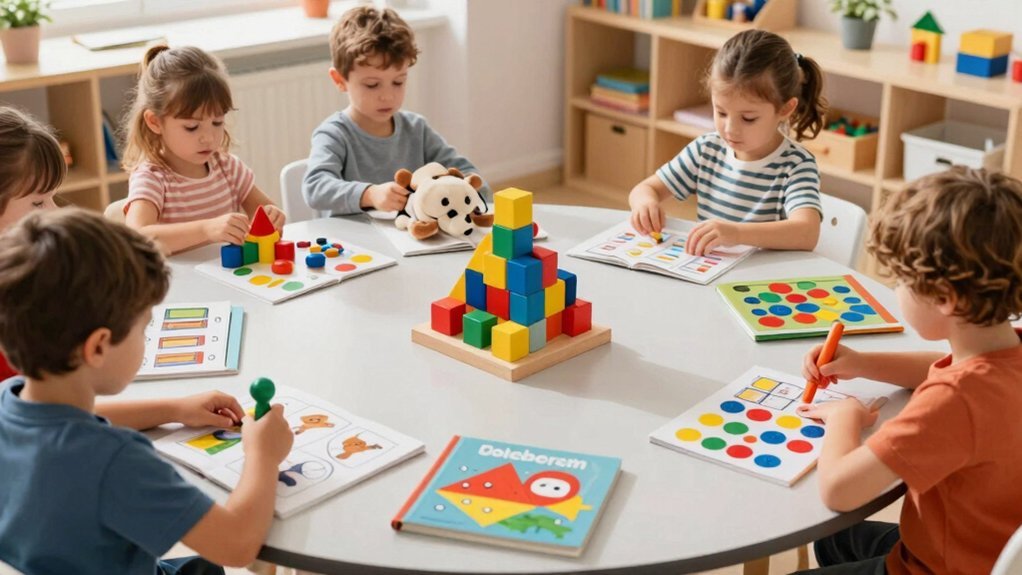
You’ll boost development and keep play safe by matching each child’s age and stage to the right educational toys and materials. For newborns (0‑6 months), choose high‑contrast, soft silicone toys that encourage sensory and oral‑motor exploration. Infants (7‑12 months) benefit from cause‑and‑effect items like textured blocks and simple puzzles. One‑year‑olds thrive with language‑rich books, chunky crayons, and pretend‑play props, while two‑year‑olds need fine‑motor challenges such as large shape sorters and knob puzzles. Preschoolers (3‑6 years) enjoy logic puzzles, snap‑together blocks, and early math games; rotating these age‑appropriate sets keeps them engaged and ready for the next milestone.
Why Age‑Specific Toys Matter for Development

Why do age‑specific toys matter? You’ll notice that when you match a child’s playthings to their development stages, the child engages more deeply and learns faster. Age‑appropriate materials hit the sweet spot between challenge and success, so frustration fades and confidence builds. By choosing toys that fit a child’s current abilities, you nurture fine‑motor skills, problem‑solving, language, and imagination all at once. Research shows that pretend play and guided exploration drive social cognition and early reasoning, but only when the toys are neither too hard nor too easy. Regularly reassessing the child’s pace lets you keep the play experience both enjoyable and educational, turning each session into a growth opportunity. For younger children, tools like the Kitchen Step Stool for Kids with Safety Rail offer four-sided safety railings that help reduce fall risk while promoting independence.
Toys for Newborns (0‑6 Months): Sensory & Oral‑Motor Basics
Matching toys to a child’s developmental stage suddenly the play experience more effective, and for newborns that means focusing on sensory and oral‑motor basics. You’ll notice that high‑contrast toys grab attention, while soft rattles and textured rings invite mouthing, fostering sensory development and oral‑motor skills. Offer a mirror for self‑recognition, a vinyl book for visual tracking, and a gentle teether for early grasping. Rotate items often to keep stimuli fresh and support attention spans. Choosing toys with non-toxic materials ensures safety and durability as your child grows.
| Toy Type | Primary Benefit | Example |
|---|---|---|
| High‑contrast visual | Visual sensory development | Black‑and‑white cards |
| Textured rattle | Tactile & oral‑motor | Soft plastic rattle |
| Soft ring | Grasp & oral‑motor | Large silicone ring |
| Unbreakable mirror | Self‑recognition | Flat safety mirror |
Safety First: Non‑Toxic Toy Materials by Age

You’ll want to match each age group with safe, non‑toxic materials—soft silicone for infants, sturdy wood or BPA‑free plastic for toddlers, and durable, lead‑free painted metal for older kids.
Make sure every finish is free of harmful chemicals, and look for UL‑approved electrical components when toys have lights or sounds.
Regularly inspect and clean the toys to keep them free of wear, sharp edges, and germs.
For kitchen-themed educational toys, consider sets with blunt tips and serrated edges to ensure safe cutting practice for children.
Safe Materials by Age
Ever wonder how to keep your child’s playtime both fun and safe? You’ll want to match toys to developmental stages, using non‑toxic materials that are age‑appropriate and free of choking hazards. Check paint labels for lead‑free formulas and inspect for wear. Choose shatter‑proof, easy‑clean surfaces, and rely on UL‑approved electric items.
- Infants (0‑12 mo) – Large, solid blocks; no detachable pieces; soft‑touch, BPA‑free silicone.
- Toddlers (1‑3 yr) – Bigger interlocking parts; durable wood or plastic; non‑toxic paint; avoid tiny beads.
- Preschoolers (3‑5 yr) – Introduce smaller, textured pieces; still non‑toxic; ensure smooth edges; keep an eye on recall lists. Many Montessori sets for this age focus on fine motor skill development through color sorting and matching exercises.
Non‑Toxic Finishes Only
Choosing toys with non‑toxic finishes is the single most important safety step for every age group. You’ll want to verify that each item carries a lead‑free label and that its paint or coating meets safety certifications like UL or ASTM. For infants and toddlers, prioritize products that are explicitly marked non‑toxic, free of phthalates and BPA, because they mouth and chew everything they touch. Check that the finish is durable and easy to clean; worn or peeled areas can expose hazardous chemicals.
When you buy educational materials, look for clear statements that the coating is non‑toxic and lead‑free, and confirm the manufacturer provides safety certifications confirming compliance.
Regularly inspect toys for scratches or chipping, and replace any that show signs of wear to keep your child’s environment safe.
Additionally, consider products with spill-prevention technology such as silicone valves or suction bases to enhance safety during active play.
Toys for Older Infants (7‑12 Months): Cause‑and‑Effect & Early Problem‑Solving
How can you turn a simple push‑and‑pull toy into a mini‑lab for cause‑and‑effect learning? You’ll see your baby’s eyes light up when a gentle tug triggers a chime or a rolling ball pops out of a tunnel. By pairing action with immediate feedback, you nurture early problem‑solving and strengthen the link between movement and outcome. Keep sessions short, repeat the motion, and label each result to embed language naturally.
- Choose toys that make noise or flash when pressed, rolled, or pulled.
- Offer large, easy‑grasp items alongside shape sorters or knob puzzles for progressive difficulty.
- Encourage standing or cruising with low push‑and‑pull toys, adding soft obstacles to spark exploration.
Selecting storage with water-resistant surfaces ensures easy cleaning after playful learning sessions.
Toys for 1‑Year‑Olds: Language‑Boosting & Creative Tools

You’ll find language‑rich board books spark word‑object connections while bright pictures hold your child’s attention.
Open‑ended art supplies like chunky crayons let them explore color and grip, laying groundwork for early writing.
Pretend‑play props—toy phones, dolls, and dress‑up pieces—invite imaginative dialogue and expand vocabulary through role‑taking.
Language‑Rich Board Books
A well‑designed board book for a one‑year‑old pairs simple, real‑object photographs with bold, clear illustrations, making it easy for your toddler to link words to what they see. You’ll notice that the sturdy, wipe‑clean pages survive enthusiastic flipping, while the repetitive text and labeled pictures invite you to model language. When you use talk‑aloud strategies—naming objects, labeling actions, describing scenes—you turn a quiet read into an interactive lesson that fuels language development. Choose titles that include nursery rhymes or short songs, then pause to chant together, reinforcing rhythm and vocabulary.
- Durable, rounded‑corner pages for safe handling
- Real‑object photos combined with vivid illustrations
- Built‑in prompts for talk‑aloud strategies during reading
Integrating early learning tools that emphasize hands-on exploration can further enhance a toddler’s sensory and cognitive skills development.
Open‑Ended Art Supplies
After turning pages of picture‑rich board books, you can keep the momentum going with open‑ended art supplies that let a one‑year‑old explore texture, color, and movement. Choose large, non‑toxic crayons, chunky markers, and oversized paper so tiny hands can grip, scribble, and experiment with early mark‑making. While they swipe bright hues, name the colors, describe the strokes, and point out the paper’s feel to weave language into sensory exploration. Offer two simple activities: a “color‑track” where you guide the crayon along a taped line, and a “texture collage” using soft fabric squares glued onto paper. Both keep attention,; supervise closely, and use only certified, washable materials that pose no choking hazards. This approach fuels creativity while boosting vocabulary.
Pretend Play Role Props
Pretend‑play props such as chunky toy phones, soft‑body dolls with accessories, and oversized dress‑up items give one‑year‑olds tangible cues for naming, describing actions, and building simple narratives.
When you hand them a plush stroller or a plastic animal, you spark language development by prompting you to label colors, sounds, and movements.
Safe, large‑scale role props let them manipulate objects without choking hazards, while varied textures keep attention high.
Model simple dialogues—“Where’s the baby going?”—to encourage back‑and‑forth exchange and turn‑taking.
Rotating toys keeps play fresh and expands vocabulary across contexts.
- Chunky toy phone for “calling” and “talking.”
- Soft‑body doll with bottle and blanket for caregiving scenes.
- Oversized dress‑up cape for imaginative role‑switching.
Transitioning From 1‑Year‑Old to 2‑Year‑Old Toys
What changes when your child moves from one to two years old? You’ll notice a shift from simple grasp‑and‑shake toys to items that demand more coordination. Keep the familiar toys that spark pretend play—baby dolls, puppets, and realistic vehicles—but choose versions with larger parts they can manipulate. Introduce blocks and shape sorters about2–4 inches) to strengthen fine motor skills and problem‑solving. Add push‑and‑pull toys and big balls for cruising and early walking confidence. Offer chunky crayons, wide markers, and two large sheets of paper so your toddler can experiment with drawing while refining grip. Pair picture books with vivid photos and sing simple rhymes together to weave language growth into every play session.
Toys for 2‑Year‑Olds: Fine‑Motor Challenges & Independent Play
You’ll notice that simple knob puzzles, snap‑together blocks, and shape sorters instantly boost fine‑motor skill building while keeping the play area tidy.
By placing large crayons, markers, and plenty of paper within reach, you empower your child to explore drawing and writing independently.
Adding age‑appropriate dolls, puppets, and rhythm instruments gives them the tools they need for self‑directed, coordinated finger movements.
Fine‑Motor Skill Builders
Ever wonder how a simple block can turn a 2‑year‑old’s tiny hands into problem‑solving machines? You’ll find that fine‑motor growth thrives on varied manipulatives that demand different grips and motions. Offer chunky blocks, giant knob puzzles, and textured shape sorters so the child practices grasping, turning, and placing. Mix easy crayons and markers with these toys to blend scribbling and construction, reinforcing grip development while keeping the experience playful. Keep everything within easy reach, so spontaneous practice feels natural and the child can explore independently or with brief guidance.
- Large non‑toxic crayons for scribbling
- Chunky blocks and shape sorters for grasping
- Giant knob puzzles for turning and placement
Independent Play Essentials
When it comes to independent play for two‑year‑olds, the right toys turn simple curiosity into purposeful fine‑motor practice. Offer block sets, large peg puzzles, and shape sorters with four to twelve pieces so they can grasp, fit, and stack while building confidence. Add pretend items—child‑sized furniture, dolls with accessories, puppets, sand and water toys—to spark imagination and refine hand‑eye coordination. Provide washable crayons, thick markers, and big paper for open‑ended drawing that encourages early writing.
Choose picture books with richer details and longer sentences, then pair them with music and movement activities that reinforce language during solo sessions. Keep everything non‑toxic, blunt‑tipped, and stored within easy reach, ensuring age‑appropriate materials support the development stage and foster self‑directed independent play.
Toys for Preschoolers (3‑6 Years): Logic, Imagination & Early Math
What sparks a preschooler’s curiosity? You’ll see their eyes light up when a puzzle with 12‑20+ pieces snaps into place, or when blocks snap together to form a tower that defies gravity. These toys nurture logical thinking, imagination, and early math concepts like counting, measurement, and pattern recognition.
- Puzzle & Sorting Sets – Challenge preschoolers to match shapes, colors, and sizes, reinforcing early math and problem‑solving.
- Construction Blocks & Transportation Toys – Offer endless building possibilities, encouraging spatial reasoning and creative role‑play.
- Creative Materials – Provide crayons, markers, clay, and playdough tools to develop fine motor skills while exploring textures and colors.
Adapting Toys for Sensory & Motor Disabilities: Practical Strategies
A child with sensory or motor challenges can still thrive in play when you tailor toys to their needs. Focus on sensory processing by choosing high‑contrast, textured items that catch visual attention without overwhelming. Use adaptive toys with large knobs, oversized buttons, and chunky rings to give motor support for limited grip strength. Offer alternative inputs—switch‑activated features, left‑handed grips, or cause‑and‑effect switches—so the child can engage comfortably. Position the play area with supportive cushions or rolled towels to create a safe, accessible surface. Select simple, predictable toys that light up with a single press or rattle gently, reducing sensory overload while reinforcing cause‑and‑effect learning. These strategies keep play inclusive, engaging, and developmentally appropriate.
Rotating Toy Collections for Ongoing Engagement
Tailoring toys for sensory and motor needs sets the stage for a dynamic play environment, and rotating those toys keeps children continually engaged. You’ll notice that Age‑Appropriate choices spark curiosity while supporting Developmental Milestones. By swapping items weekly or bi‑weekly, you maintain novelty and safety, ensuring each child meets the next skill threshold without frustration.
Tailored, rotating toys spark curiosity, support milestones, and keep play fresh and safe.
- Schedule swaps – set a calendar reminder to rotate collections regularly.
- Match stages – align toys with the 0‑12 mo, 7‑12 mo, and 1‑3 yr brackets for optimal challenge.
- Observe progress – watch how new Rot propel fine motor, language, and problem‑solving growth.
Implementing Rotating Toys creates a fresh, stimulating environment that fuels learning and adapts as your child advances through each developmental milestone.
Frequently Asked Questions
What Are Developmentally Appropriate Materials?
You’ll find developmentally appropriate materials are safe, engaging items matched to a child’s age and abilities—high‑contrast toys for infants, cause‑and‑effect objects for toddlers, and puzzles, art supplies, and imaginative play gear for preschoolers.
What Are the 5 Stages of Development Age?
You go through five stages: infants (0‑6 months), younger infants (7‑12 months), one‑year‑olds (12‑24 months), toddlers (2‑3 years), and preschoolers to early school‑age (3‑7 years).
What Are the 7 Stages of Child Development Age?
You’ve got seven stages: newborn (0‑2 months), infant (3‑4 months), early infant (5‑6 months), crawling/standing (7‑9 months), walking (10‑12 months), toddler (13‑24 months), preschool (2‑4 years), and early school (5‑7 years).
What Are the 5 C’s of Child Development?
You’ll find the five C’s are Communication, Cooperation, Confidence, Creativity, and Critical Thinking—each shaping how you express ideas, collaborate, trust yourself, imagine solutions, and evaluate information logically.




Leave a Reply