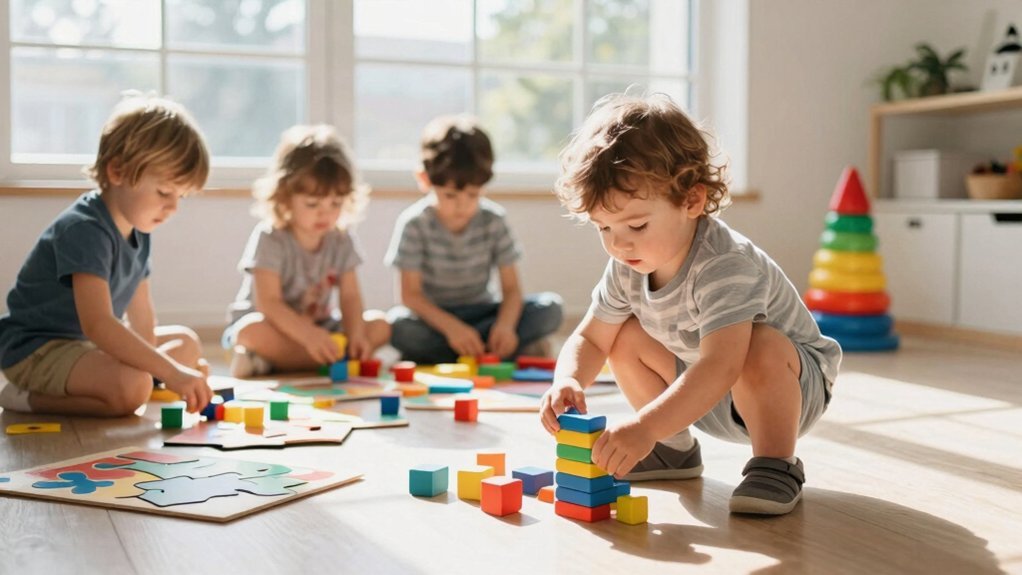
You’ll see that child‑led learning syncs with brain‑development milestones because kids’ spontaneous curiosity triggers dopamine spikes, tagging experiences as important and reinforcing self‑directed tasks. Those dopamine‑rich moments boost prefrontal growth, sharpening executive function while experience‑driven pruning strengthens the neural pathways they use most. Activities like pouring combine visual, proprioceptive, and problem‑solving cues, turning messes into data points that refine planning and monitoring. Keep exploring these ideas to discover how each step builds deeper cognitive skills.
How Child‑Led Learning Mirrors Brain Development Milestones

Ever wondered why a child’s spontaneous curiosity feels so powerful? You’ll see that child‑led learning aligns tightly with brain development milestones. When kids engage in curiosity‑driven exploration, they trigger dopamine memory signaling that tags experiences as important, cementing neural pathways. Self‑directed play, like Montessori‑style activities such as pouring, blends visual, proprioceptive, and problem‑solving cues, boosting neural development across domains. This focused attention on chosen tasks fuels prefrontal growth, sharpening executive function. As two trillion connections form in the first five years, experience‑driven pruning strengthens the most used routes. Longer, autonomous sessions outpace brief adult‑directed instruction, ensuring the brain’s sponge‑like growth follows the natural timeline of developmental milestones. Providing children with safe, supportive tools like Montessori step stools encourages independence and supports their engagement in hands-on learning experiences.
How the Dopamine Reward Loop Fuels Child‑Led Learning
When a child picks a task that sparks curiosity, the brain instantly releases dopamine, flagging that experience as valuable and cementing it in memory. That dopamine surge fuels the reward loop, turning a self‑chosen task into a powerful learning event. You’ll notice the child’s engagement spikes, and the brain’s executive function kicks in, planning and monitoring the activity. Each repetition strengthens neural pathways, making memory consolidation more robust than in passive, adult‑directed lessons. Because the child controls the focus, curiosity stays high, and the reward loop reinforces the behavior, creating a virtuous cycle. In short, child‑led learning harnesses dopamine to build durable connections and sharpen executive skills.
How Simple Pouring Activities Boost Child‑Led Learning

You’ll notice how watching the water rise and fall sharpens your visual processing while the grip and wrist motion refine your proprioception.
Each repeat pour builds stronger neural pathways, turning fleeting actions into lasting skill.
As you experiment with speed and angle, you naturally solve problems and reinforce learning through the satisfaction of successful outcomes.
This type of play supports early development of memory and concentration crucial for cognitive growth.
Visual Processing Benefits
How does a simple act of pouring sharpen a child’s visual system? You watch the water level rise, the angle of the cup, the flow pattern, and your brain registers each change. This visual processing fuels early neural development, turning fleeting glances into durable neural pathways.
As you adjust the pour, you strengthen hand–eye coordination and cement the link between sight and action. Your curiosity keeps attention steady, and each successful or overflowing pour sparks a hypothesis you test, sharpening problem‑solving skills.
Because the activity feels like learning through play, you stay engaged, and the repeated cycles of observation and adjustment embed the visual‑motor connection deeper, supporting child‑led learning overall. Using tools with child-size aprons can also enhance engagement and protect clothing during such hands-on activities.
Proprioceptive Skill Development
Why does a simple pour feel like a mini‑workout for a child’s body? You tilt a cup, feel the weight shift, and watch liquid flow, sparking proprioception and spatial awareness. Each adjustment sharpens hand–eye coordination, while the rhythmic motion creates kinesthetic feedback that reinforces motor pathways. As you experiment with angles and speeds, you practice tool manipulation and build motor development foundations. The activity demands self‑directed exploration, letting you regulate attention and emotions without adult prompting. Repeating pours converts fleeting neural signals into durable connections, supporting later self-regulated play and learning. In short, a modest pour packs sensory, motor, and cognitive gains into a single, engaging task. This type of play often incorporates open-ended, Montessori-inspired designs that promote imagination and skill development.
Problem‑Solving Through Repetition
When you keep pouring, the child starts treating each spill and splash as a puzzle to solve. Repetition turns fleeting attempts into durable neural pathways, so the child refines visual tracking, grip control, and timing while engaging in problem‑solving. Each successful or failed pour becomes a meaningful task that fuels self‑directed inquiry, sharpening executive functions like planning and monitoring. In this child‑led learning loop, the learning environment feels playful yet purposeful, and skill development accelerates.
- Adjusting angle to avoid overflow builds spatial reasoning.
- Timing the pour to fill a cup teaches cause‑and‑effect.
- Switching containers encourages flexible strategy selection.
- Reflecting on outcomes strengthens executive functions.
- Just as varied angle options enhance finger strength training, adjusting actions in pouring activities enriches problem-solving skills.
How to Embrace Messes and Safe Failure in Child‑Led Learning

You’ll let kids play with sticky paint, sand, and clay, treating the mess as a learning cue rather than a problem.
When they stumble, you’ll frame the setback as a safe chance to try again, showing that failure is just feedback.
Incorporating tactile tools like wooden calendars can enhance hands-on learning and reinforce developmental concepts.
Acceptbrace Messy Materials
Messy play isn’t chaos; it’s a purposeful laboratory where children experiment with physics, motor skills, and problem‑solving. When you hand them messy materials, you invite open‑ended play that mirrors natural development patterns. The tactile feedback of pouring, squishing, and mixing fuels exploration, while the inevitable spills become opportunities for self‑regulation and safe experimentation. You’ll notice a sharper focus on hands‑on learning as kids test hypotheses and adjust strategies without immediate adult correction.
- Provide varied containers, scoops, and fabrics to spark curiosity.
- Arrange a low‑risk cleanup zone so children can manage messes.
- Encourage them to describe what they observed after each trial.
- Celebrate persistence, not perfection, to reinforce problem‑solving confidence.
Including tools designed specifically with child-safe materials and sizes can further support safe, engaging sensory experiences.
Normalize Safe Failure
After offering varied containers and low‑risk cleanup zones, the next step is to let kids experience safe failure. You’ll notice that child‑led learning thrives when you give them space to stumble, observe, and try again.
A little scaffolding—just enough to keep autonomy intact—creates a sweet spot in development patterns where trial‑and‑error feels rewarding, not punitive.
When a mess spreads, pause, watch the process, and offer responsive prompts that guide reflection instead of fixing the outcome.
This approach builds resilience, letting dopamine‑driven exploration cement neural pathways.
Model Reflective Problem‑Solving
When children experiment with a toppled tower or a spilled tray, they instantly launch a cycle of hypothesis, trial, and reflection that fuels deeper learning. In child‑led learning you model reflective problem‑solving by letting messes become data points. You ask, “What happened?” and guide them through hypothesis testing, trial‑and‑error, and safe failure. This nurtures neural development, executive function, and causal reasoning, while exploratory play builds confidence.
- Prompt a “what‑if” question after each misstep.
- Highlight the link between the action and its outcome.
- Celebrate the adjustment rather than the perfect result.
- Connect the experience to later, more abstract problems.
How Early Curiosity Enhances Child‑Led Learning Skills
What sparks a child’s drive to explore? Curiosity fuels child‑led learning by turning self-chosen tasks into dopamine‑rich experiences that cement memory. In early development, neural plasticity makes each exploratory action reshape pathways, so repeated problem‑solving builds durable connections.
Curiosity transforms self‑chosen tasks into dopamine‑rich experiences, reshaping neural pathways and strengthening lasting memory.
When you let a child follow an intrinsic motivation, they sustain attention longer, giving the prefrontal cortex time to strengthen executive functions like planning and flexible thinking.
Montessori‑style pouring shows how a simple, self‑directed activity integrates visual processing, proprioception, and reasoning, turning play into purposeful learning.
Five minutes of adult‑directed instruction rarely matches the depth achieved through sustained, interest‑driven engagement, which nurtures curiosity, enhances executive functions, and solidifies learning foundations.
What Parents Can Do to Support Child‑Led Learning
Curiosity’s spark turns into lasting learning when parents shape the environment to let children lead. You create a responsive environment with a low shelf of open‑ended materials, letting the child choose without hovering. Use open‑ended prompts like “What happens if…?” to keep intrinsic motivation alive, and observe to tailor future opportunities. Align activities with the child’s interests—bugs, rocks, water—so development patterns reinforce neural pathways. Offer just enough scaffolding to nudge them forward, then step back and let them troubleshoot, including mess as part of the process.
- Provide open‑ended materials within easy reach.
- Ask exploratory questions instead of giving answers.
- Follow the child’s interests to spark intrinsic motivation.
- Observe, then tailor scaffolding to each developmental stage.
Frequently Asked Questions
What Is the 3 3 3 Rule for Kids?
You’ll find the 3‑3‑3 rule means kids hit key milestones in three domains—physical, cognitive, social‑emotional—by roughly age three, then again at six and nine, guiding learning stages.
Why Are Learning Patterns Important for Kids?
You need learning patterns because they align with your brain’s natural growth phases, making new skills stick, boosting confidence, and guiding you toward focused, resilient, and self‑driven problem‑solving.
What Pattern of Learning Do Children Follow From Birth?
You follow a responsive, serve‑and‑return pattern from birth, moving through curiosity‑driven exploration, language bursts, motor milestones, and social interaction waves, each stage building on neural connections and scaffolding.
Why Is It Important to Follow Your Child’s Lead?
You should follow your child’s lead because it taps their natural curiosity, boosts dopamine, strengthens memory, builds intrinsic motivation, and nurtures executive functions, leading to deeper, lasting learning.