
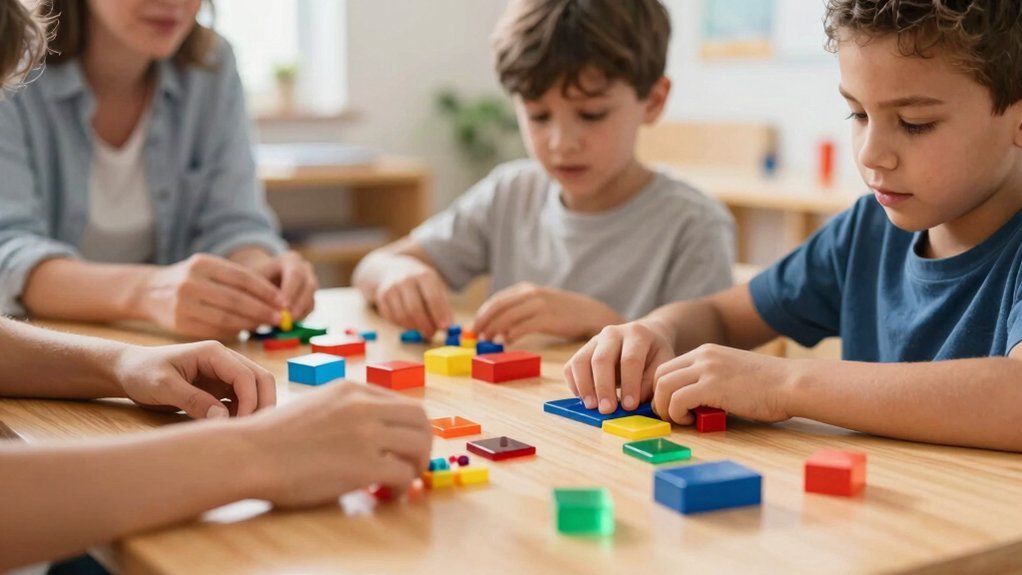
Start with base‑ten blocks or two‑color counters to make place value and number bonds tangible, then shift to pictorial sketches before moving to symbols. Use virtual number lines and fraction simulations to reinforce the same ideas when you need quick, scalable practice. As you transition, keep the concrete patterns in mind—they become the mental shortcuts for addition, subtraction, and multiplication. By linking each tactile step to a mental strategy, you’ll build fluency and confidence, and the next sections will show you how to scale this approach.
Why Concrete Manipulatives Matter for Early Math

Because abstract symbols can feel distant, concrete manipulatives give you a tactile bridge to early math concepts. When you hand students base ten blocks or two‑color counters, they instantly see how ones, tens, and hundreds stack, turning place value into a physical puzzle. This hands‑on stage launches the concrete‑pictorial‑abstract (CPA) progression, letting you move from touching blocks to drawing pictorial models, then to writing symbols.
Research shows that well‑tacled use of concrete manipulatives boosts engagement and deepens conceptual understanding, especially for struggling learners in early math. By weaving CPA progression into daily lessons, you create a seamless learning arc that connects concrete experience to abstract reasoning. Creating inviting learning spaces, like a reading nook with book storage, can further enhance students’ focus and engagement during hands-on math activities.
Select the Right Physical Manipulative for Each Skill
Which physical tool best supports a given math skill? You match each concept to a concrete‑pictorial‑abstract progression step, then pick the manipulative that makes the idea visible. For place value, use base‑ten blocks or two‑color counters to group ones, tens, and hundreds. When teaching operations with regrouping, linking cubes let you combine and split units physically. Fractions become clear with fraction strips or pattern blocks, letting you see halves, thirds, and quarters. Targeted guidance tells you when to shift from concrete to pictorial, ensuring skill‑specific learning stays anchored in conceptual understanding. By aligning manipulatives with the skill’s developmental stage, you streamline instruction and keep students actively engaged. Selecting manipulatives that incorporate cognitive development benefits enhances both memory and concentration alongside math skills.
Integrate Virtual Manipulatives to Complement Hands‑On Learning

You can blend virtual manipulatives with your hands‑on activities to create a seamless learning experience. These digital tools are designed for accessibility, letting every student engage regardless of device or location. By pairing zoomable number lines or interactive fraction simulations with physical objects, you reinforce concepts while meeting grade‑level standards. Considering factors such as variety of fastening types and developmental progression can support a more inclusive learning environment.
On Virtual Blend
How can you blend digital tools with tactile experiences without losing the benefits of either? You can use virtual manipulatives to reinforce the concrete‑pictorial‑symbolic progression while students explore zoomable number lines and digital base‑ten blocks. By pairing these tools with hands‑on kits, you create a blended learning environment that deepens number sense and accelerates mental math mastery. Follow the CPS progression charts to decide when to shift from concrete to virtual, ensuring each math concept builds on the previous representation.
Design instructional strategies that prioritize student access and inclusion, offering printable mats and videos for varied learners. This balanced approach keeps engagement high, supports diverse needs, and solidifies conceptual understanding before moving to abstract reasoning. Incorporating realistic and interactive features, such as those found in Montessori-inspired play kitchens, can further enhance hands-on learning by fostering cognitive and motor skills alongside digital exploration.
Accessibility‑Focused Digital Tools
Why should accessibility drive your choice of digital tools? You need resources that let every learner move from concrete to abstract representation without barriers. When you pair hands‑on materials with virtual manipulatives, you create inclusive learning that adapts to diverse needs.
- Zoomable number lines – let students explore fractions and intervals with adjustable scale, supporting visual and tactile preferences.
- Digital base ten blocks – mirror physical blocks, offering color‑coded, interactive counting that reinforces place value.
- Printable work mats – provide offline practice that aligns with online activities, ensuring continuity for low‑bandwidth or non‑digital environments.
These digital tools prioritize accessibility, giving you a seamless bridge from tangible manipulatives to abstract concepts while maintaining consistent representation across classroom and home. Integrating prefolded designs with flatware pockets from practical materials can inspire similar effective layering and organization in digital tool interfaces.
Blend Physical and Virtual Manipulatives in the CPA Sequence
Ever wondered how to keep students engaged while moving smoothly through concrete, pictorial, and abstract stages? You can blend physical manipulatives and virtual manipulatives to reinforce the concrete-pictorial-abstract CPA progression. Start with base‑ten blocks or fraction tiles, then switch to zoomable number lines and digital tools that mirror the same models. This blended learning lets learners build number sense, transition between representations, and stay on track during distance learning. Use the physical set for tactile feedback, then cue the virtual version for quick manipulation and visual scaling. Align both tools on the same topic, so students see the bridge from concrete to abstract, paving the way for mental math mastery. Incorporating wooden puzzles for preschoolers can further enhance hands-on spatial reasoning and problem-solving skills in early learners.
Link Manipulatives to Mental‑Math Strategies

By starting with concrete tools—like base‑ten blocks, two‑color counters, or fraction tiles—you give students a visual anchor that later becomes the mental image they use for rapid calculations. You then guide them through the concrete‑pictorial‑abstract CPA progression, turning each manipulative experience into a mental‑math shortcut. When they see a ten‑block, they internalize place‑value; when they pair two‑color counters, they reinforce number bonds to 20; when they manipulate fraction tiles, they practice counting strategies that lead to rapid recall. This bridge lets abstract mental strategies emerge naturally, so learners can compute without touching anything. Integrating hands-on tools with safety features and design helps ensure that learning environments remain secure and supportive.
Concrete tools become mental anchors, turning manipulatives into rapid, abstract calculation shortcuts.
- Convert base‑ten blocks into place‑value mental images.
- Use two‑color counters to cement number bonds and near‑doubles.
- Translate fraction‑tile partitions into abstract mental strategies.
Practice Patterns With Manipulatives to Build Mental Fluency
You’ll notice that arranging two‑color counters into repeating groups helps you spot patterns instantly, and those patterns become the foundation for faster mental calculations.
By chunking numbers into manageable blocks—like grouping tens, hundreds, or visual—you train your brain to retrieve sums without counting each digit.
Combining these two strategies with manipulatives turns abstract math into a concrete, fluid process.
Pattern Recognition With Counters
When students arrange counters into simple, repeating groups—like three‑by‑three blocks or alternating colors—they instantly see the numerical pattern that underlies addition, subtraction, and multiplication. You notice how pattern recognition with counters turns abstract strategies into concrete visual cues, accelerating mental math and rapid recall. The CPA progression guides you from concrete‑to‑abstract thinking, letting you move from seeing repeating patterns to applying them across operations. This hands‑on approach builds confidence, so you can shift from manipulatives to mental calculations without losing insight.
- Identify a repeating unit (e.g., a block of four).
- Count how many units fit into the target number.
- Translate the visual count into a mental math shortcut.
Progressive Chunking Strategies
What if you could turn a handful of counters into a mental shortcut that snaps into place every time you calculate? You start with manipulatives—base‑ten blocks or simple counters—to explore number bonds and place‑value chunks. By repeating a small, concrete pattern, you build automaticity. Then you shift to pictorial sketches, linking the physical representation to symbols. Finally, you drop the objects, solving the same chunk in pure mental math. This progressive chunking follows CPA guidelines, moving from concrete‑pictorial‑abstract while preserving the representation of each step. Keeping the tools nearby during independent work lets you adjust pace, deepen fluency, and transition smoothly to mental calculations that feel effortless.
Manage Classroom Behavior While Using Manipulatives
How can you keep students focused while they explore manipulatives? You’ll see that purposeful, well‑structured tasks cut off‑task chatter. Begin with explicit strategies: demonstrate the tool, give step‑by‑step directions, and hand out printable work mats that anchor attention. Align each activity to a math topic and the CPS progression, moving from concrete to pictorial to symbolic representations. This scaffold reduces distractibility and smooths transitions. Virtual manipulatives add predictability for blended settings, reinforcing the same expectations.
- Clear demo + guided practice – model use before independent work.
- Print‑and‑use work mats – keep students on‑task and organized.
- CPS‑aligned stations – shift from concrete to symbolic, sustaining engagement.
Observe Understanding Before Shifting to Mental Math
| Phase | Tool | Goal |
|---|---|---|
| Concrete | Manipulatives | Anchor concepts |
| Pictorial | Drawings | Visualize relationships |
| Symbolic | Numbers | Transition to abstraction |
| Mental | Head work | Test fluency and accuracy |
Use this rhythm to ensure each learner’s thinking is solid before you move them toward mental calculations.
Extending Manipulative Practices to Upper‑Elementary Math
You’ll start by building concrete manipulative experiences that bridge smoothly to abstract concepts, so students see the connection between hands‑on work and mental reasoning.
By scaling these activities for grades 4‑5—using base‑ten blocks, fraction strips, or digital number lines—you reinforce place‑value understanding and multi‑digit operations.
This approach lets you shift students from concrete models to rapid mental calculations with confidence.
Phas Building Manip Manip#Comma
Ever wonder how the concrete confidence you built with early‑grade manipulatives can survive the jump to multi‑digit operations and decimals? In upper‑elementary you’ll keep that confidence by pairing physical tools with virtual manipulatives, guiding students through a concrete‑to‑abstract journey. You’ll use double‑sided meter sticks and measuring tapes to visualize place value, then shift to digital blocks for multiplication and division of larger numbers. Fractions become slices of a virtual pizza, reinforcing mental math while preserving the tactile link. A guided CPS progression ensures you introduce each tool at the right moment, so students move smoothly from hands‑on to mental strategies.
- Physical‑to‑virtual transition
- Place‑value scaffolding
- Fraction‑focused mental math
Connecting Concrete to Abstract
When you move from concrete manipulatives to abstract symbols, the CPS (concrete‑pictorial‑symbolic) progression guides students to translate tactile experiences into mental images before they master mental math. In upper elementary, you begin with concrete representations like base‑ten blocks, then shift to pictorial representations—drawings or virtual manipulatives that preserve shape and proportion.
Next, you introduce symbolic representations, letting students replace pictures with numbers and variables. Strategic scaffolding ensures you revisit manipulatives when misconceptions arise, reinforcing the link between physical and mental strategies. Virtual manipulatives add zoomable, interactive layers that mirror the physical tools, making the CPS progression seamless across blended settings.
This bridge from concrete to abstract builds rapid recall, flexible problem‑solving, and lasting mental‑math fluency.
Scaling Strategies for Grades 4‑5
After mastering the CPS bridge, you now expand those concrete tools to handle the larger numbers, decimals, and multi‑step problems that dominate grades 4‑5. You’ll keep the same hands‑on mindset while scaling up: base‑ten blocks become extended rods for thousands, fraction circles stretch into decimal grids, and virtual manipulatives let you model place value instantly. By linking these visuals to mental math, you boost fluency with multiplication facts and decimal representation, freeing you to tackle multi‑step operations without getting stuck.
- Extend manipulatives – use larger base‑ten blocks and digital grids to visualize thousands and hundredths.
- Embed mental math drills – rapid recall of 11‑12 multiplication facts supports higher‑level problem solving.
- Transition to abstract – replace physical models with symbolic equations while preserving place‑value insight.
Daily Routines to Keep Mental Math Sharp
How can you turn a quick, hands‑on activity into lasting mental‑math fluency? Start each day with a 3‑minute warm‑up that uses manipulatives to model a problem, then ask for verbal reasoning before shifting to mental math. Let students manipulate objects, then explain near‑doubles or compensation strategies, reinforcing the concrete‑pictorial‑abstract progression. Follow the activity with a quick check—an exit ticket or Y‑answer—to gauge transfer without the tools. Use printable work mats and short videos to keep routines consistent during independent practice. Treat each quick check as formative assessment, adjusting instruction on the fly. By embedding these routines, you cement fluency, boost confidence, and keep mental math sharp all day.
Frequently Asked Questions
How Many Manipulatives Should a Class Have for Optimal Engagement?
You should aim for about 10–15 manipulatives per student, rotating them in groups of three or four so everyone stays engaged, gets hands‑on practice, and you can manage classroom flow efficiently.
Can Manipulatives Be Used Effectively for Students With Severe Fine‑Motor Challenges?
Yes, you can adapt manipulatives for severe fine‑motor challenges by choosing lightweight, textured items, offering larger grips, and allowing digital or tactile alternatives, so every student engages confidently and meaningfully.
What Budget‑Friendly Alternatives Exist for Schools Lacking Resources?
You can use printable worksheets, recycled cardboard manipulatives, DIY dice from bottle caps, and free online math games; these low‑cost tools let you teach concepts effectively without pricey equipment.
How Often Should Manipulatives Be Rotated to Maintain Student Interest?
You should rotate manipulatives every two to three weeks, swapping themes or difficulty levels to keep lessons fresh, spark curiosity, and prevent boredom while reinforcing concepts consistently.
Do Manipulatives Improve Performance on Standardized Math Assessments?
You’ll see gains; manipulatives boost conceptual understanding, which translates into higher standardized math scores. They engage you actively, reinforce number sense, and help you solve problems faster and more accurately.