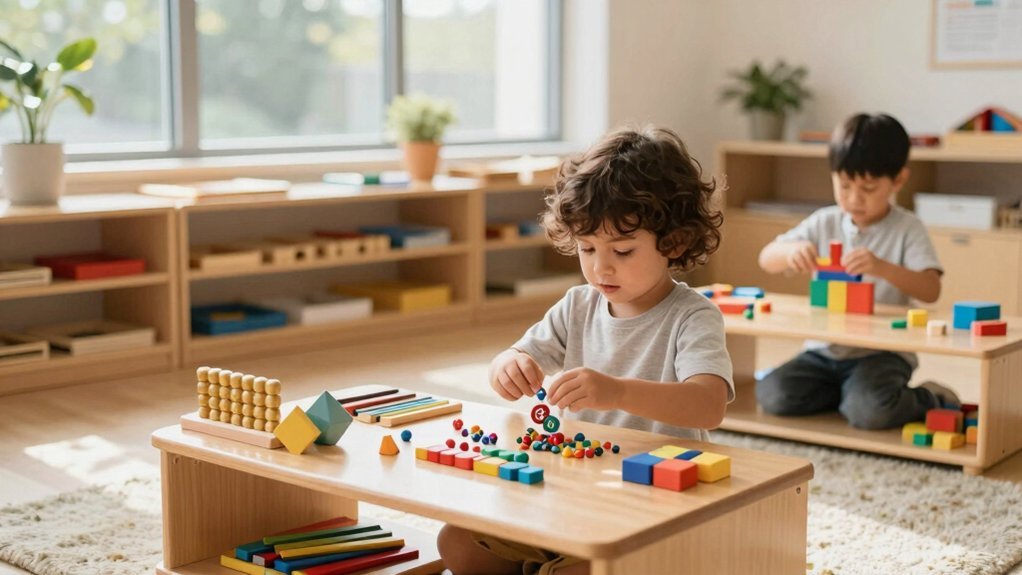
You’ll see that a clean, minimalist space with shelves and trays arranged left‑to‑right and top‑to‑bottom cues your eye to follow a logical sequence, letting you move from concrete blocks to abstract symbols without distraction. Self‑correcting tools give instant feedback, so you test hypotheses and refine reasoning on your own. Mixed‑age peers model strategies, while the calm aesthetic reduces cognitive load, fostering deeper reflection. Keep exploring to discover how these principles translate into everyday learning.
Montessori Prepared Environments Spark Abstract Thinking

Why does a Montessori classroom feel like a thinking laboratory? You step into a Prepared Environment where every shelf, tray, and rug is arranged to invite exploration. The materials progression moves from concrete manipulatives to abstract symbols, letting you internalize concepts before you label them. As you handle self‑correcting tools, you test hypotheses, notice patterns, and refine reasoning without adult prompting. Mixed‑age groups amplify this effect: older peers model strategies, younger children observe, and both negotiate meaning together. The orderly layout reduces cognitive load, so you can focus on abstract thinking rather than searching for resources. In this setting, you naturally transition from sensory discovery to higher‑order analysis, turning everyday objects into intellectual catalysts. Designed with careful consideration for safety and independence, features like the Kitchen Step Stool for Kids with Safety Rail support the child’s growing autonomy in hands-on learning.
Left‑to‑Right Progression Builds Logical Sequences
How does a left‑to‑right layout shape your thinking? In a prepared environment, you encounter a left-to-right progression that mirrors reading order, so each material naturally follows the previous one. This directional sequencing trains you to anticipate what comes next, reinforcing logical sequences in your mind.
As you move from simple to complex items, you see how ideas build cumulatively, which sharpens planning skills and strengthens mental mapping of progress. Returning finished work to its exact left‑to‑right shelf position cements the pattern, making sequencing an automatic habit.
Over time, this consistent flow transfers to symbolic tasks, helping you apply the same logical sequences to language, math, and beyond.
Using natural materials like wooden spinning tops in educational environments further enhances fine motor skills and cause-and-effect understanding, complementing the development of abstract thinking.
Concrete Tools → Symbolic Thinking in Montessori

You’ll see how concrete materials act as bridges to abstract ideas, letting you grasp quantity and order before any symbols appear.
Repeating the same manipulations gradually strips away the physical details, so the concepts become internalized and ready for notation.
As you move from the Pink Tower to written numbers, symbolic language emerges almost automatically.
Montessori tools like the binomial and trinomial cubes provide hands-on experience with algebraic concepts, deepening this transition from concrete to abstract thinking.
Concrete Materials Bridge Abstract Concepts
Ever wondered how a simple chain of golden beads can turn counting into a mental language? You’ll notice that concrete materials like the Golden Bead chain give you a tactile way to explore units, tens, hundreds, and thousands. When you slide a bead, you see quantity shift instantly, and the self‑correcting design of Cylinder Blocks—fitting only into matching holes—lets you spot mistakes without adult prompting. This built‑in feedback fuels a natural progression from handling objects to visualizing symbols. As you move from beads to written numbers, your brain builds the abstraction layer that underlies arithmetic. The sequence’s left‑to‑right, top‑to‑bottom flow mirrors cultural writing habits, reinforcing working memory and preparing you for symbolic reasoning. Utilizing quality materials such as natural solid beech wood in Montessori trays enhances tactile learning and supports the transition from concrete to abstract thinking.
Incremental Abstraction Through Repetition
Why does repeating the same hands‑on activity feel effortless yet powerful? You notice that self‑correcting materials let you spot errors instantly, so each cycle feels like a quick check rather than a chore. The left‑to‑right, top‑to‑bottom layout of the Golden Beads creates a concrete‑to‑abstract progression: you start counting beads, then group them into tens, hundreds, and finally symbols. Every exact return to the shelf reinforces the pattern, nudging you toward symbolic reasoning without explicit instruction. As you rotate the set, the repeated actions produce incremental abstraction, turning tactile experience into mental schema. Watching older peers manipulate the same tools accelerates this shift, letting you internalize abstract rules through observation and subtle, collaborative practice. Similarly, practical life baby doll care sets provide hands-on care learning opportunities that cultivate imagination and empathy within concrete, playful contexts.
Symbolic Language Emerges Naturally
How does a simple bead become a letter in a child’s mind? You watch the child count unit beads, then match each cluster to a sandpaper letter. The prepared environment lines the materials left‑to‑right, guiding a concrete‑to‑abstract progression. Self‑correcting materials let the child notice mismatches, infer rules, and adjust without teacher prompting. As the child names sounds and records them with a moveable alphabet, symbolic language emerges naturally, linking tactile experience to abstract symbols.
Durable materials with child-friendly design features also support hands-on learning by ensuring safety and ease of use during exploration.
| Material | Symbolic Role |
|---|---|
| Unit beads | Quantitative abstraction |
| Sandpaper letters | Sound‑to‑letter mapping |
| Moveable alphabet | Word construction |
| Pink Tower | Spatial ordering |
Minimalist Design Boosts Focused Reflection

You’ll notice that a clutter‑free visual field lets your mind settle on one idea at a time, while a simplified material layout guides your attention in a natural, left‑to‑right flow. This calm setting encourages you to reflect deeply without competing stimuli. As a result, your thinking becomes more focused and abstract.
Clutter‑Free Visuals
Ever notice how a clean, uncluttered space lets your mind settle on the task at hand? When you arrange shelves with clutter‑free visuals, you create a prepared environment that signals focus. The single‑item presentation on trays invites you to choose deliberately, slowing your processing and deepening reflection. This simplicity supports executive function: you plan, anticipate, and solve problems without competing stimuli.
A neutral palette and natural materials calm your nervous system, boosting concentration and abstract reasoning. As you work, the clear left‑to‑right, top‑to‑bottom progression scaffolds concepts, helping you move from concrete manipulation to symbolic understanding.
Incorporating tools like wooden clothespins and tweezers further enhances fine motor skills and hand–eye coordination, essential foundations for higher-level cognitive processes.
Ultimately, the minimalist setting nurtures independent learning, letting you explore ideas with fewer distractions and more confidence.
Simplified Material Layout
Clarity becomes the silent guide when you arrange materials in a clean, left‑to‑right, top‑to‑bottom sequence. By stripping away excess, you let each object speak, turning the space into a rehearsal ground for abstract thought. The minimalist layout encourages sustained attention, while predictable sequencing builds patience and will. When children see only a few well‑chosen items, they translate concrete actions into internal concepts, deepening reflection.
- Keep shelves uncluttered, using individual trays or baskets.
- Limit the number of materials to foster patience.
- Follow a left‑to‑right, top‑to‑bottom progression for consistent sequencing.
- Rotate items periodically to maintain novelty without breaking organization.
These steps turn simple organization into a catalyst for focused, abstract thinking.
Child‑Sized Freedom Within Structured Limits
How does a child’s sense of autonomy flourish when the classroom is both inviting and disciplined? In a prepared environment you see independence bloom because the layout offers a clear sense of order. Shelves line left‑to‑right, trays sit top‑to‑bottom, and each material invites you to pick, use, and return it on your own. You’re free to choose activities, but the teacher’s boundaries keep safety and progress in check. Long work cycles—often three uninterrupted hours—let you dive deep, test ideas, and self‑correct without constant adult direction. Real‑world tools and textures demand deliberate movement, reinforcing accountability. While you explore, the teacher observes quietly, stepping in only when necessary, allowing sustained, self‑directed practice that builds executive function.
Self‑Correcting Materials Show Cause and Effect
When the classroom’s order lets you pick and work freely, the next step is giving you tools that instantly tell you when you’ve missed a mark. Self‑correcting materials turn every slip into a visible cue, so you see the cause and effect without waiting for a teacher. The Cylinder Blocks, for instance, only fit their matching holes, forcing you to notice the mismatch and try again. This immediate feedback fuels independent problem‑solving and pushes concrete‑to‑abstract thinking.
- Shape‑based errors reveal spatial reasoning gaps.
- Fit‑and‑balance cues highlight physical‑causal links.
- Color mismatches trigger hypothesis testing.
- Sequential locks enforce logical ordering.
You learn to diagnose, adjust, and internalize the underlying principles, deepening abstract reasoning through hands‑on exploration.
Ordered Material Sets Strengthen Pattern Recognition
When you work with ordered material sets, you repeatedly encounter the same patterns, which trains your mind to spot regularities instantly. As the sets slowly increase in complexity, you build deeper insight into how simple elements combine into intricate structures. The built‑in self‑correction gives you immediate feedback, letting you abstract the pattern without waiting for an adult’s cue.
Repeating Sets Reinforce Patterns
Repeating sets in Montessori materials give you a clear, consistent pattern that shows up in different contexts, so you start spotting order and progression without even thinking about it. The repetition of shapes, colors, and sizes forces your brain to lock onto a sequence, turning raw observation into pattern recognition. As you manipulate the Pink Tower or Cylinder Blocks, you notice mismatches instantly, correcting them and moving toward mastery. This continual exposure builds confidence that the same logic applies elsewhere.
- Encounter the same set in varied layouts.
- Observe left‑to‑right, top‑to‑bottom ordering.
- Detect and fix discrepancies yourself.
- Anticipate the next piece before it appears.
These steps cement abstract thinking, letting you apply learned structures to new challenges.
Gradual Complexity Builds Insight
Structure emerges as you move from simple to more complex Montessori sets, each step arranged left‑to‑right and top‑to‑bottom. You notice that the gradual complexity of the materials creates a clear progression, so your brain learns to anticipate the next challenge. The ordered shelves let you see relationships, reinforcing pattern recognition as you add beads, rods, or puzzles. When a piece doesn’t fit, the self‑correcting design nudges you to spot the error, turning a mistake into a learning moment. This steady climb from basic counting to abstract reasoning builds insight, because each new level builds on the invariants you’ve already mastered. You end up seeing deeper mathematical and linguistic patterns across all curriculum domains.
Self‑Correction Enhances Abstraction
Self‑correction transforms a simple hands‑on activity into a powerful lesson in pattern recognition, because each material set is ordered from the most basic to the most complex. You’ll notice how Montessori materials let you spot errors instantly, turning every mis‑fit into a clue. As you move through progressive sequencing, each step builds on the last, sharpening abstraction and reinforcing mental schemas without adult prompting. The cylinder blocks illustrate this: you align shapes, feel the feedback, and internalize shape‑recognition rules. Repeating these self‑guided cycles trains you to anticipate outcomes and extract underlying concepts from concrete manipulation.
- Identify the error.
- Adjust placement.
- Observe the fit.
- Internalize the rule.
Sensory Exploration Turns Into Conceptual Vocabulary
How does a child turn a simple texture into a word like “soft”? In a prepared environment you guide sensory exploration so it becomes a bridge to abstract thinking. When a child feels the smoothness of a Color Tablet, they notice the difference, label it “soft,” and store that term in a conceptual vocabulary. Repeating this process with the Pink Tower, fabrics, and sandpaper lets them infer rules—size, texture, hue—without explicit instruction. The self‑correcting nature of the materials lets them test hypotheses, strengthening neural pathways that later support symbolic representation. Because the classroom is calm and orderly, cognitive load stays low, letting the child focus on extracting meaning from each tactile cue.
Beauty and Harmony Enhance Abstract Thinking
Why does a beautifully arranged classroom feel like a mental springboard? You notice the calm that natural wood and neutral tones bring, and you realize that a prepared environment eases cognitive load, freeing mental bandwidth for abstract thinking. The harmony of aesthetics guides your focus toward patterns and relationships, not distractions.
- Minimalist displays reduce visual clutter, lowering cognitive load.
- Consistent order highlights hierarchies, sharpening classification skills.
- Visually appealing materials invite close inspection, deepening conceptual grasp.
- Natural textures create a soothing backdrop, sustaining concentration for higher‑order reasoning.
When you sit amid such beauty, you naturally move from concrete objects to abstract ideas, internalizing concepts securely and transferring them to novel problems. This synergy of aesthetics and structure fuels your abstract thinking.
Rotational Activities Let Kids Test Hypotheses
Ever notice how rotating a child’s learning stations feels like a live experiment? You set up a sequence of Montessori materials that move from simple to complex, then you let the child explore each station, forming a hypothesis about how it works.
As rotations shift, the child anticipates new challenges, formulates tentative solutions, and tests them against the next task. When they finish, they return the item to its exact shelf, creating a predictable pattern that lets them compare outcomes across trials.
Self‑correction kicks in with items like Cylinder Blocks, offering immediate feedback so the child refines reasoning without adult prompting.
Mixed‑age peers watch, model strategies, and inspire fresh hypothesis testing, turning every rotation into a mini‑science lab.
Executive Functions That Power Abstract Problem Solving
Executive functions—working memory, inhibitory control, and cognitive flexibility—are the mental engines that let children turn concrete tasks into abstract solutions. In a prepared classroom, you’ll notice self‑directed work paired with self‑correction materials that push kids to plan, monitor, and adjust their thinking. The concrete‑to‑abstract progression built into each activity lets them link tactile manipulation to symbolic reasoning, while calm, orderly zones let mixed‑age peers model strategies.
- Working memory: hold steps while moving pieces left‑to‑right.
- Inhibitory control: pause before grabbing the next tool.
- Cognitive flexibility: switch tactics after a failed attempt.
- Executive functions: integrate feedback from self‑correction materials to refine solutions.
These habits sharpen attention, sustain goal‑directed problem solving, and make abstract reasoning a natural outcome of everyday play.
Practical Ways Parents Foster Abstract Thinking at Home
How can you turn everyday moments into mental workouts for your child? Build a prepared environment that invites abstract thinking through open‑ended tasks and self‑correction. Offer real‑life problems—like planning a simple recipe—so they sequence steps, estimate quantities, and reflect on outcomes. Use natural materials (stones, shells) for pattern replication, letting them infer rules without direct instruction. Present a bridge‑building challenge with household items, discuss multiple designs, and weigh trade‑offs. Model precise language: “What happens if we change this part of the plan?” to spark hypothesis testing. Establish routines that involve sequencing, timing, and categorizing objects, reinforcing executive function and transfer to complex abstract tasks.
| Activity | Skill Target |
|---|---|
| Recipe planning | Sequencing & estimation |
| Stone pattern replication | Self‑correction & rule inference |
| Bridge building | Open‑ended problem solving |
Frequently Asked Questions
What Are the Six Principles of Montessori Prepared Environment?
You get Freedom, Structure and Order, Beauty and Atmosphere, Nature and Reality, Social Environment, and the idea that prepared spaces stay orderly, beautiful, functional, and support independence.
Why Do Learners Struggle to Transition From Concrete to Abstract Thinking?
You struggle because you rely on tactile cues, lack gradual symbolic steps, and miss self‑correcting feedback that forces you to infer meaning without concrete prompts, hindering abstract reasoning development.
How Can Teachers Encourage Abstract Thinking?
You encourage abstract thinking by offering concrete materials, modeling mental steps, then stepping back so students explore, self‑correct, and discuss ideas, gradually increasing complexity while observing readiness cues.
What Is One Benefit of Preparing the Environment?
You’ll see children develop stronger planning skills because the organized layout guides them to choose materials purposefully, reinforcing self‑regulation and the ability to hold multiple steps in working memory.