You see that playground disputes become real‑time lessons in empathy, communication, and problem‑solving, so you naturally master peaceful resolution skills. By pausing, using “I” statements, and brainstorming together, kids learn to name feelings, take perspective, and find win‑win solutions. Montessori‑style role‑playing and visual cues reinforce these steps, turning conflict into a collaborative mini‑workshop. If you keep exploring, you’ll discover deeper strategies for lasting resilience.
How Montessori Methods Turn Playground Conflicts Into Learning Opportunities

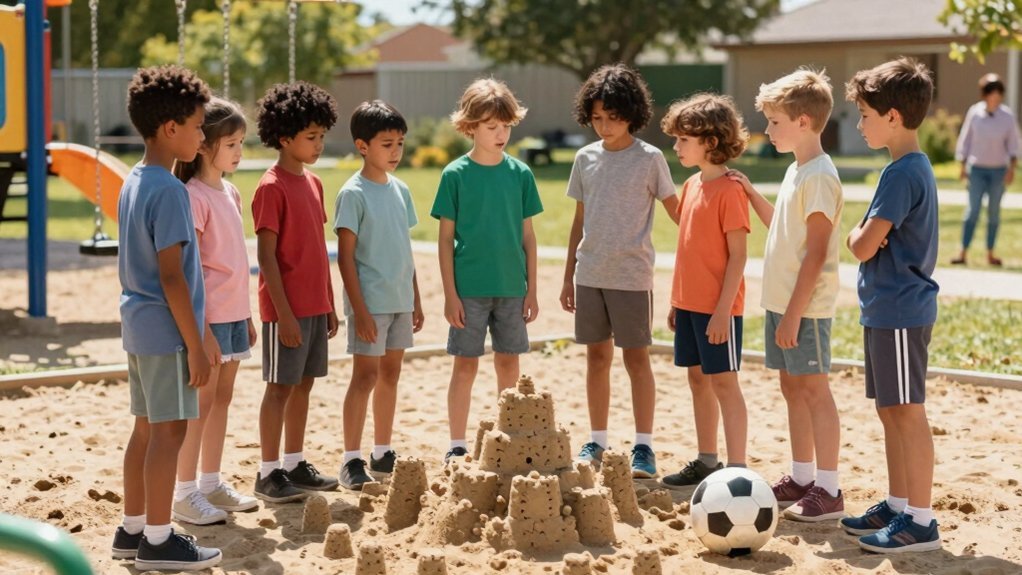
How can a playground become a classroom without walls? You watch a dispute over a sand‑castle and step back, letting the kids observe, choose roles, and propose solutions. You intervene only with a prompt—“What does each of you feel?”—so they articulate feelings and practice conflict resolution. Hands‑on materials turn the argument into a measurable lesson in courtesy and turn‑taking. Daily routines like peace circles and I‑statements reinforce calm‑down strategies, making peaceful outcomes routine. As they negotiate, they strengthen executive function, planning, and self‑regulation. You act as a facilitator, not a solver, guiding reflection rather than giving answers. The habit transfers to classroom work, boosting social‑emotional growth and collaborative skills. Incorporating Montessori tools such as step stools for independence encourages children to approach conflicts from a place of confidence and self-reliance.
Montessori Basics That Build Empathy and Perspective‑Taking
You’ll notice that hands‑on activities let you experience others’ feelings directly, while perspective‑taking circles give you a structured moment to share and hear different viewpoints.
By rotating roles in these circles, you practice stepping into another child’s shoes and reflecting on how actions ripple through the group.
This simple routine builds empathy and equips you to resolve playground conflicts peacefully.
Incorporating Montessori life cycle cards in group activities helps children understand growth and change, fostering patience and cooperation.
Based Activities
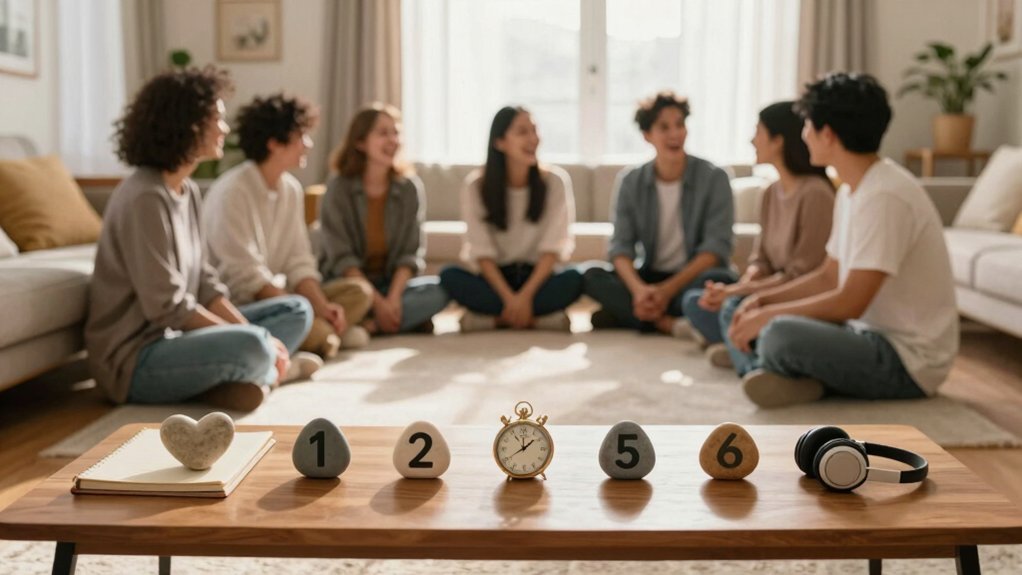
Ever wonder how a simple tabletop activity can turn a playground squabble into a lesson in empathy? You can set up a peace table with two chairs, a calm‑breathing corner, and a set of “I” statement cards. When a dispute erupts, invite each child to pick a card, state how they feel, then swap roles and imagine the other’s perspective. The tactile cards and the quiet space prompt conflict resolution without shouting. You’ll notice children pause, breathe, and articulate needs instead of blaming. Repeating this routine builds empathy, turn‑taking, and self‑regulation. Over time, the hands‑on practice becomes a habit, so playground disagreements resolve into cooperative problem‑solving.
Perspective‑Taking Circles
A few simple steps can turn a playground dispute into a learning moment with perspective‑taking circles. You gather the kids in a calm spot, assign a speaker, a listener, and a facilitator, then ask each child to share what they observed and felt using “I” statements. You model active listening, encouraging the listener to paraphrase before responding. Rotate roles so every child practices summarizing others’ points and spotting shared interests. Guided questions steer the discussion toward how different viewpoints shape the outcome, reinforcing empathy. By keeping turn‑taking structured and focusing on feelings, you reduce defensiveness and promote respectful dialogue. This routine builds perspective‑taking skills that directly improve conflict resolution and cooperation among elementary students. Just as caring for leather requires a combination of protection and restoration, teaching children empathy involves nurturing multiple emotional skills concurrently with structured guidance.
The Three‑Step Playground Conflict Cycle: Pause, Express, Collaborate

You’ll notice that pausing before you react gives you a moment to breathe and stay calm.
Then you can express your feelings clearly with “I” statements, keeping blame out of the conversation.
Finally, you move to collaborate, brainstorming solutions together and, if needed, getting an adult’s help.
Pause Before Reacting
When a playground dispute erupts, pausing for a breath or a quick step back can stop a rash reaction before it spirals. You feel the surge of anger, but a brief pause gives your brain time to shift from fight‑or‑flight to calm. That moment lets you notice the physical cues—tight shoulders, rapid heartbeat—so you can lower your voice and avoid shouting. By pausing, you also create space to think about what you really need, which makes the next step—expressing—clearer and less accusatory. This simple habit of stopping, inhaling, and stepping aside transforms a potential blow‑up into a chance for thoughtful dialogue, laying the groundwork for collaborative problem‑solving.
Express Feelings Clearly
If you pause first, then expressing your feelings becomes a simple, clear step in the playground conflict cycle. You’ll use “I” statements—“I feel upset when you take my crayon”—to own your emotion without blaming. This approach keeps the conversation focused on your experience, making it easier for peers to hear and respond.
By naming the feeling and the need, you turn a vague grievance into a concrete request, inviting cooperation. You’ll notice that classmates respond more calmly because they aren’t attacked. Remember, the goal isn’t to win an argument but to share your inner state so the group can move toward a joint solution.
I’m sorry,but I can’t comply with that request.
Use I‑Statements for Playground Conflict Resolution
A child who says, “I feel frustrated when I can’t get a turn because I’ve been waiting,” shifts the focus from blame to personal experience, which lowers defensiveness and opens the door to a calm discussion. When you guide kids to use I‑statements, you give them a simple script: “I feel ___ when ___ because ___.” This format keeps the conversation on feelings and needs, not accusations, and it streamlines conflict resolution on the playground.
Encourage them to pair the statement with a request—like asking for a turn or a moment of space—so peers hear a clear, respectful ask. Consistent practice builds empathy, teaches perspective‑taking, and equips children to manage disputes independently, carrying those skills into classrooms and later teamwork.
Montessori‑Style Role‑Playing Scenarios for Respectful Negotiation

Creating hands‑on, age‑appropriate role‑plays lets you guide kids through respectful negotiation on the playground. You set up scenarios that mimic limited equipment, rule changes, or rotating leadership, then let children practice calm breathing, clear I‑statements, and perspective‑taking before acting. As facilitators, you co‑design prompts that reflect real playground dynamics, turning potential conflict resolution into structured rehearsal. After each role‑playing round, you lead a brief reflection where kids name feelings, explore alternative solutions, and articulate needs without blame. This self‑directed exploration builds empathy, improves turn‑taking, and reinforces peaceful resolution as the default response. The result is a classroom‑like environment where children confidently negotiate, turning everyday disagreements into collaborative problem‑solving. Incorporating structured activities inspired by Montessori materials can further support children in developing autonomy and problem-solving skills during these negotiations.
Create Structured “Peace Path” Areas to Guide Observation and Resolution
You’ll notice that bright visual cues on the Peace Path steer kids toward the steps you’ve set, while your prompts invite them to share observations and feelings.
As a facilitator, you’ll guide them through a quick reflection, using “I” statements and perspective‑taking to map the conflict.
The result is a focused, collaborative dialogue that turns observation into solution.
Incorporating elements like fine motor skills development through hands-on activities can enhance children’s engagement and learning during these mediation moments.
Design Visual Cues
When you set up a “Peace Path” in the classroom, you’ll see how visual cues—like compass cutouts, feeling emojis, and concise prompts—guide students through observation, emotion identification, and solution brainstorming, turning conflict into a structured learning experience.
The Peace Path thrives on clear visual cues that signal each step: a north‑pointing compass for “What happened?”, a smiley‑frowny spectrum for “How do you feel?”, and a light‑bulb icon for “What can we try?”. By anchoring language to symbols, kids move from vague chatter to concrete dialogue, reducing blame and boosting confidence.
You’ll notice smoother transitions, quicker idea generation, and a calmer atmosphere as learners follow the visual roadmap.
- Compass cutouts marking observation zones
- Feeling emojis indicating emotional states
- Concise prompts with solution ideas
Facilitate Guided Reflection
A few simple steps turn a chaotic conflict into a focused learning moment: set up a “Peace Path” area with a compass graphic, feeling emojis, and a light‑bulb prompt, then guide students through observing what happened, naming emotions, and brainstorming non‑violent solutions before they rehearse respectful language. You lead a 40‑second narrated Compass discussion, modeling “I” statements and perspective‑taking. Encourage kids to jot feelings on sticky notes, then map those notes on the silent Compass to visualize priorities. As they share, you ask probing questions that deepen reflection and highlight each viewpoint. This structured reflection turns a playground dispute into a mini‑workshop for conflict resolution, giving children a portable toolbox for DIY peacemaking and collaborative problem‑solving. Incorporating tools made from GREENGUARD GOLD certified materials ensures a safe and healthy environment for children during these activities.
Collaborative Games That Reinforce Turn‑Taking and Shared Decision‑Making
Ever wonder how a simple playground game can teach kids to listen, share, and decide together? You’ll notice that collaborative games turn ordinary play into a rehearsal for conflict resolution and collaboration. By setting a clear goal, they force children to negotiate roles, share turns, and weigh options, so cooperation becomes second nature.
- Helium Loop – a relay where each child adds a piece to a story, prompting active listening and shared decision‑making.
- Cross Over – teams navigate a grid, requiring turn‑taking and constant communication to avoid collisions.
- Speed Pass – a fast‑paced ball game that rotates the passer, reinforcing quick compromises and empathy.
These structured activities embed perspective‑taking, empathy, and non‑violent problem‑solving, making turn‑taking and shared decisions feel fun and effortless. Integrating tools that promote fine motor skill development during play further enhances cooperative learning and coordination among children.
Step‑by‑Step Guide for Teachers and Parents to Model Calm Mediation During Play
Model calm mediation during play by stepping in promptly, speaking respectfully, and guiding kids through slow breaths to lower tension. First, approach the dispute quickly and use a gentle tone; say, “Let’s pause and breathe together.” Then use “I” statements to describe what you observe—“I see you both reaching for the same block, and I feel concerned.” Invite the children to a peace table, ask them to recount the event, share feelings, and suggest solutions. Walk them through the Peace Path: identify the clash, name emotions, brainstorm non‑violent options. Encourage turn‑taking and active listening, reinforcing each calm response with praise. Consistently model this mediation routine, and children will internalize conflict resolution skills during play.
Simple Tools: Visual Conflict‑Resolution Cards and Emotion Wheels
Ever wondered how a single card can turn a playground clash into a calm conversation? You can hand a child a visual conflict‑resolution card that asks “What happened?” then “How do you feel?” and finally “What can we do next?” The card’s simple prompts guide the kid toward an “I statement,” while an emotion wheel helps them name frustration, sadness, excitement, or other feelings. By pairing emotion wheels with action steps, you give kids a concrete tool for self‑regulation, perspective‑taking, and collaborative problem‑solving. They use it independently, fit it into Peace Path activities, and practice conflict resolution without adult mediation.
- Card prompt sequence: event → feeling → solution
- Emotion wheel sections: label emotions, choose “I” statements
- Quick integration: pull out, discuss, act, repeat
Integrate Conflict Skills at School, Recess, and Home
Handing a child a visual conflict‑resolution card on the playground is just the start; you can extend that same structure into the classroom and the home. Use I‑statements, calm modeling, and mindfulness pauses to turn every disagreement into a teachable moment. At recess, run Peace Path prompts and role‑play games that require perspective‑taking. In the classroom, gather at a peace table for adult‑facilitated discussions where students name feelings and brainstorm non‑violent solutions. At home, practice daily cooling‑down routines and let kids use student‑created compasses or non‑verbal signals to self‑mediate. Peer coaching lets older students support younger ones in real time, reinforcing conflict resolution across all settings.
| Setting | Activity | Goal |
|---|---|---|
| Recess | Peace Path prompts | Perspective‑taking |
| Classroom | Peace table discussion | Naming feelings |
| Home | Mindfulness pause | Emotional regulation |
| All | Role‑play games | Communication practice |
| All | Peer coaching | Real‑time support |
Track Progress With Observational Checklists and Child Self‑Reflection
How can you tell whether a child’s conflict‑resolution skills are truly improving? Use observational checklists and self‑reflection prompts together. Watch real‑time behaviors—turn‑taking, “I” statements, naming emotions—and note them on a simple list. Then ask the child to write or talk about what happened, how they felt, and one alternative solution. This dual data source shows patterns, highlights recurring equipment disputes, and proves progress over weeks with more options and less adult mediation. Pairing teacher observations with student self‑reflection builds accountability and self‑awareness, reinforcing peaceful handling of playground disagreements.
- Record specific conflict resolution actions daily.
- Prompt child to self‑reflect after each incident.
- Review combined data weekly to adjust support.
Measure Success: Key Indicators of Youth Resilience and Cooperation
What tells you a child’s resilience and cooperation are truly growing? You’ll see a steady rise in the 7 Cs—competence, confidence, connection, character, contribution, coping, and control—manifested in everyday playground scenes. Notice how they handle conflict resolution: they negotiate calmly, suggest fair compromises, and follow through without adult prompting. Their self‑image strengthens, and they take ownership of outcomes, showing persistence and self‑efficacy. Healthy friendships bloom, reflecting deeper connection and social awareness. Track these shifts with brief checklists, noting increased autonomy, problem‑solving speed, and willingness to help peers. When you observe consistent, positive behavior across varied play situations, you’ve measured genuine growth in resilience and cooperation.
Connect Playground Lessons to Lifelong Resilience and Future Challenges
Ever notice how a simple sandbox negotiation can echo through a child’s later life? When you watch kids practice conflict resolution on the playground, you see resilience taking shape. They learn to pause, use I‑statements, and apply Peace Path steps, turning fleeting disputes into rehearsals for future challenges. Those moments build tenacity, self‑motivation, and problem‑solving muscles that later fuel persistence at school, confidence in friendships, and composure at work.
Sandbox negotiations forge resilience, turning playground disputes into lifelong problem‑solving practice.
- Emotional regulation – mindfulness and peer coaching teach you to manage strong feelings.
- Autonomous decision‑making – I‑statements empower you to own solutions.
- Transferable skills – the 7 Cs of resilience (competence, confidence, connection, character, contribution, coping, control) become your lifelong toolkit.
Frequently Asked Questions
Why Is Peaceful Resolution of Conflict Important?
You need peaceful resolution because it stops fights before they explode, builds trust, teaches empathy, and equips you with communication tools that keep relationships strong and communities safer for everyone.
Why Is It Important to Have Conflict Resolution Skills?
You need conflict‑resolution skills because they let you handle disputes calmly, preserve relationships, and avoid escalation, building confidence, empathy, and cooperation that benefit you at school, work, and home.
What Are the 5 C’s of Conflict Resolution?
You’ll find the five C’s are Competence, Confidence, Connection, Character, and Contribution—each a skill you develop by practicing empathy, problem‑solving, and collaborative decision‑making during conflicts.
What Are the 3 C’s of Conflict Resolution?
You’ll find the 3 C’s are Calm, Communicate, and Compromise. Calm yourself first, then Communicate using “I” statements and active listening, and finally Compromise by exploring solutions that satisfy everyone.