
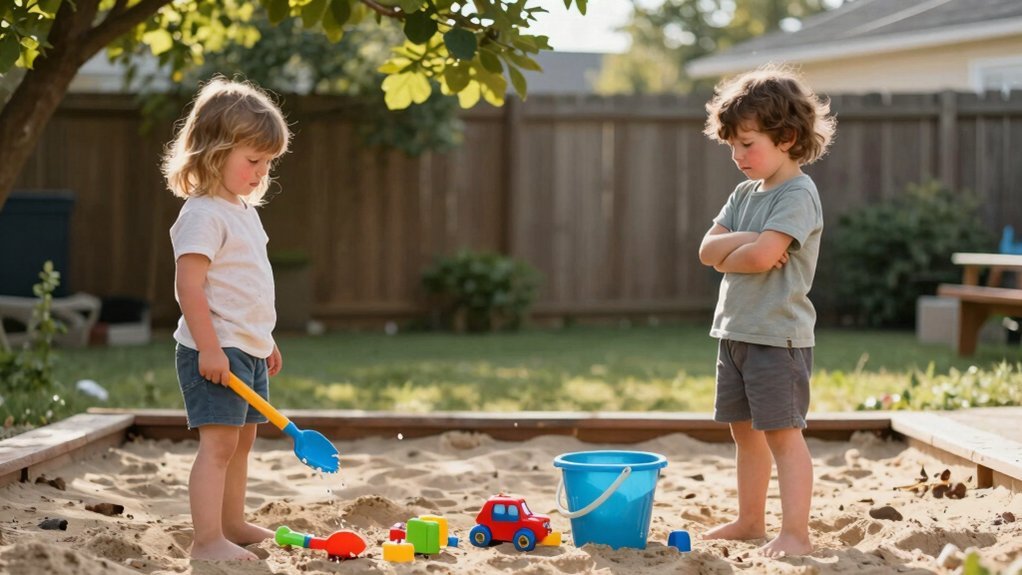
You can turn a sibling clash into a teachable moment by using natural consequences: when a child grabs a toy out of turn, calmly remove the toy for a brief, age‑appropriate period and explain that the action caused the loss. Then invite the child to fix the situation—perhaps by sharing or taking turns—while naming emotions and encouraging a do‑over. This approach mirrors Montessori’s focus on responsibility and self‑direction, and if you keep going you’ll discover more practical steps.
Define Natural Consequences for Sibling Conflicts
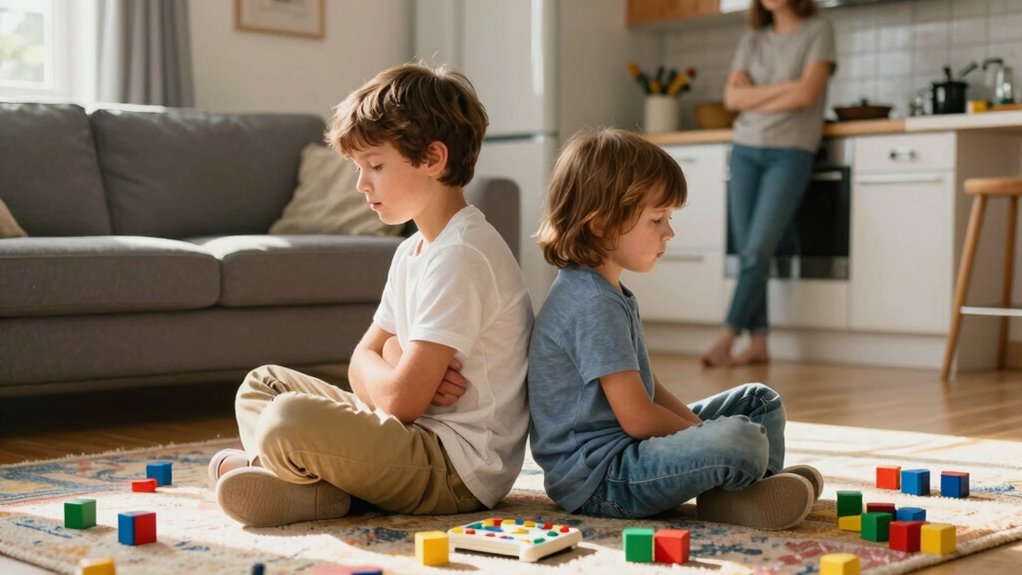
Natural consequences in sibling conflicts are the logical outcomes that follow a child’s actions without adult punishment, shaping behavior through experience.
You define natural consequences as the immediate, predictable effects that arise when a child’s behavior disrupts a shared space or item—like taking a toy out of reach or offering a quiet corner for regrouping.
These outcomes teach responsibility because the child sees the direct link between their actions and the result.
When you pair this with guided problem‑solving, you help them negotiate a redo or a shared repair task, such as baking together for a neighbor.
You also require calm, constructive communication—using “I feel” statements—before reintegration.
Over time, repeated practice and incremental mediation make natural consequences more effective as their maturity grows.
Incorporating tools like practical life button boards can further support children in developing the fine motor skills and patience needed for cooperative problem-solving.
Explain Why Natural Consequences Fit Montessori Principles
Why do you see children thriving when they’re allowed to feel the direct results of their choices? Natural consequences echo Montessori principles because they let kids witness the real outcome of their actions, fostering self‑direction and responsibility. When a toy breaks, it’s simply unavailable until repaired, prompting problem‑solving instead of adult‑imposed punishment. This immediate, observable link between behavior and result cultivates emotional regulation, communication, and cooperation—core Montessori aims. Children learn to reflect on how their choices affect siblings and shared spaces, building independence while adults step back. Montessori environments also emphasize age-appropriate safety standards to support responsible, safe exploration during such learning moments.
| Situation | Natural Consequence | Montessori Benefit |
|---|---|---|
| Misusing a toy | Loss of access | Encourages self‑control |
| Forgetting to clean up | Clutter remains | Teaches responsibility |
| Taking a sibling’s turn | Turn lost for a while | Promotes fairness |
| Breaking a shared item | Item unusable until fixed | Sparks problem‑solving |
| Ignoring a request | No help offered | Builds autonomy |
Identify the Immediate Need Before Acting

What’s the first thing you should do when a sibling clash erupts? Pause, observe, and pinpoint the immediate need driving the fight. You’ll discover whether they crave space, a shared toy, or personal boundaries. Once you know the need, you can craft a non‑punitive response that targets the conflict’s core, preventing escalation and preserving peace.
- Identify each child’s current need: privacy, control, or a quick repair gesture.
- Match the need to a natural consequence: a designated cooling‑off corner, a turn‑taking schedule, or a brief repair activity.
- Record the need and chosen consequence to evaluate effectiveness and adjust future interventions.
- For conflicts involving independence and safety, consider tools like a Montessori step stool that encourage autonomy while maintaining supervision.
Remove the Triggering Object Using Natural Consequences
When a toy sparks a fight, simply taking the item out of reach for a short, age‑appropriate period creates a natural consequence that cuts off the immediate trigger. You’ll notice the kids calm down faster because the source of tension disappears. Choose a removal time that matches their age and the disruption’s severity, reinforcing proportionality. After the pause, return the toy and brief briefly to ensure fair use. Use the moment to name emotions, discuss coping strategies, and remind them that the natural consequences target behavior, not worth. Incorporating play environments with Montessori-inspired features can further promote cooperative and independent play among siblings.
| Age | Removal Time | Follow‑up Action |
|---|---|---|
| 2‑3 | 5 min | Supervise play |
| 4‑5 | 10 min | Prompt sharing |
| 6‑7 | 15 min | Reflect feelings |
| 8‑9 | 20 min | Role‑play solutions |
| 10+ | 25 min | Set up rules |
Set Up an Age‑Specific Space‑Away Time‑Out
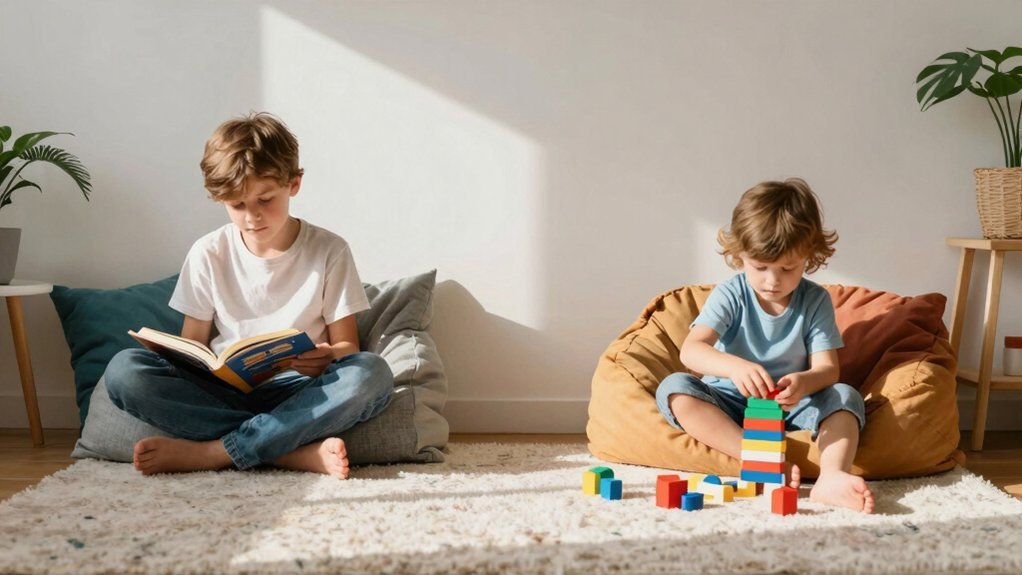
You’ll set a short, age‑appropriate timer so the child knows exactly how long the space‑away lasts. Then you’ll create a clear, physical boundary—like a quiet corner or a closed door—to keep the conflict contained. Finally, you’ll consistently reinforce the rule by checking in, naming feelings, and guiding a calmer re‑entry before the activity resumes. Choosing tools with adjustable height ranges can help tailor accessible spaces that support effective time-outs for children of different ages.
Age-priate Duration
How long should a time‑out last? You match the duration to the child’s age and the “crime” they committed, letting the period shrink as they improve self‑regulation. A three‑year‑old gets one minute per year of age; a ten‑year‑old might stay out for ten minutes, or longer if the conflict was severe. Keep the space consistent—a quiet corner or separate chair—so the child knows it’s a calm zone, not a punishment. Remove the triggering toy or device when you can, then reassess the length each time you use it.
- 2‑year‑old: 2‑minute time‑out, short and simple.
- 5‑year‑old: 5‑minute time‑out, with a brief reminder of rules.
- 8‑year‑old: 8‑minute time‑out, plus a discussion on self‑regulation afterward.
Incorporating tools designed for age range and developmental goals can support children in learning self-regulation during these time-outs.
Clear Physical Boundaries
Matching the time‑out length to a child’s age works best when the space itself supports the calm‑down. You set up a private, low‑stimulus corner—maybe a small chair, a mat, or a tiny room—where each sibling can retreat.
Mark clear physical boundaries by giving each child a personal shelf or mat, so they can’t instantly grab shared toys during a flare‑up.
When a conflict sparks, remove the triggering item from reach and only return it after the age‑appropriate break, preventing repeat incidents.
After the brief pause, check in, label the emotion, and point out the boundary that was crossed.
This approach lets siblings learn that respectful space and defined boundaries de‑escalate tension and guide them back toward cooperation.
Including age-appropriate tools with grip comfort and control can further support positive and safe interactions during playtime.
Consistent Reinforcement Rules
Why set a clear, age‑specific space‑away rule? You give each child a predictable consequence that matches their developmental level, turning a heated moment into a brief timeout that de‑escalates tension. Consistency teaches that personal spaces and shared belongings must be respected, and it builds shared accountability among siblings.
- Designate a calm corner or bedroom as the space‑away zone, removing the triggering toy or item.
- Scale the timeout: one minute per year of age for younger kids, longer but still brief for older ones.
- Pair the timeout with a quick emotional‑labeling pause, then guide them back to problem‑solving once they’re calm.
Practice 5‑Minute Kindness to Replace Hurtful Words
Ever wondered how a simple timer can turn a heated sibling argument into a burst of genuine praise? You set a timer for 5‑Minutes of Kindness, have the kids sit close, and tell each other something positive. If a hurtful word slips out, the timer restarts, forcing them to pause and reframe. When they simply echo the other’s compliment, the clock keeps ticking, reinforcing authentic praise instead of mimicry. Should the fight flare again, you reset the timer, reminding them that calm, constructive speech is the only way to stay in the activity. This structured pause becomes a powerful tool for conflict resolution, turning negative chatter into empathy and supportive communication.
Guide Children to Write a Hand‑Written Apology Letter
The 5‑Minute Kindness timer gives kids a moment to pause and reflect, and that pause can be turned into a concrete step toward repair: a handwritten apology letter. Invite the child to sit with a prompt that asks what happened, how it hurt the sibling, and how they’ll prevent a repeat. Let them choose a quiet spot, a favorite pen, and enough time to write sincerely. The act of writing reinforces accountability, turning a fleeting regret into a tangible commitment.
- Describe the incident clearly, using “I” statements.
- Explain the sibling’s feelings and the impact.
- Promise a specific change and sign the letter.
You’ll see empathy grow as the apology letter becomes a bridge toward restored trust.
Teach the “When I ___, I Feel ___” Communication Phrase
When conflict erupts, give kids a simple script—“When I ___, I feel ___”—so they can name the action and the emotion without blaming. Teach the exact phrase by filling both blanks yourself first, then ask the other child to repeat it, reinforcing the communication phrase.
Use it right after a disagreement to guide conflict resolution; the speaker identifies the trigger and the feeling, then adds a desired change, such as “When you borrow my toy without asking, I feel hurt, and I want us to ask first.” Model the exchange daily, and after each incident have the kids restate the phrase to confirm clarity.
Consistent practice translates emotions into constructive action and builds healthier sibling interactions.
Offer a Do‑Over for a Better Response
After teaching kids the “When I ___, I feel ___” script, give them a chance to redo a hurtful reaction. Offer a do‑over right after the conflict, reminding them that a second chance isn’t guaranteed for every mistake but can be earned through humility. Explain that a do‑over repairs harm, models accountability, and builds a healthier sibling conflict dynamic.
- Pause, acknowledge the sting, and suggest a calmer phrase.
- Role‑play the revised response together, emphasizing tone and body language.
- Celebrate the successful redo, reinforcing the lesson that graceful fixes strengthen their bond.
Design a Joint Service Project to Build Cooperation
If you give siblings a concrete, shared goal—like baking cookies for a neighbor or doing yard work for a grandparent—they’ll naturally learn to cooperate, plan together, and split duties fairly. Choose a simple service task, assign clear roles (logistics vs. preparation), and set a deadline. Use Positive Discipline to praise effort, not just outcome, reinforcing cooperation each they negotiate who does what. After the project, sit down for a brief reflection: What worked? What could improve? How did each child contribute? This debrief cements accountability, improves communication, and builds empathy for others’ needs.
Gradually increase complexity—adding more steps or larger beneficiaries—to deepen trust, shared ownership, and a measurable sense of achievement.
Add a Short Prayer or Verse Reading Together
You can bring prayerful unity to the moment by pausing for a brief, shared scripture reading that mirrors the conflict’s theme. Choose a short, age‑appropriate verse—like Proverbs 12:18—to remind everyone that wise speech heals. This simple ritual reinforces humility, accountability, and the commitment to kinder actions.
Prayerful Unity
How can a simple prayer or verse transform a heated argument into a moment of shared calm? When you invite your siblings to pause, breathe, and speak a short prayer together, you create prayerful unity that softens tension and opens space for conflict resolution. The ritual signals humility, invites forgiveness, and reminds everyone that you’re on the same team. By aligning hearts with a common spiritual rhythm, you turn a clash into a collaborative pause.
- You each say a line asking for wisdom and patience.
- You repeat a verse that affirms love over rivalry.
- You finish by expressing gratitude for the chance to reconcile.
This brief practice normalizes apologizing, builds trust, and reinforces that peace is a shared responsibility.
Shared Scripture Reading
Ever wonder how a single verse can shift a quarrel into a quiet moment of unity? You gather your siblings, open a favorite passage—perhaps Proverbs 12:18—and read it aloud together. The words remind you that gentle speech heals, while rash words wound, steering sibling relationships toward empathy. After the verse, you each offer a short prayer, asking for patience, kindness, and self‑control. This ritual turns abstract faith into concrete conflict resolution: you agree to use “I feel” statements and maybe share a restorative gesture. By taking turns reading, every sibling feels heard and accountable. The shared scripture becomes a living guide, shaping daily interactions and turning disputes into opportunities for reconciliation.
Establish a Firm Sharing Policy and Centralized Play Areas
Why not turn the whole house into a shared playground? You can set a firm sharing policy that tells siblings every item belongs to the household, not to one child. By centralizing toys and play zones, you make it easy to monitor usage, reshelve items, and enforce boundaries. Special toys stay out of reach unless you give clear guidance and supervision, so kids know the rules before they grab them. Older siblings step in as troubleshooters, reinforcing responsibility and teamwork.
Create a shared playground at home: centralize toys, set clear policies, and foster teamwork through guided responsibility.
- A single bookshelf for all board games, labeled for quick access.
- A cushioned corner with bins for blocks, dolls, and art supplies.
- A “checkout” chart where each child signs out a special item under your watchful eye.
This structure reduces ownership disputes and encourages collaborative play.
Track Progress and Adjust Strategies for Ongoing Success
Now that the play zones and sharing rules are in place, you need to measure how well they’re working. Begin conflict resolution by noting the time it takes to settle each dispute; aim for shorter resolution times each week. Keep a simple log of incident frequency, solution type, and whether the next clash mirrors the previous pattern. Watch for older siblings stepping in more often—signs of shared responsibility. When progress stalls, tweak your approach: increase parent mediation, shift from removing toys to guided problem‑solving, or adjust the calm. Document each outcome, labeling it “solved with shared space and calm discussion” or “requiring mediation.” This data fuels progress tracking, letting you refine strategies for lasting peace.
Frequently Asked Questions
How to Deal With Siblings Constantly Fighting?
You intervene by calmly separating them, naming their feelings, then guiding each to share perspectives, brainstorm compromises, and write solutions. This teaches empathy, problem‑solving, and self‑resolution without harsh punishments.
What Is a Good Consequence for Siblings Fighting?
You should give them a brief time‑out and remove the disputed toy, then require a joint apology or a cooperative task before returning the item, teaching responsibility and repair.
How to Deal With Sibling Resentment in Adulthood?
You should confront the resentment directly, using honest “I” statements, actively listen to their feelings, and collaboratively create shared goals or rituals that rebuild trust and reinforce mutual respect.
What Causes Sibling Rivalry in Adulthood?
You feel rivalry because unresolved childhood competition, unclear boundaries, and lingering authority struggles surface when resources, roles, or social circles overlap, especially if parental mediation was inconsistent or punitive.




Leave a Reply