
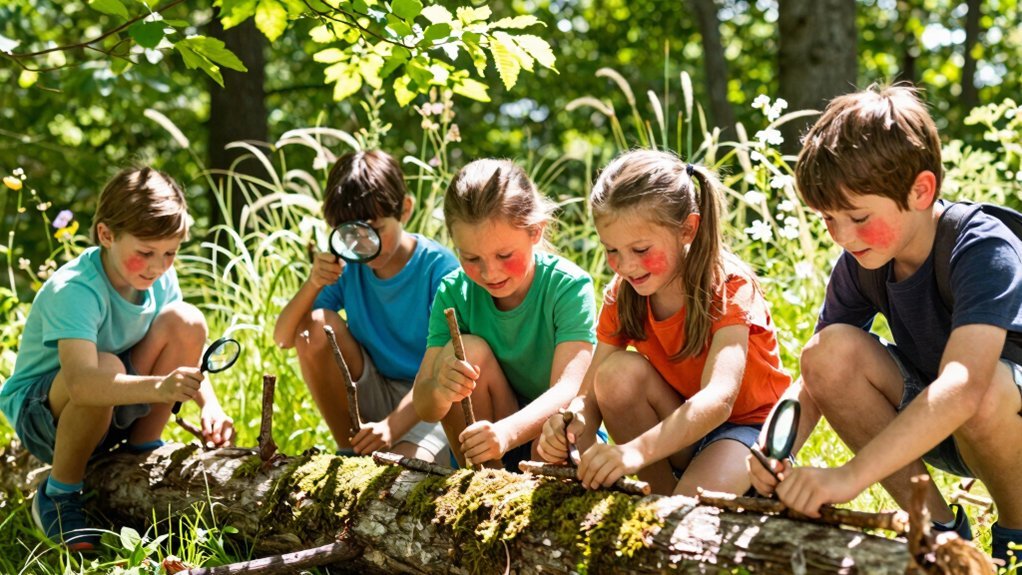
You’ll find that moving outdoors turns every step, climb, and discovery into a hands‑on lesson that sharpens language, math, and motor skills while boosting confidence and social‑emotional growth. Real‑world materials let kids count leaves, measure distances, and label textures, weaving literacy and numeracy into play. Gross‑motor challenges like obstacle courses build strength and independence, and the fresh air regulates sleep and attention. Keep exploring, and you’ll uncover even more ways to integrate Montessori principles into your backyard.
Why Outdoor Movement Matters for Montessori Learning

When children move freely outdoors, they instantly tap into Montessori’s core principle of self‑directed discovery, turning the environment into a living classroom. You’ll see outdoor movement become a natural extension of Montessori learning, where kids choose tasks, negotiate space, and engage with real‑world materials.
Their gross motor skills sharpen as they climb, run, and carry garden tools, building coordination and strength that support practical‑life activities. At the same time, the rich sensory input boosts executive function, helping them sustain attention, plan steps, and regulate impulses during focused work.
Incorporating hands-on learning for foundational math concepts through movement further deepens children’s sensory engagement and cognitive development.
How Outdoor Movement Enhances Language and Literacy
Ever wonder how a simple stroll through the garden can turn into a language laboratory? When you guide kids through outdoor movement, you spark language development through hands‑on labeling of leaves, rocks, and clouds. They name colors, shapes, and textures while walking, turning each step into a vocabulary lesson. Storytelling erupts as they describe a bird’s flight path or the sequence of building a fort, linking movement to emergent literacy.
Counting petals, measuring soil, and narrating watering steps blend math and language, reinforcing descriptive talk. Collaborative tasks like leaf rubbings or patterning with sticks encourage interactive reading and early writing, making every outdoor adventure a rich, hands‑on learning experience. Engaging children in activities that develop fine motor skills through tactile and sensory exploration further enhances their cognitive and language growth.
Building Math Concepts Through Real‑World Physical Activities

You can turn a simple walk into a math adventure by counting each step you take and noticing patterns in the trees and rocks you pass. When you measure the length of a leaf or the distance between two stones, you’re practicing estimation and spatial reasoning without even realizing it. These playful activities let you explore geometry, symmetry, and sequencing while staying active outdoors. Incorporating tactile tools like the Montessori Stamp Game can reinforce these early math concepts through hands-on, visual learning experiences.
Counting Steps Outdoors
| Terrain | Steps per Segment | Observation |
|---|---|---|
| Grass | 12 | Soft, even |
| Gravel | 15 | Crunchy, uneven |
| Trail | 20 | Incline, longer |
| Sand | 8 | Slow, sinking |
Using a sturdy and well-designed Montessori-friendly step stool can encourage children to explore outdoor environments independently and safely.
Measuring Nature’s Patterns
A sunny meadow becomes a living math lab when you count petals, compare leaf sizes, and track the rhythm of rain drops. You turn outdoor measurement into a game, using sticks to gauge trunk circumference or rocks to mark intervals along a stream. By noting patterns in leaf veins, bark textures, or cloud formations, you sharpen nature literacy and translate visual cues into numbers.
Hands‑on math emerges as you sort leaves by shape, group stones by weight, and record daily temperature changes in a notebook. Each activity links concrete observation with abstract concepts, reinforcing classroom lessons and building algebraic intuition.
The movement‑rich environment lets you feel the math, making learning vivid, memorable, and deeply rooted in the natural world. Using tools like movable clock hands in wooden puzzles enhances fine motor skills and reinforces numerical understanding through interactive play.
Estimating Distances Playfully
Ever wondered how a simple stride can turn a playground into a living ruler? You can turn outdoor movement into a math lab by letting kids estimate distances with their bodies. Ask them to stretch toward a target, walk a set number of strides between benches, or compare a path to the height of a tree. Each step, arm span, or pace becomes a data point, linking words like “short” and “farther” to concrete action. Using Montessori materials like plant growth cycle cards can help children connect physical measurement skills with natural science concepts.
Strengthening Fine and Gross Motor Skills for Early Independence

You’ll notice that picking up pinecones or threading beads hones fine motor mastery while climbing rocks or navigating a trail builds gross motor confidence.
These outdoor challenges let you practice precise hand‑eye coordination and powerful whole‑body movements in real time.
As you succeed, you gain the independence to tackle more complex tasks both inside and outside the classroom.
Integrating comfortable and versatile floor cushions in learning spaces can further support children’s physical well-being during indoor activities.
Fine Motor Mastery
Often, children discover fine‑motor mastery while they’re already busy strengthening gross skills—grasping a pinecone, threading beads onto a string, or digging a seedbed with a small trowel. You’ll notice that each tiny grip, pinch, and twist builds fine motor skills that complement outdoor play and spark hands‑on discovery. The natural setting turns simple tasks into powerful exercises for motor development, reinforcing coordination and confidence.
- Pick up pebbles – strengthens pincer grasp and finger strength.
- Tie shoe laces – refines sequencing and bilateral coordination.
- Squeeze a water‑filled balloon – boosts hand endurance and control.
- Stack twigs into a tower – hones precision and spatial awareness.
These activities weave fine‑motor practice into the larger tapestry of movement, encouraging early independence.
Gross Motor Confidence
Leaping across a backyard obstacle course instantly builds the confidence that comes from mastering balance, coordination, and strength. When you watch your child sprint, climb, and jump, you see gross motor abilities sharpening while self‑regulation improves. Each burst of physical activity forces the brain to plan, execute, and adjust movements, reinforcing coordination and persistence. Structured games like tag or unstructured play on a hill both challenge muscles and teach children how to control their bodies in real‑world settings. Regular outdoor movement also supports bone health and reduces obesity risk, which in turn fuels more energetic exploration. As confidence grows, children approach new tasks with less hesitation, laying a foundation for early independence and a readiness to learn across subjects.
How Outdoor Play Builds Social‑Emotional Skills
Why does a simple game of tag feel like a masterclass in empathy? When you watch kids dart across a lawn, you see outdoor play turning into a training ground for social‑emotional skills. They negotiate rules, share victories, and console each other, all while learning collaboration and empathy in real time.
A game of tag becomes a live lesson in empathy, collaboration, and emotional growth.
- Turn‑taking – Kids pause, let a peer run, then resume, reinforcing patience.
- Conflict resolution – A disagreement over a ball becomes a quick, cooperative fix, sharpening perspective‑taking.
- Shared exploration – Mixed‑age groups hunt for hidden treasures, building communication and friendship.
- Risk‑aware play – Safe challenges teach comfort‑giving and encouragement, deepening emotional understanding.
These moments boost mood, attention, and sleep, which in turn strengthen social confidence and lasting relationships.
Connecting Outdoor Play to Scientific Inquiry
You’ll notice that a simple walk among leaves sparks curiosity‑driven observation, turning a child’s “why?” into a real‑world question.
By gathering seeds, rocks, or bugs, you give them hands‑on experimentation tools that reveal patterns and cause‑effect relationships.
This natural cycle of wonder and testing builds a solid foundation for scientific inquiry.
Curiosity‑Driven Observation
Ever wonder how a simple walk among trees can turn a child’s idle curiosity into a full‑blown science investigation? You’ll see that outdoor observation fuels curiosity, turning a stroll into hands‑on learning and nature exploration. When kids spot a sprouting seed or a busy ant trail, they start asking “why?” and “how?”—the first steps of scientific inquiry.
- Pause to note changes in leaf color, texture, or position.
- Prompt them to compare two plants, noting size, shape, or growth rate.
- Encourage sketching or photographing findings to capture details.
- Guide a brief discussion about possible causes, linking observations to concepts like cause‑and‑effect.
These moments transform movement into a living laboratory, sharpening attention and building a foundation for deeper investigation.
Hands‑On Experimentation
How does a simple garden plot become a laboratory where play and science collide? You plant acorns, peas, beans, and corn, then watch them sprout while you ask, “Which seed grows fastest?” This outdoor experimentation turns a backyard into a data‑rich lab, letting you count petals, measure soil moisture, and label leaves.
Hands‑on learning lets you dig for worms, make leaf rubbings, and track cloud patterns, so every observation fuels inquiry. Nature‑based play blends literacy and math as you record numbers and write hypotheses on a notebook. Guided prompts give structure, but child‑led exploration keeps curiosity alive, sharpening observation skills and cementing scientific concepts in tangible, memorable ways.
How Daily Outdoor Movement Improves Sleep and Attention in Montessori Children
Why does a day spent running, climbing, and exploring outdoors make bedtime smoother and classroom focus sharper for your Montessori child? You’ll see the link when you notice calmer evenings and sharper mornings. Outdoor movement fuels physical tired, daylight exposure, and energy use, which translate into deeper sleep and steadier attention. The rhythm of play also mirrors Montessori plans that value independence and sensory engagement.
Outdoor play fuels natural tiredness, daylight rhythm, and sensory balance, leading to calmer evenings and sharper Montessori focus.
- Physical fatigue – active play drains excess energy, easing the transition to sleep.
- Daylight boost – natural light regulates circadian rhythms, improving nighttime rest.
- Sensory regulation – varied textures and motions balance arousal, sharpening focus.
- Self‑directed confidence – mastering climbs and runs builds persistence, sustaining attention during work periods.
These four effects together create a virtuous cycle of better sleep and heightened attention for your child.
Reducing Screen Time With Outdoor Movement Activities
Can you imagine swapping an hour of screen scrolling for a quick game of tag in the park? When you schedule outdoor movement, you automatically cut down screen time, replacing sedentary scrolling with peer‑rich exploration. Kids gain better sleep, brighter mood, and sharper attention, which translates into classroom readiness and concrete learning benefits. Outdoor time also offers hands‑on problem solving, so children rely less on devices for engagement.
| Activity | Outdoor Movement | Learning Benefits |
|---|---|---|
| Tag game | High‑energy running | Boosts concentration |
| Nature scavenger hunt | Exploratory walking | Enhances curiosity |
| Obstacle course | Coordinated play | Improves spatial reasoning |
Setting up Outdoor Movement Stations With Montessori Materials
Swapping screen time for a game of tag naturally leads to the next step: turning the park into a series of Montessori‑inspired movement stations. You’ll see kids thrive when you blend outdoor movement stations with Montessori materials that spark independent exploration and boost gross motor development.
Swapping screen time for tag transforms parks into vibrant Montessori‑inspired movement stations.
- Practical‑life corner – place watering cans, tweezers, and scoops near a garden bed; children pour, pinch, and transfer, sharpening fine and gross motor skills.
- Obstacle path – line low logs, stepping stones, and a short climb; kids negotiate balance and coordination while planning each move.
- Sensory sand zone – provide scoops, rakes, and measuring cups; tactile play links math concepts to natural textures.
- Nature‑counting station – scatter pine cones and leaves; children sort, count, and compare, reinforcing language and math through purposeful activity.
These setups keep attention high, nurture self‑regulation, and turn play into meaningful learning.
Safe, Risk‑Balanced Outdoor Challenges for Confident Learners
Ever wonder how a well‑designed outdoor challenge can turn hesitation into confidence? You’ll see that outdoor movement, when paired with safe risk‑taking, creates a playground for confidence‑building.
Set up obstacle courses or low‑height climbing stations with clear rules; children test limits, solve problems, and bounce back from minor setbacks.
Supervision ensures that each outdoor challenge stays within a balanced risk zone, so kids feel secure while stretching their abilities.
As they navigate varied terrain, they sharpen gross motor skills, balance, and spatial awareness, which translates to independence in everyday tasks.
Peer support and adult guidance turn every stumble into a learning moment, reinforcing resilience, planning, and decision‑making—all essential for confident learners.
Seasonal Strategies to Keep Outdoor Learning Fresh Year‑Round
When confidence blossoms through safe, low‑risk challenges, the next step is to let the seasons keep that momentum alive. You can weave outdoor learning into every month by matching activities to weather and daylight, turning each change into a catalyst for child development. Here are four seasonal strategies that keep nature exploration fresh year‑round:
We confidence blossoms through low‑risk challenges, let seasonal outdoor learning sustain momentum year‑round.
- Spring – Plant seeds, track budding buds, and run insect‑spotting scavenger hunts that align with science standards.
- Summer – Use water‑based experiments, create splash‑art, and extend play into longer evenings for sustained engagement.
- Fall – Collect and sort leaves by color or shape, discuss plant cycles, and integrate shade‑friendly investigations.
- Winter – Encourage sensory snow play, track animal tracks, and use rain sounds for indoor‑outdoor transitions.
Blending structured goals with unstructured exploration ensures consistent learning outcomes despite seasonal shifts.
Outdoor Movement at Home: Simple Steps for Parents
How can you turn your backyard or front yard into a daily playground that fuels both movement and curiosity? Start by setting a simple schedule: 30 minutes of outdoor play each day, mixing free running with a quick scavenger hunt. Let your child chase a ball, jump over a low log, or climb a sturdy step—these actions boost physical development and gross‑motor skills while lowering obesity risk.
Sprinkle nature‑based activities like watering a garden, gathering leaves, or building a stick fort; each task ties movement to early learning in science and math.
Keep the space safe and supervised, then gradually introduce age‑appropriate challenges that encourage independence, cooperation, and confidence. Your backyard becomes a living classroom where curiosity and health grow together.
Frequently Asked Questions
How Do Weather Changes Affect Outdoor Lesson Planning?
You’ll adjust activities, layer clothing, and shift timing when temperature, rain, or wind changes; you’ll keep safety in mind, use shelters or indoor backups, and modify equipment to suit the conditions.
What Equipment Is Needed for Safe Outdoor Movement in Small Spaces?
You’ll need non‑slip mats, portable cones, lightweight resistance bands, a small foam balance beam, a soft ball, and easy‑to‑store safety helmets; keep everything compact, sturdy, and quick‑to‑assemble.
Can Outdoor Activities Replace Traditional Classroom Assessments?
You can’t fully replace traditional assessments with outdoor activities, but you can supplement them; use observations, performance tasks, and reflective journals outdoors capture learning, keeping standards while embracing movement‑based experiences.
How to Involve Parents in Outdoor Movement Without Extra Cost?
You invite parents by sharing simple activity ideas via email or group chat, using free community spaces, encouraging them to join school‑run walk‑or‑play days, and asking them to track progress with shared spreadsheets.
What Guidelines Ensure Inclusivity for Children With Mobility Challenges?
You should design ramps, wide pathways, and adjustable equipment; provide seated activity options; ensure clear signage; train staff on adaptive techniques; and regularly consult families to tailor accommodations for each child’s mobility needs.