You can turn invisible speech into concrete, manipulable units with sound (Elkonin) boxes, letting kids hear, segment, and count each phoneme. As you place a marker in each square while saying the word slowly, they build auditory discrimination and phonemic awareness, key for early literacy. The tactile and visual cues reinforce one‑to‑one sound‑to‑letter mapping, and the activity works for diverse learners, including English‑learners and hearing‑impaired children. Keep exploring to discover how to adapt these tools for math, music, and spelling.
What Are Sound Boxes and Elkonin Boxes?

Sound boxes—also called Elkonin boxes—are a set of drawn squares, each representing one phoneme in a target word. You place a marker in each box as you say the word slowly, letting the child repeat and then slide the marker to match each sound. This visual‑auditory pairing sharpens phonological awareness by making the invisible phonemes visible. Because the focus stays on sounds, not letters, children learn the exact number of phonemes, which supports phoneme‑grapheme mapping and the alphabetic principle. In practice, an adult pronounces the word, the child echoes it, and then the child fills the boxes, reinforcing segmentation skills. Elkonin boxes thus turn abstract speech into concrete, manipulable units. Using Montessori-inspired musical instruments alongside this method can enhance auditory discrimination and rhythm recognition in early development.
Why Sound Boxes Are Essential for Early Auditory Development?
You’ll notice that handling the boxes sharpens your child’s ability to segment sounds, a core skill for phonemic awareness. The distinct tones they hear and match boost auditory discrimination, making it easier to tell similar sounds apart.
As a result, these early listening experiences lay a solid foundation for later literacy and reading success. Incorporating tools with color-coded segments can enhance cognitive associations between auditory and visual learning.
Phon Segmentation Foundations
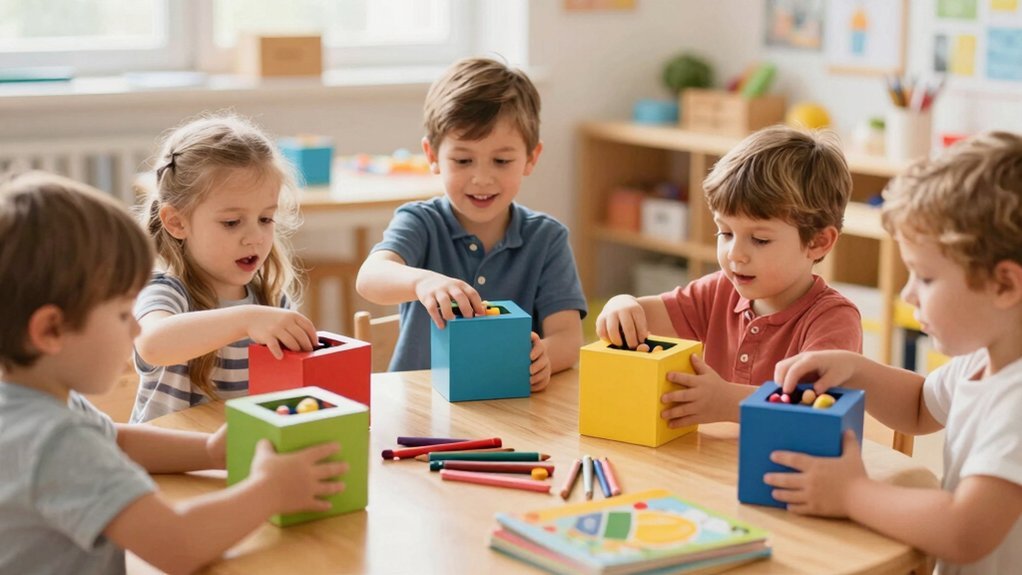
Why does early auditory discrimination matter? You’ll notice that when you give kids Sound Boxes, they practice matching identical tones, sharpening auditory discrimination. That skill feeds directly into phonemic awareness, the ability to hear and manipulate individual sounds in words. By pairing the red and blue cylinders, you create a hands‑on version of Elkonin boxes, where each sound segment lives in a separate slot. As children sort and compare tones, they begin to isolate phonemes, a prerequisite for reading and spelling. The tactile cue of shaking a cylinder while listening reinforces the mental link between sound and symbol. This multisensory routine builds the neural pathways that later support phoneme segmentation, laying a solid foundation for literacy. Using tools designed with Montessori-inspired design principles can further enhance this developmental process by encouraging hands-on learning and independence.
Auditory Discrimination Enhancement
Ever wonder how a simple shake can sharpen a child’s ear? When you hand a child a pair of Montessori Sound Boxes, the distinct sound each cylinder makes invites immediate comparison. You’ll notice the child listening for pitch, timbre, and volume, then matching the red and blue cylinders.
This hands‑on routine hones auditory discrimination by forcing the brain to separate subtle sound variations. The tactile vibration and visual cue reinforce the auditory signal, so even hearing‑impaired kids can grasp the concept. Repeated sorting builds concentration and strengthens neural pathways for language processing. By integrating this activity daily, you create a fun, focused environment where sound becomes a concrete, measurable skill rather than an abstract notion. Using tools designed for developmental suitability ensures children engage effectively with sensory activities tailored to their learning stage.
Early Literacy Skill Integration
Auditory discrimination fuels phonemic awareness, and sound boxes turn that abstract skill into a concrete, hands‑on experience. When you let children match Elkonin sounds in the cylinders, they hear subtle differences, label them, and begin to link each auditory pattern to a letter name. This tactile‑visual‑auditory loop builds phonemic awareness faster than rote drills, laying a solid early literacy foundation. The vibration and visual cues keep focus sharp, even for learners with hearing challenges, while the sorting game reinforces concentration and memory.
In both Montessori and traditional classrooms, you can weave these activities into literacy circles, turning every shake into a step toward decoding and spelling. The result is a versatile, research‑backed tool that accelerates early literacy skill integration. Many educational toys, such as the Montessori Educational Toy for Baby, further strengthen fine motor skills alongside auditory development.
Step‑by‑Step Guide to Using Sound Boxes at Home or School
Pick sturdy, child‑safe cylinders and place them on a low tray so they’re easy to reach. Then, invite the child to shake one box, listen closely, and match it with the identical‑sounding partner, repeating the pattern to build segmentation skills. As they improve, you can add a simple label or picture to connect the sound with a letter or word. For organized play and easy access, consider using storage solutions like the ECR4Kids Dress-Up Center with its kid-sized closet design to keep sound boxes and related materials neatly arranged.
Choose Appropriate Materials
- Verify each box’s sound is clear and consistent.
- Provide enough counters to match the number of boxes.
- Adjust the quantity of boxes for varied listening paces.
- Ensure the area is tidy, visually simple, and tactilely inviting.
These steps let you create an engaging, inclusive auditory experience that supports discrimination and matching skills.
To maximize learning, consider the material quality standards when selecting sound boxes to ensure durability and effective sound projection.
Guide Segmentation Practice
Where do you start with sound‑box segmentation? Begin by choosing a simple word and saying it slowly, emphasizing each sound. Draw one Elkonin box for every phoneme, not every letter, and place a counter at the leftmost box. As you repeat the word, slide the counter into the next box, saying the sound aloud. This left‑to‑right movement builds phonemic awareness and reinforces segmentation practice.
After the oral pass, ask the learner to write the corresponding grapheme in each box, noting that some sounds need multiple letters or silent letters. Keep sessions brief, repeat daily, and gradually increase word length. The tactile, visual, and auditory cues together solidify early reading and spelling skills.
Adapting Sound Box Activities for English‑Learners and Hearing‑Impaired Children

How can you make sound‑box activities work for English‑learners and hearing‑impaired children? You can turn Elkonin boxes into a multimodal hub that boosts phonemic awareness while modeling inclusive education.
- Attach high‑contrast labels and pictures to each cylinder so learners see the symbol, hear the sound, and feel the shape.
- Use a vibrating pad or tap the box when a sound is played, giving tactile feedback that compensates for limited hearing.
- Slow the pace, model each phoneme twice, and encourage partners to watch mouth movements and gestures.
- Pair learners for collaborative sorting, letting them discuss and verify matches aloud or through sign.
These tweaks keep the activity engaging, accessible, and effective for diverse language and hearing needs.
Play‑Based Activities That Reinforce Sound Box Skills With Math and Music Connections
When you blend sound‑box work with math and music, you turn a simple phonemic drill into a lively, multisensory game. You hand each child a set of counters, a bell, and a small drum. First, you ask them to clap a rhythm that matches the syllable pattern of a target word, then they place one counter for each phoneme, counting aloud. Next, they add or subtract counters to model “add a sound” or “remove a sound,” reinforcing one‑to‑one correspondence while building phonemic awareness. Group play encourages turn‑taking and listening, and the beat‑based chant links language to tempo, cementing cross‑curricular connections between literacy, math, and music.
| Activity | Math Link | Music Link |
|---|---|---|
| Counter placement | Count & compare counters | Clap rhythm for each phoneme |
| Add/subtract sounds | Simple addition/subtraction | Drum beat for added phoneme |
| Group blend | Compare totals across peers | Call‑and‑response chant |
Connecting Sound Boxes to Letter Recognition and Early Spelling

After the rhythm‑based math games, you can shift the focus to letters by having kids place a letter tile in each sound box as they say the corresponding phoneme. This step builds phonemic awareness and reinforces the Elkonin‑style sound‑letter mapping that underlies early spelling. You model segmentation, then let children write the grapheme in the matching box, turning auditory discrimination into a concrete visual‑tactile cue.
- Present a word, segment it with sound boxes, and ask the child to name each phoneme.
- Hand a corresponding letter tile and have the child place it in the appropriate box.
- Prompt the child to write the letter on a worksheet, linking sound to symbol.
- Review the sequence, encouraging the child to read the newly formed pseudo‑word aloud.
These actions cement sound‑letter mapping and set the stage for confident decoding and encoding.
What Research Shows and Real‑World Success Stories From Montessori Programs
Ever wondered why Montessori classrooms see such rapid gains in early literacy? You’ll find that research consistently links sound boxes to stronger auditory discrimination, a cornerstone of phonemic awareness. Studies show children who handle these tactile devices sharpen their ability to match sounds to symbols and stay focused during deliberate listening tasks. Real‑world Montessori programs report measurable boosts in early literacy readiness when sound boxes become a daily routine. The vibrotactile feedback supports inclusive learning, helping kids with sensory differences or hearing impairments engage fully. By weaving sound boxes into the broader sensorial curriculum, Montessori programs foster concentration, purposeful exploration, and cross‑disciplinary connections that translate into higher reading confidence and proficiency.
Printable Templates and DIY Materials for Quick Implementation
Looking to get sound boxes into your classroom today? You can download printable templates for Elkonin boxes, each two‑page worksheet covering two‑to‑five‑sound words and aligning with RF.K.2 and RF.1.2 standards. Pair them with DIY materials—simple counters or small objects—to let each student move one item into a box per phoneme, reinforcing left‑to‑right blending. Add printable letter tiles or sound lists for English language learners, ensuring phoneme‑grapheme mapping.
- Print the PDF and laminate for durability.
- Cut counters from pom‑poms, beans, or coins.
- Distribute one set per student or small group.
- Follow the step‑by‑step directions on the template for quick implementation.
These resources let you launch effective auditory practice in minutes.
Frequently Asked Questions
How Many Sound Boxes Are Needed for a Typical Classroom?
You’ll need about six to eight sound boxes for a typical classroom, spacing them evenly so each student can hear clearly, and rotating groups to keep engagement high without overwhelming the space.
Can Sound Boxes Be Used for Bilingual Phonics Instruction?
Yes, you can use sound boxes for bilingual phonics instruction; they let kids match phonemes across languages, reinforce auditory discrimination, and practice rhythm and intonation, making dual‑language learning engaging and effective.
What Age Range Benefits Most From Sound Box Activities?
You’ll see the biggest gains in kids aged three to seven, especially when you blend rhythmic tapping with simple phoneme matching, because their auditory discrimination and fine‑motor coordination are rapidly developing during that window.
Do Sound Boxes Align With Common Core State Standards?
Yes, you’ll find sound‑box activities map onto Common Core standards for kindergarten‑first‑grade listening, speaking, and language arts, supporting standards like CCSS.ELA‑LITERACY.RI.1.1 and SL.1.1.3.Yes, you’ll find sound‑box activities map onto Common Core standards for kindergarten‑first‑grade listening, speaking, and language arts, supporting standards like CCSS.ELA‑LITERACY.RI.1.1 and SL.1.1.3.
How Often Should Sound Box Practice Be Scheduled Weekly?
You should schedule sound‑box practice three to four times a week, keeping each session short—about ten to fifteen minutes—so kids stay engaged, reinforce skills, and avoid fatigue.