
Watch what truly captures your child’s attention—puzzles, stories, block‑building, or a nurse’s role‑play—and then give them tools, media, and open‑ended play that let that interest expand. Offer simple props, books, and short videos that reflect the activity, and label the skills they show (like “engineer” when they stack towers). Keep the environment pressure‑free, rotate materials, and note patterns over time. Continue to explore these steps and discover deeper strategies.
Preschool Career Exploration: Who Children Observe

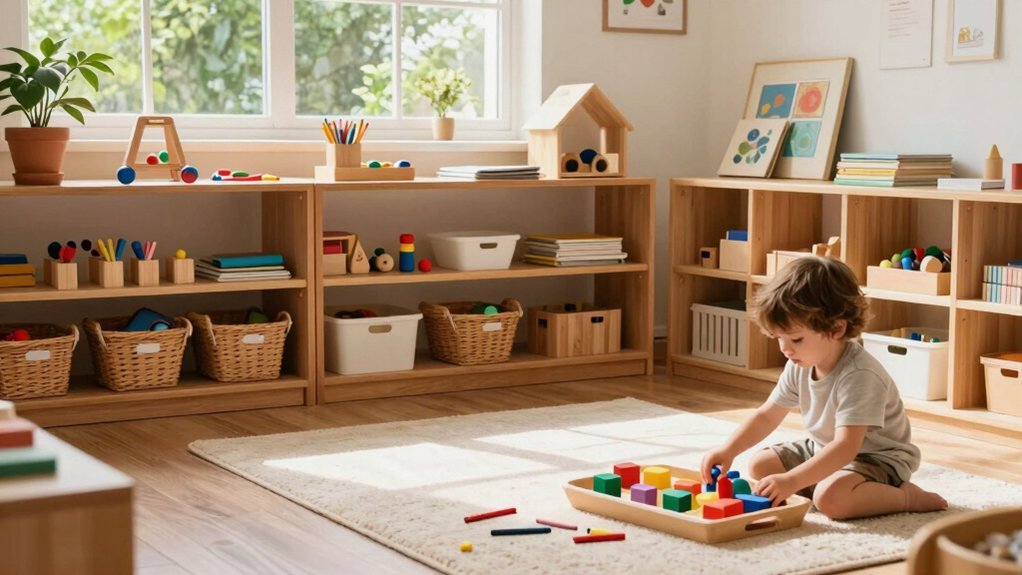
Ever wonder who your preschooler actually watches when they’re curious about the world? You’ll notice they gravitate toward the people they see daily—pediatric nurses, mail carriers, or the librarian at the corner shop. Point out that each field holds many specialties: a podiatrist treats feet, a pediatric cardiologist fixes hearts, a school counselor guides learning. Use books, kid‑friendly podcasts, and short videos to expand the roster beyond home and classroom. Choose stories that showcase doctors, engineers, and artists of varied races and genders, so your child sees inclusive role models. When you observe which adults your child mentions and what tasks they describe, you can link those observations to their emerging interests and gently steer future exploration. Providing children with organized play and learning spaces, such as a low toy rotation shelving system with multiple tiers and compartments, can further support their evolving interests and curiosity.
Preschool Career Exploration: Mapping Kids’ Skills
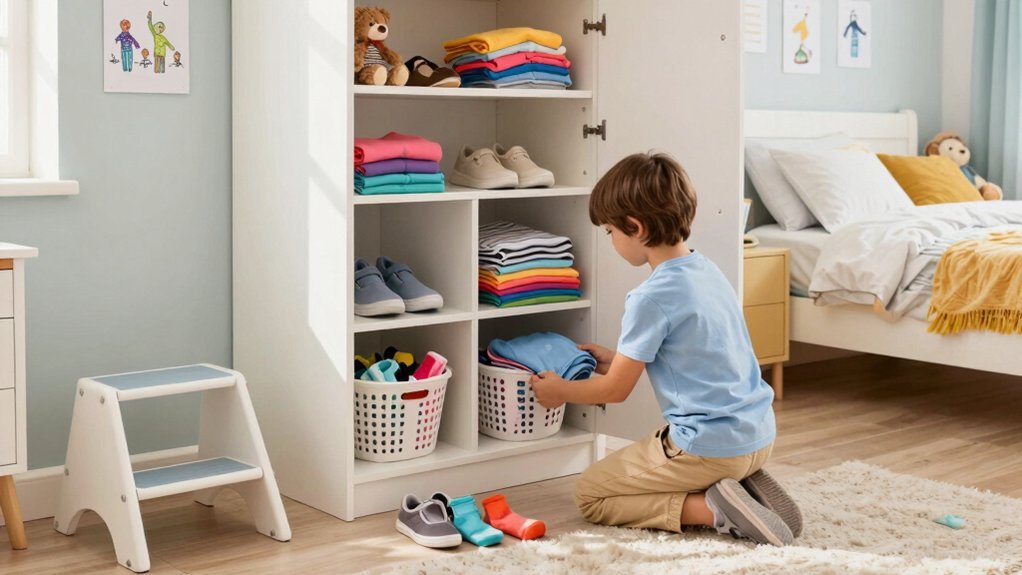
What catches your preschooler’s eye—whether it’s a jigsaw, a pet, or a dance move—reveals the skills they’re already developing. You can map those skills by noting what holds their attention, what they choose first, and what makes them smile without prompting. Track daily patterns and ask caregivers about puzzle‑solving, animal care, or movement‑based play. When interests cluster, offer related tasks—blocks for math concepts, art supplies for creativity, books for language—to encourage open‑ended exploration. This hands‑on approach builds underlying abilities while keeping curiosity front‑and‑center. By emphasizing exploration over fixed outcomes, you help your child see a broad array of possibilities, laying a flexible foundation for future career thinking without pressuring a single path. Providing organized spaces with low step-in toy storage encourages independent cleanup and supports ongoing exploration.
Preschool Career Exploration: Play‑Based Job Simulations

You can spark your child’s curiosity by setting up role‑play scenes with everyday items—goggles for a scientist, a bottle for a baker, dye for a fashion designer. These materials‑rich activities let them experiment with different professions while you watch their natural problem‑solving unfold. Keep the play open‑ended, rotate roles, and note which scenarios they return to most often. Incorporating tools like a Montessori step stool can promote independence and confidence as children explore different roles at counter height.
Based Role Play
When you set out a few everyday objects—like goggles, empty bottles, or a splash of food‑color—preschoolers instantly transform them into tools for a scientist, an entomologist, a paleontologist, or a fashion designer. You can nurture that spark by arranging open‑ended stations: a hand lens by the garden, a tray of colored water for “mixing chemicals,” a box of blocks for “building structures.” Invite children to narrate their tasks, ask “What’s the next step?” and let them solve problems the way adults do—measuring, hypothesizing, iterating. Keep the focus on curiosity, not outcomes; the goal is skill building, not a résumé. By mirroring real‑world processes in playful scenarios, you turn ordinary moments into career‑exploration opportunities. Incorporating open-ended exploration materials like Montessori magnet kits can further foster independent scientific thinking and hands-on learning.
Materials‑Rich Exploration Activities
Ever wondered how a handful of everyday objects can turn your preschooler’s playroom into a mini‑lab, kitchen, or construction site? You can spark exploration by gathering simple tools—goggles, bottles, dye, hand lenses, and cardboard. Let your child mix colored water in a bottle, pretend to examine a rock with a lens, or build a “kitchen” from boxes. Keep instructions light; watch them lead, then reflect on the roles they gravitate toward. The goal isn’t a finished product but a tactile investigation that hints at future interests.
- Scientist station: goggles, magnifying glass, colored liquids.
- Designer corner: cardboard, markers, tape.
- Builder zone: blocks, recycled containers, pretend tools.
Preschool Career Exploration: Spotting Emerging Interests
How can you tell which sparks truly capture a preschooler’s imagination? You watch what holds their attention with minimal prompting—puzzles they solve repeatedly, animals they name, or drawings they return to daily. Notice the topics they talk about most, the activities they choose first, and the moments that demand patience, problem‑solving, or creativity. Daycare reports often echo these patterns, highlighting emerging strengths. For instance, a child who loves memory games may be gravitating toward logic, while another who cares for pets might be exploring biology.
Offer open‑ended opportunities: building blocks that embed math concepts, art supplies for experimentation, or safe climbing structures for movement. By integrating related skills, you nurture those interests and guide natural career curiosity. Practical life activities like buttoning frames and dressing boards can also support fine motor skill development alongside these interests.
Preschool Career Exploration: Setting Age‑Appropriate Goals

You can start by talking about jobs in simple, relatable terms that match your child’s everyday experiences. Use play—like building a “clinic” with blocks or pretending to be a scientist with kitchen experiments—to let them explore interests without pressure. Keep the goals focused on noticing what excites them and what skills they’re using, not on creating a formal plan. Providing age-appropriate tools such as child-size oven mitts can also encourage safe hands-on learning during activities like cooking.
Age‑Appropriate Career Talk
What captures a preschooler’s imagination—whether it’s a stethoscope, a paintbrush, or a building block—offers a natural entry point for age‑appropriate career talk. You watch the toys they gravitate toward, listen to the stories they tell, and notice the skills they display—problem‑solving, collaboration, creativity. Frame each observation as a glimpse of a possible role, not a commitment. Keep the dialogue open‑ended, invite questions, and reassure them that interests can shift as they grow.
- Doctor‑like play – point out how caring for dolls mirrors a physician’s empathy.
- Artist‑style creations – link paint‑splatter adventures to a designer’s imagination.
- Builder‑type blocks – connect stacking to an engineer’s problem‑solving mindset.
Providing children with age-appropriate tools that encourage sensory exploration and fine motor skills can deepen their engagement and learning through play.
Exploring Interests Through Play
Watching a child gravitate toward a stethoscope, a paintbrush, or a set of blocks already hints at the roles they might love, so the next step is turning that curiosity into play that mirrors real‑world jobs. You can spark imaginative play with everyday items—goggles, bottles, dye—so they act like a scientist or entomologist, learning through hands‑on exploration instead of formal instruction.
Offer simple tools such as hand lenses or park‑based activities that simulate professions, letting preschoolers experiment with paleontology, fashion design, or engineering. Keep the pretend scenarios open‑ended; no specialized kits are needed. Emphasize that this play builds problem‑solving, pattern recognition, and movement skills, exposing possibilities and nurturing emerging interests without pressuring a career decision.
Preschool Career Exploration: Media to Inspire Kids
Ever wondered how a simple cartoon can spark a preschooler’s curiosity about real‑world jobs? You can turn screen time into a launchpad for education by choosing shows that spotlight everyday heroes—pediatric nurses, podiatrists, and scientists. Pair each episode with a hands‑on activity, like using a hand lens to examine leaves after a “bug‑finder” segment. Notice which characters make your child light up, then supply related books, toys, or mini‑experiments. Consistent exposure builds confidence and shows how interests translate into skills.
- PBS KIDS – “What Will You Become?” – short clips of diverse professions.
- Interactive storybooks – feature a nurse or a marine biologist.
- Kid‑friendly podcasts – interview professionals in simple language.
Preschool Career Exploration: How to Encourage Curiosity
How can you turn everyday moments into mini‑career adventures for your preschooler? Spot a parent washing dishes and ask, “What’s happening here?” Then label the role—chef, caretaker, or cleaner—and let your child imitate the steps with a toy pot.
Spot everyday tasks, name the role, and let preschoolers reenact with toys for mini‑career adventures.
Use books and short videos to give exposure to a wide range of jobs, from pediatric nurse to engineer, and pause to connect the story to your child’s current strengths.
Offer open‑ended play with ordinary items: a cardboard box becomes a lab, a blanket a runway for a designer.
Celebrate questions, model problem‑solving language, and remind yourself that interests shift. Your goal is to broaden possibilities, not lock in a career path.
Preschool Career Exploration: Common Missteps to Avoid
After turning everyday moments into mini‑career adventures, it’s easy to slip into habits that hinder genuine exploration. You might feel pressure to pick a “right” path, but that often narrows curiosity. Instead, focus on letting play guide learning and keep the experience joyful.
- Push a single hobby – insisting on one activity limits the chance to expose your child to a variety of interests and can breed resentment.
- Label quitting as failure – stopping a pursuit isn’t a defeat; it’s a cue to shift toward new, engaging experiences.
- Rely only on structured lessons – over‑scheduling curtails open‑ended play, where real‑world exploration uncovers hidden strengths.
Watch for signs of burnout, and adjust exposure so your child feels supported, not confined. This balance nurtures authentic discovery.
Preschool Career Exploration: Next Steps for Parents
What’s the next move after turning everyday moments into mini‑career adventures? Keep the momentum by weaving intentional “career‑spark” moments into routine play. Choose a theme each week—like health, building, or storytelling—and sprinkle books, podcasts, or short videos that showcase diverse roles such as pediatric nurse or podiatrist. When your child builds a tower, say, “You’re solving a problem like an engineer,” and celebrate the skill. Use simple props—goggles, bottles, crayons—to stage imaginative scenarios without expensive kits. The goal is to broaden possibilities, notice emerging interests, and stay pressure‑free.
| Theme | Resource | Prompt |
|---|---|---|
| Health | Picture book about doctors | “What does a nurse do?” |
| Building | DIY block set | “How would an engineer design this?” |
| Storytelling | Audio story podcast | “Who tells the story in this tale?” |
Frequently Asked Questions
What Is the 3-3-3 Rule for Children?
You limit recreational screen time to three hours daily, schedule three separate breaks, and guarantee three hours of non‑screen activities like play, creativity, and social interaction. This balances digital use with real‑world growth.
What Is the 7 7 7 Rule for Parenting?
You follow the 7‑7‑7 rule by ensuring each day you give your child roughly seven hours of sleep, seven hours of active play or activities, and seven hours of screen time, adjusting flexibly for their needs.
What Is the 10-10-10 Rule for Kids?
You evaluate a new interest after ten days, ten weeks, and ten months, checking if attention, consistency, and long‑term joy remain, then decide whether to continue, adjust, or let go.
What Is the 50 30 20 Rule for Kids?
You allocate half of a child’s money to essentials, 30% to fun or non‑essential items, and 20% to savings or long‑term goals, teaching budgeting while allowing flexibility as they grow.


Leave a Reply